AI-Academy
Increase efficiency with the property management ticket system
Discover how the property management ticket system optimises your processes,...
A ticket system for property management is a central, digital inbox that transforms the daily flood of enquiries – whether by email, phone or portal – into clear, trackable tasks ("tickets"). Instead of sinking into the chaos of overloaded inboxes, the system ensures structured workflows, seamless documentation and a significant increase in service quality. It transforms reactive troubleshooting into proactive process management.
What you should consider when switching to a ticket system
Implementing a ticket system is a strategic step towards increasing efficiency. To make the transition as smooth as possible and achieve maximum benefit, you should carefully review the following points. This checklist will help you set the right course:
Clearly define goals: What specifically do you want to achieve? Faster response times, seamless documentation of all processes or a reduction in follow-up queries?
Identify communication channels: Through which channels do you receive the most enquiries? Email, telephone, a customer portal or even social media?
Analyse existing processes: Where are the current bottlenecks? At what points does information get lost or do delays occur?
Involve the team early: Get your employees on board right from the start. Explain the benefits of the system to build acceptance and gather valuable feedback.
Select technology carefully: Check which software really fits your specific needs and your existing IT infrastructure (e.g. ERP system).
Check the functional scope: Do you need a customer portal, a mobile app for on the go or the option to commission service providers directly?
Identify automation potential: Which recurring tasks (e.g. status updates, assignments) can be automated to relieve your team?
This centralisation not only ensures order, but also lays the foundation for proactive action. It noticeably increases service quality and gives your team the freedom to concentrate once again on truly value-adding activities.
Through this structured approach, the transition from an overloaded inbox to a clean, organised process becomes significantly easier. Modern solutions like DoNexus are designed precisely to make this transformation as smooth as possible. They quickly deliver measurable added value by automating routine tasks and bundling all communication in one place.
How to successfully implement a ticket system in 10 steps
Switching to a new system does not have to cause headaches. With a good plan, it succeeds surprisingly smoothly. This practical guide accompanies you step by step through the entire process – from analysing your current workflows to productive use. We structure the implementation into ten manageable steps so that your new ticket system for property management delivers real added value from day one.
The following graphic illustrates the change: away from the unstructured inbox, towards an organised system that finally brings clarity.
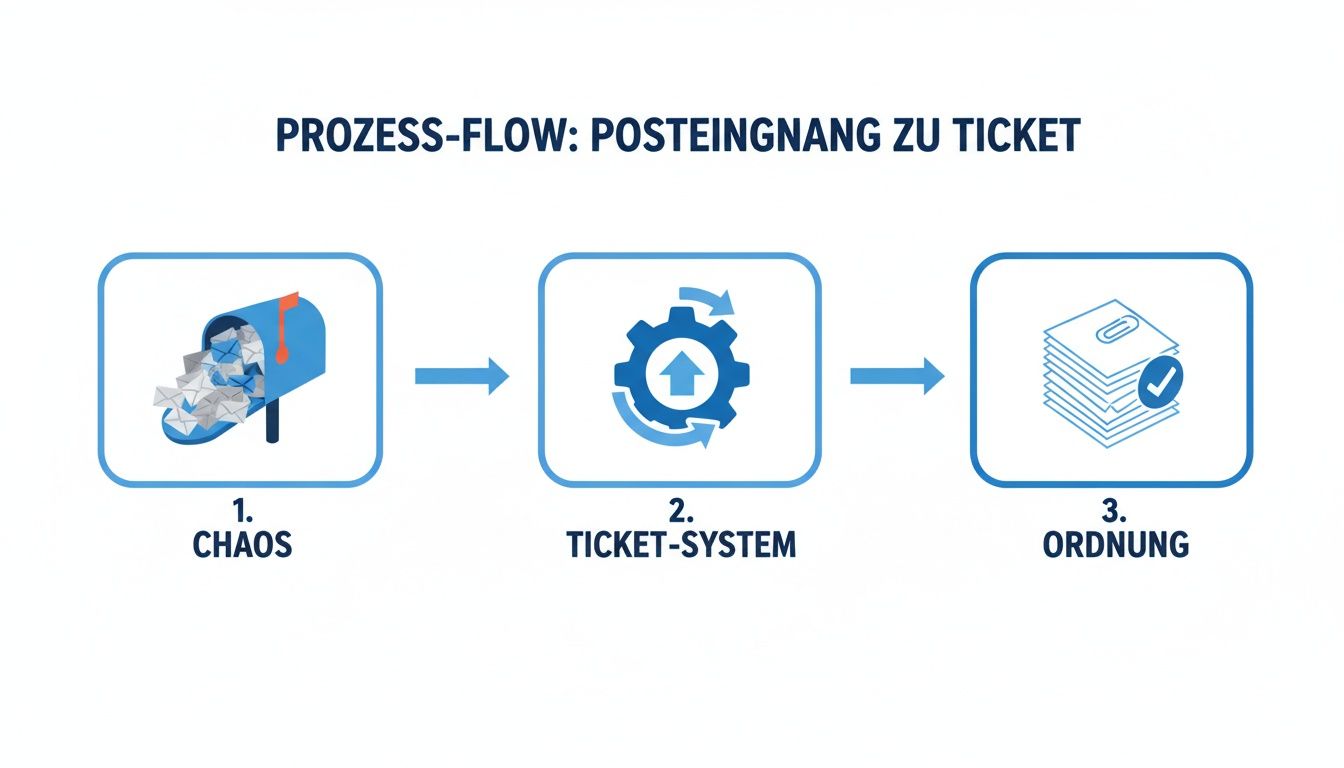
You can see immediately how the ticket system transforms the chaos of an overloaded inbox into organised, trackable tasks. This is the foundation for truly efficient management.
The 10 steps to successful implementation
A structured approach is the key to success. The following ten steps will help you master typical hurdles and bring your project safely to the finish line.
As-is analysis and defining goals: First, take a close look at your current processes. Where does information get lost? What are the most frequent enquiries? Use this to define clear, measurable goals, for example reducing average processing times by 25%.
Involve the team early: Talk about the benefits of the new system from the start. Get feedback from future users. This not only ensures acceptance, but also provides valuable ideas for configuration.
Create a requirements catalogue: List all the functions you actually need. Do you need a mobile app, a customer portal for tenants and owners or a connection to your ERP system?
Evaluate providers: Compare different solutions. Look for scalability, user-friendliness and, above all, industry-specific functions for property management. Request a live demo to see the software in action.
Appoint a project team: Designate a project manager and a small core team. These individuals are the central contacts during the implementation and later the first in-house experts.
Configure the system: Now it gets concrete. Set up the system to match your processes. Define ticket categories (e.g. damage report, billing query), assignment rules and priority levels.
A crucial point here is defining Service Level Agreements (SLAs). Set clear deadlines for the initial response and the final resolution of tickets. This is the only way to guarantee a consistently high quality of service.
Set up automations: Use the power of the system to get rid of recurring tasks. Have emails on specific topics automatically assigned to the correct employee and status updates sent to the reporter.
Plan data migration: Plan the transfer of relevant data such as contacts, property data and open cases. A clean data import is crucial for a smooth start.
Train the team and test: Conduct comprehensive training sessions for your entire team. Run through real-life use cases in a test environment before going live. A clear customer portal is also an important aspect here that should be tested.
Go-live and optimisation: Start with the new system. Actively collect feedback in the first few weeks and adjust configurations and workflows where necessary.
Practical figures support the benefits: In German property management, modern systems save up to 60% of processing time by classifying enquiries and linking workflows with ERP systems. Some providers even enable a reduction in administrative effort of up to 80% through extensive automation.
Careful planning may seem time-consuming at first, but it quickly pays off. By following these steps, you create a solid foundation for greater efficiency and transparency. Providers like DoNexus support you in this with structured onboarding specifically tailored to the needs of property managers, enabling a fast and productive start.
What is a ticket system and how does it work?
Anyone working in property management knows the daily flood of enquiries only too well. Emails, calls, messages – everything ends up in one big pot. A ticket system finally brings structure to this chaos. You can think of it as a digital project manager for every single task, from a dripping tap to complex defect resolution.
Instead of a damage report getting lost in an overloaded inbox, it is automatically converted into a "ticket".
This ticket is like a digital file for the process. It bundles all information, the entire communication and all documents in one central location. Nothing gets lost anymore, and every step remains trackable.
The lifecycle of a ticket: A practical example
Imagine a typical case: A tenant reports a burst pipe by email. Without a system, this often triggers a confusing chain of phone calls, forwards and sticky notes. With a ticket system, the process looks completely different – clear, structured and transparent.
This is how the process works:
Creation of the ticket: The tenant's email arrives. The system intercepts it and immediately creates a new ticket. It automatically detects which property and which flat the report belongs to.
Classification and assignment: Based on keywords like "burst pipe", the system classifies the incident as an urgent emergency. The ticket is automatically assigned to the responsible manager or directly to the emergency team, and the priority is set to "High".
Processing and communication: The responsible employee sees the new ticket in their task list. They can commission a contractor directly from it. All communication – whether with the tenant or the service provider – is seamlessly documented in the ticket history.
Closure and documentation: The contractor reports back that the repair has been successfully completed. The manager closes the ticket, and the tenant automatically receives a notification that their request has been resolved.
Archiving: The completed ticket is archived securely in an audit-compliant manner. All information, from the initial report to the correspondence and the contractor's invoice, is permanently stored and can be retrieved instantly if needed.
The key advantage is transparency. Everyone involved – from the manager to the contractor to the tenant (via a customer portal) – can see the current status at any time. Enquiries like "What is the current status?" become unnecessary.
This structured process makes it clear why a ticket system fundamentally transforms property management. It is far more than just an email inbox. It prevents information from getting lost, noticeably speeds up processing times and ensures professional, traceable service.
Comparison of workflows with and without a ticket system
This table contrasts the inefficient manual processes of traditional management with the optimised, digital workflows of a ticket system.
Process | Traditional processing via email and phone | Optimised processing with a ticket system |
|---|---|---|
Incoming reports | Manual screening of emails; information gets lost in the inbox. | Automatic creation of a ticket from every email or call. |
Assignment | Manual forwarding to the responsible employee; unclear who is responsible. | Automatic assignment to the right person or team based on rules. |
Communication | Confusing email chains and phone notes; no central documentation. | All messages and notes are seamlessly stored in the ticket history. |
Status tracking | Status is unclear; constant enquiries from tenants and owners. | Transparent status visible to all parties involved at any time. |
Documentation | Documents (invoices, photos) are scattered across different folders and emails. | All relevant documents are directly attached to the ticket and archived. |
Closure | Process is marked as "done" verbally or via a short email; no history. | Traceable closure with automatic notification and audit-compliant archive. |
The comparison makes it clear: a ticket system does not just replace manual email sorting, it creates a completely new foundation for efficient and professional work.
Modern platforms like DoNexus go even further. They use AI not just to manage enquiries, but to proactively link them with the correct properties, people and even relevant contract clauses. This significantly accelerates the entire process from the report to the solution.
The core functions for modern property management
A powerful ticket system for property management can do far more than just collect and sort enquiries. The real leap in efficiency only occurs through features that are tailored precisely to the needs of the real estate industry. These features turn a simple tool into a central control centre that noticeably reduces daily workloads and takes service quality to a new level.
It is about not just creating order, but actively controlling and automating processes. Only the interaction of various core functions makes a system an indispensable helper in demanding daily management routines.
What a ticket system must absolutely be able to do
To get the full benefit from a system, you should look out for a series of indispensable functions. They form the foundation for efficient, transparent communication and smooth internal workflows. Consider these points as a kind of checklist for your software selection.
You should keep an eye on these 10 crucial functions:
Central multi-channel inbox: All enquiries, whether via email, phone call, customer portal or WhatsApp, land in one single place. The endless jumping back and forth between different programs and inboxes is finally a thing of the past.
Automatic classification and assignment: The system should analyse incoming tickets independently. Based on keywords (such as "heating broken") or the sender, it directly assigns the process to the correct category, priority and responsible employee. This saves valuable time during the initial screening.
Intelligent task and deadline management: Clear deadlines for reaction and final resolution (Service Level Agreements, SLAs) must be stored for each ticket. The system monitors these deadlines automatically and ensures that nothing gets overlooked.
Automated workflows: Define standardised workflows for recurring processes. If a tenant reports damage, the system can, for example, automatically send a confirmation email and create a task to commission a contractor.
Escalation mechanisms: If a deadline is exceeded, the system automatically escalates the issue. The ticket is, for example, forwarded to the team leader or the priority is increased to speed things up in urgent cases.
A modern ticket system acts like a digital assistant that not only distributes tasks, but also keeps an eye on their punctual completion. This keeps you in control at all times, even during high workloads.
Transparent customer portal: A portal for tenants and owners is indispensable today. Here, they can not only submit new enquiries, but also view the processing status of their active tickets at any time. This creates transparency and noticeably reduces follow-up queries.
Direct contractor commissioning: Good systems make it possible to commission handymen and other service providers directly from the ticket. Offers, orders and invoices are thus stored centrally within the process.
Seamless ERP integration: Connecting to your existing ERP software is crucial. Only in this way can data on properties, tenants and owners be synchronised and processes processed in the right context.
AI-powered document analysis: Advanced solutions can analyse documents like tenancy agreements or declarations of division and automatically link relevant information to a ticket. This enormously accelerates research.
Seamless logging and reporting: Every action, email and internal note must be documented in the ticket history in an audit-compliant manner. Meaningful reports help to identify bottlenecks and measure your own performance.
Industry analyses confirm how important such structured processes are. Especially in German property management, which accounts for a high share of sales in the overall service market, recurring tasks such as maintenance are central. Here, a ticket system for property management can reduce the number of queries by up to 50 percent through optimised workflows. You can read more about the growth trends in the German real estate service market here.
These functions fit together like cogs and create an ecosystem that sustainably improves efficiency and service quality. Platforms like DoNexus bundle these core functions and additionally enrich them with AI capabilities. This not only optimises the management of enquiries, but also takes customer communication to a new level by making daily work even easier with proactive suggestions and automations.
Where a ticket system in property management makes the biggest difference
Whether you manage a homeowners' association (HOA) or look after pure rental properties – the challenges are often fundamentally different. A good ticket system for property management is therefore not a rigid template. It is a flexible tool that adapts to each world and tackles problems exactly where it hurts.
Added value for HOA management
In HOA management, everything revolves around community. It is about transparency between all parties, the traceable implementation of resolutions and coordinating the many interests of owners and advisory boards. This is exactly where a ticket system shows its strengths.
An end to communication chaos: Every enquiry from an owner, every tip from the advisory board ends up as a ticket in the system. This makes it clear who reported what and when, and where the processing currently stands. No more questioning: "Did my email arrive?"
Implementing resolutions cleanly: A resolution to renovate the facade has been passed. But what happens next? The ticket system makes the entire process visible. From the initial collection of quotes to coordination with the advisory board and the final acceptance, every step is fully documented and can be viewed by all authorised parties.
Maintenance under control: Damage to common property? The report is recorded centrally, and the contractor is commissioned directly from the system. This not only speeds up the repair, but also secures all relevant receipts for the annual billing in one place.
In HOA management, the ticket system becomes the single source of truth. It creates an unassailable documentation basis for all transactions, which is invaluable during owners' meetings or for legal questions.
Tailored benefits in rental management
When managing rental properties, the focus shifts. Here, tenant satisfaction, fast response times and clean documentation for service charge billing are of paramount importance.
Resolving defects faster: The heating fails, the tap drips – every report is immediately recorded as a ticket and sorted by urgency. Studies show that fast and transparent processing of defects can increase tenant satisfaction by over 30%. This is no coincidence, but the result of a clear process.
Service charge billing without headaches: All processes relevant to billing – be it lift repairs or garden maintenance – are stored in the ticket system along with invoices and logs. This makes creating the service charge billing at the end of the year significantly easier and minimises queries.
Actively reducing vacancy rates: Professional service retains tenants. Those who feel well looked after stay longer. Quick responses to enquiries are one of the strongest levers against tenant turnover and the associated costly search for new tenants.
Whether HOA or rental – a good ticket system supports specific workflows instead of forcing them into a straitjacket. It delivers measurable results by optimising precisely those processes that cost the most time and nerves in daily management.
The introduction of such a system raises communication to a new level. This creates a win-win situation for both types of management: managers work more efficiently and with less stress, while owners and tenants experience better, more transparent service. Modern platforms like DoNexus were designed from scratch for the complex requirements of both worlds and support their respective workflows intelligently.
Frequently asked questions about the ticket system
A new system always raises questions. This is completely normal. That is why we have gathered the most common concerns and considerations that we encounter time and again in discussions with property managers. Our goal: to give you clear and honest answers so you know exactly what matters.
Because one thing is clear: a ticket system is not just a technical upgrade. It is a strategic decision that fundamentally changes your daily work – towards more structure, transparency and peace in your daily business.
Isn't introducing such a system terribly time-consuming?
The worry of endless IT projects is understandable, but unfounded with modern systems. Cloud-based solutions are designed precisely to be ready to go quickly. Instead of months of installation, teams can often start working productively after just a few days.
The initial setup effort quickly pays off. The time gained and the immediately noticeable efficiency more than make up for it.
Is it worth it for a small property management company?
Absolutely. Small managers with limited staff resources benefit enormously. A ticket system takes tedious routine tasks off your hands, creates crystal-clear processes and ensures that even a small team can handle a high volume of enquiries professionally – without stress.
It is the perfect foundation to grow healthily without sinking into chaos.
What should you look out for before starting?
Before getting started, a few central points should be clarified. This brief checklist will help you set the right course and get the maximum benefit from the system.
What is the biggest advantage over my old email inbox? Quite clearly: structure and traceability. While emails get lost or overlooked in the inbox, every enquiry becomes a tangible task. Each ticket has an owner, a status and a deadline. Nothing is lost, and every process is fully documented.
How do tenants and owners react to the switch? Experience shows: almost entirely positively. Tenants and owners love the new transparency. They can check what is happening with their request at any time via a customer portal. They get faster and more reliable feedback. This creates satisfaction and strengthens trust in your work.
Can the system be connected to my existing software? Yes, a good solution comes with interfaces to common ERP and accounting systems. This integration is crucial because it prevents double data entry and ensures that all information flows smoothly between your programs.
A key success factor is open communication during the transition. Take your team, tenants and owners along with you. Explain the new processes and, above all, the benefits to everyone. This creates high acceptance from the very beginning.
A modern ticket system for property management is no longer a luxury today. It is a tangible competitive advantage that not only increases efficiency, but also noticeably improves service quality and the satisfaction of everyone involved.
With an intelligent platform like DoNexus, getting started is even easier. The structured onboarding process and AI-powered automation relieve your team from day one. Discover how to make your management fit for the future at https://www.donexus.ai.

Daniel Parak
Founder & CEO
Latest Posts
Discover more posts on our blog