AI-Academy
Property management profit: Strategies for 2026 & sustainable growth
Boost your property management profits in 2026! Discover strategies to...
More profit in property management is not a coincidence, but the result of clear strategic decisions. To sustainably increase profitability, you must eliminate hidden cost drivers, optimise your pricing and automate repetitive tasks. This guide shows you how, through targeted measures, you can transform from a reactive service provider into a proactive, profitable partner for your owners and thus significantly increase the profit of your property management business.
Top 10 steps for more profit in your property management business
To directly and measurably increase your profitability, focus on these ten actionable steps:
Conduct a contribution margin analysis: Find out which properties are unprofitable by comparing direct costs against the income per property.
Consequently adjust prices: Review your management contracts and adjust flat fees to the actual effort involved.
Bill for additional services: Create a clear catalogue for extra services (e.g. renovation management, insurance claims) and bill for them consistently.
Automate dunning processes: Rely on automated dunning runs to reduce outstanding items and secure liquidity.
Identify time-wasters: For one week, log which repetitive tasks (sorting emails, data entry) tie up the most time.
Standardise communication: Use text templates and automated replies for frequent enquiries to increase efficiency.
Expand your service portfolio: Offer new, high-margin services such as letting services or premium reporting for capital investors.
Introduce a client portal: Create transparency and lower communication effort through a digital self-service area for owners and tenants.
Systematically review contracts: Use technology to search old contracts for fee adjustment clauses or special fees.
Invest in automation: Implement specialised software that automates manual processes from damage reporting to documentation.
A well-thought-out structure is key here. How best to set up your processes for this is also shown in our post on the organisation of a property management company.
By tackling these core areas, you create a solid foundation for sustainable growth. A platform like DoNexus helps you turn these strategic goals into reality through targeted automation and transparent processes, positioning your management profitably for the future.
How to truly increase the profit of your property management
Many managers know the feeling: you work hard, but at the end of the year, surprisingly little is left over. Invisible costs and missed revenue opportunities eat away at the margin. In fact, the average profit margin in the sector is often only between 5% and 10%. This shows how fine the line is and how crucial efficient processes are for success.
The solution is no secret, but a combination of precise analysis, consistent process optimisation and intelligent service. It is about developing a clear sense of which properties are truly worthwhile and which only tie up your resources.
Focusing on the essentials
Instead of getting lost in the details, you should concentrate your energy on the levers that have the greatest impact on the profit of your property management. In practice, three areas have proven particularly effective:
Identify unprofitable properties: Perform an honest contribution margin calculation per property. It sounds like effort, but it is the only way to find out which contracts are dragging your margin down and urgently need to be renegotiated.
Adjust your prices: Many management businesses work with flat fees that no longer reflect the actual effort. Develop a fair fee structure that clearly defines basic services and consistently bills for additional services. Every unbilled extra task is lost profit.
Automate repetitive tasks: Manually sorting emails, coordinating appointments, filing documents – all these are massive time-wasters. The targeted use of AI-driven automation can dramatically reduce these costs and keep your team's back free.
A profitable management business is built not by working more, but by working smarter. Focusing on value-creating tasks and automating routines are the most direct paths to a tangibly higher profit margin.
Where the real margin lies in property management
To sustainably increase the profit of your property management, you do not need to reinvent the wheel. Rather, it is about turning the right screws – specifically those that have the greatest impact on your margin. Here we look at the four central levers that turn a labor-intensive business into a truly profitable company.
The path to more profitability starts with brutal transparency about your own performance. Only when you know exactly which properties pay off and which do not can you make well-founded decisions.
1. The contribution margin analysis: Find your silent cost drivers
Every property management business has them: the "silent cost drivers". These are properties that look good on paper but, in reality, consume disproportionate resources and eat up your margin. A detailed contribution margin analysis is the best tool to expose exactly these unprofitable contracts.
Here is how to get clarity:
Record all direct costs: Allocate to each property the costs it directly causes. This includes the working hours of your employees for calls, emails and meetings, but also travel expenses, specific software licences or postage costs.
Calculate the contribution margin: Simply subtract these direct costs from the annual income (i.e. management fees) of the property. The formula is:
Income per property - Direct costs per property = Contribution margin per property.Identify the problem contracts: Properties with a very low or even negative contribution margin are your most urgent action areas. This is where you are losing money.
A practical example: An association of co-owners (WEG) with 20 units brings you €5,000 in annual fees. However, your analysis shows that the work time spent alone (due to many internal disputes and special requests) causes costs of €4,800. On top of that, there are €400 in travel costs for frequent on-site appointments. The contribution margin is negative at -€200 – so you are paying extra.
This analysis gives you an invaluable foundation for the next contract negotiations. You can specifically demand fee adjustments or, in extreme cases, terminate the management of an unprofitable property to finally free up resources for profitable clients.
2. Bill dynamic prices and additional services
A huge, often untapped potential lies in the consistent billing of services that go beyond the flat-rate basic fee. Many managers provide these services out of pure habit without billing them, giving away hard cash in the process.
With these strategies, you create a fair pricing model:
Define the basic service crystal clearly: Your management contract should list exactly which tasks are covered by the monthly flat fee. Everything else costs extra.
Create an additional service catalogue: List all potential extra services with fixed prices or hourly rates. Typical examples are the organisation and supervision of renovation measures over €5,000, the handling of complex insurance claims or attending extraordinary advisory board meetings.
Communicate transparently: Be open about your pricing structure from the very beginning of the client relationship. This builds trust and avoids unpleasant discussions later on.
Through this clear separation, you ensure that your extra effort is also fairly compensated. You can find more details on structuring management fees in our guide on the costs of rental management.
3. Finally get a grip on dunning and receivables management
Outstanding receivables tie up capital and threaten your liquidity. Strict receivables management is not a sign of harshness, but of professional commercial action and absolutely essential for a healthy property management profit.
Automate your dunning system: Rely on automated reminders and dunning runs. This saves a huge amount of time and ensures that no deadline is missed.
Define clear processes: Establish exactly when the first reminder, the first formal warning and the final step before handing over to a collection agency or lawyer take place.
Offer easy payment methods: A client portal with online payment options can often significantly improve payment reliability because it is more convenient for the owners.
Efficient receivables management ensures steady cash flow and reduces not only administrative effort but also the risk of payment defaults considerably.
4. Strategically expand the service portfolio
As soon as your core processes are running profitably, you can think about expanding your offering. In this way, you tap into new, often highly profitable revenue streams – right within your existing customer base.
Possible new services could include:
Letting service: Handling the complete process of new lettings for capital investors – from advertising to handover of the property.
Technical building management: Offering specialised technical inspections and detailed maintenance plans as an add-on package.
Digital document safe: A paid service for owners who want secure, round-the-clock access to all relevant documents.
This strategic approach, by the way, aligns with market observations. According to the VDIV Sector Barometer 2025, larger companies in particular are focusing specifically on increasing efficiency through digitisation and process optimisation to improve profitability. Smaller management firms, by contrast, are often still more dependent on pure fee adjustments.
A platform like DoNexus supports you in all of these levers. It not only helps with tracking working hours for contribution margin analysis, but also automates communication and task management. This ensures that billable extra services are detected and no deadlines in receivables management are missed – the perfect basis for a profitable transformation of your business.
Drastically reduce costs through smart automation
Those who truly want to increase the margin of their property management business often only look at the income side. Yet, by far the biggest lever lies elsewhere: in the invisible costs caused by routine administrative work. Every manual step, every repetitive task slows down your profitability.
Think about daily work life: managing floods of emails, coordinating tradespeople, typing up logs after inspections. These are the real margin eaters. Studies show that knowledge workers spend up to 40% of their time on tasks that could easily be automated. This time is missing elsewhere – for personal care, solving complex cases or strategic development.
The path to more profit follows a clear pattern: first comes the analysis, then the adjustment of prices and services.
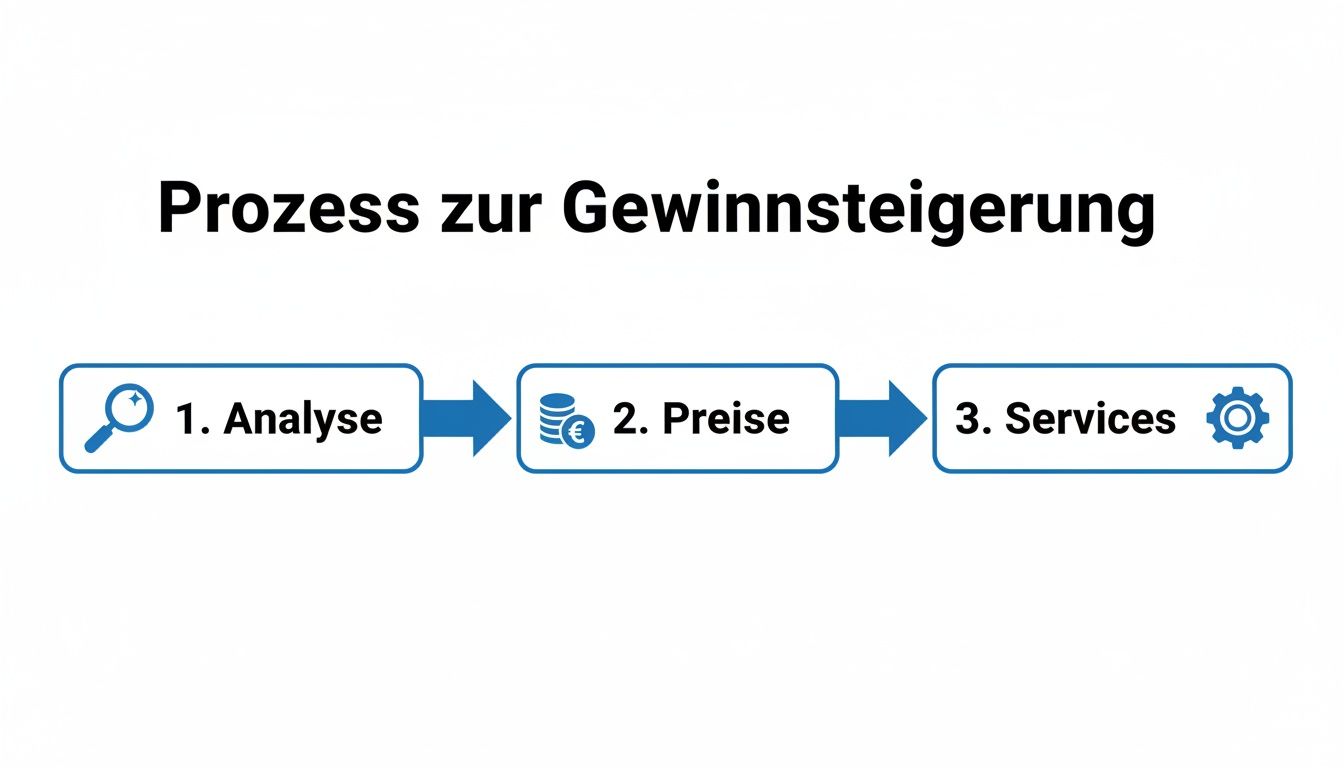
It is clearly visible: a solid analysis is the foundation. Only those who know their costs and effort can structure prices fairly and optimise services so that more is left over in the end.
Get out of reactive mode: How automation truly helps
Most management businesses work in reactive mode. An email comes in, an employee reacts. This costs time and nerves. Modern, AI-powered platforms turn the tables. They transform reactive single tasks into proactive, largely automated processes.
Imagine software that understands incoming enquiries, automatically assigns them to the correct process and forwards them to the responsible colleague – without anyone having to manually review the email first.
A classic example is coordinating tradespeople. Instead of countless phone calls and emails, a system can suggest the appropriate service provider from a saved list, query availability and coordinate the appointment with the tenant. This not only dramatically reduces work effort, but also makes the entire process faster and traceable for everyone involved.
Automation does not mean replacing people. It gives them back the freedom to focus on what truly matters: solving complex problems, advising owners and providing excellent service. This increases not only profit but also team satisfaction.
Process optimisation using the example of water damage: Manual vs. Automated
Nothing illustrates the potential of automation as well as an unforeseen event. Let's take the classic: water damage. The following comparison shows exactly where time – and thus your money – is lost.
The table makes the difference clear at a glance. The manual process is characterised by interruptions, waiting times and high communication effort, while the automated process is clearly structured and significantly more efficient.
Process step | Manual effort (Traditional) | Automated process (with AI platform) | Savings potential |
|---|---|---|---|
Damage reporting | Tenant calls or emails. Employee must manually record info, prioritise & create case. | Tenant reports damage via portal. AI detects urgency ("water damage"), creates case & prioritises automatically. | -15 mins. |
Tradesperson search | Employee calls partner companies, describes the damage multiple times, waits for replies. | System starts workflow, contacts suitable partner companies automatically with standardised damage details. | -30 mins. |
Appointment coordination | Multiple calls/emails between tradesperson, tenant and management to find a suitable date. | First available tradesperson confirms appointment in system. Tenant & owner receive automatic notification. | -20 mins. |
Documentation | Emails, notes, photos and invoices must be manually sorted, filed and followed up. | All messages, status updates & documents are automatically saved in the central case file. | -10 mins. |
Total savings | approx. 75 mins. per case |
The result is not just massive time savings. Faster response times can reduce consequential damage and lower costs. Above all, the profit margin is directly influenced because employees have significantly less effort per claim and can focus on value-creating tasks instead.
What you can do today
You do not need to overhaul your entire IT overnight. Start small, but start.
Log your time-wasters: For one week, observe which tasks keep recurring and take up the most time. Often it is sorting emails, answering the same questions over and over or manual data entry.
Standardise communication: Create simple text templates for frequent requests (e.g. appointment queries, damage reports). This is the first, simple step towards automation.
Use smart inboxes: Even simple rules and filters in your email program can help better sort and channel the daily flood.
Check specialised software: Find out what possibilities AI in property management already offers you today. Modern platforms are tailored exactly to the typical bottlenecks of property managers.
A platform like DoNexus starts right here. It bundles all communication in one place, sorts enquiries with the help of AI and automates the assignment of tasks. In this way, reactive steps become efficient, clean workflows. For your team, this means tangible relief – and for your company, a direct increase in profitability.
Unlocking revenue potential through better client management
Of course, cost reduction through automation is a powerful lever. But the biggest growth potential for your property management business often lies on the revenue side. How profitably you work depends heavily on how well you manage your clients and contracts. It is not just about winning new properties, but primarily about getting more out of your existing portfolio.
Strategic client and contract management is the key to unlocking hidden revenue. The first step: a brutal analysis of your existing agreements.
Uncovering hidden potential in your contracts
Many management contracts have remained unchanged for years and no longer reflect the actual effort involved. This is exactly where enormous potential slumbers, which you can unlock with a systematic review.
Look at each contract individually. Search specifically for clauses on additional services that go beyond the flat rate. In the daily rush, these are quickly overlooked and simply not billed.
What are typical examples of such forgotten, yet billable services?
The organisation and supervision of renovations above a certain value, for example above €5,000.
The handling of complex insurance claims, which are far more than just a quick notification.
Creating special reports for individual capital investors.
Attending extraordinary advisory board meetings or mediating in disputes.
With this analysis, you can refine your fee structure for new contracts and specifically renegotiate existing ones. It is important that you clearly communicate the added value – this creates the necessary acceptance.
Every unbilled extra service is lost profit. A detailed contract analysis is not a bureaucratic act, but a direct measure to increase your margin.
Client satisfaction as a direct revenue driver
Satisfied clients are your most valuable asset. They are not only loyal and less likely to terminate, but they are also much more open to booking additional, paid services. High service quality is therefore a direct investment in your revenue.
A decisive factor for satisfaction is transparency. Owners and tenants want to know what is happening with their concerns.
A digital client portal can make a massive difference here. It offers everyone involved round-the-clock insight into:
The current status of enquiries and damage reports.
All important documents such as deeds of division, logs or statements.
Upcoming dates and planned measures.
This transparency not only reduces the number of queries by phone or email, but above all strengthens trust in your work. Studies show: increasing customer retention by just 5% can increase profitability by 25% to 95%, because loyal clients are less price-sensitive and use more services.
Introduce and market new, profitable services
On the foundation of satisfied clients, you can specifically offer new, paid services. It is only important that these bring real added value and are tailored to the needs of your target groups.
Here are some practical ideas:
Premium reporting for investors: Offer detailed analyses of returns, maintenance costs and rental potentials as a paid package.
Digital document safe: A secure online storage for all property and contract documents, available at any time.
Letting service "Carefree Package": Take over the complete letting process for owners – from the ad to viewings to property handover.
To win new clients and fully exploit the revenue potential of your property management business, a strategic online presence can be crucial. This also includes using successful SEO strategies to increase visibility.
For the introduction of such services, clear communication is key. Explain the benefit and price transparently and fairly.
A platform like DoNexus helps you systematically tap into this revenue potential. The document AI searches contracts in a flash for billable clauses. At the same time, the client portal creates the necessary transparency and service quality as a basis for new, profitable services. This is how you turn good client management directly into higher profits for your property management business.
How DoNexus makes your management truly profitable
The strategies for increasing profit we have looked at are far more than just theory. With the right technological tool, they can be put into practice in everyday business. A specialised platform is not a pure cost item, but the lever that realigns your processes so that profitability becomes the logical consequence.
From concept to concrete implementation
If you want to increase the profit of your property management business, you must turn three crucial screws: lower administrative costs, increase revenue potential and strengthen client retention. This is exactly where a modern solution like DoNexus comes in. It replaces manual, error-prone steps with intelligent, automated workflows. It is about moving from pure processing to proactive, profit-oriented action.
Let's look at how technology works in practice:
Get rid of manual effort: No more endless reviewing of email inboxes. An AI-powered platform bundles all communication – email, phone and portals – in one central place. Every incoming query is automatically analysed, assigned to a category (such as a damage report or document request) and routed directly to the correct property and colleague. This alone often reduces the administrative effort by 30% to 40% from day one.
Secure every billable service: How often do additional services simply get lost in the daily rush? Intelligent task management ensures that not a single billable task slips through. Every job, from coordinating a renovation to creating a special report, is recorded, tracked and is immediately ready for billing.
Use contracts as a source of revenue: In many management contracts, clauses for fee adjustments or special remuneration lie dormant because nobody has them on their radar. A document AI combs through your entire contract inventory in seconds for terms like "fee adjustment" or "special fee". The result? A clear list of all contracts where you are leaving untapped revenue potential on the table.
A property management company that relies on technology does not necessarily work more, but above all smarter. When you automate routine tasks, you win back exactly the time you need for value-creating tasks – i.e. the activities that directly influence your profit.
More service quality, stronger client retention
An often underestimated factor for the profit of a property management business is client satisfaction. High client turnover is not only expensive, it also damages your reputation. With the right technology, you deliver a service that not only satisfies but delights and retains clients in the long term.
Here are two points that make the difference in practice:
Create full transparency: A digital client portal is no longer a luxury today, but an expected standard. It gives owners and tenants insight into the processing status of their requests, all relevant documents and upcoming dates at any time. This not only reduces the flood of telephone queries but also builds trust and conveys a high level of professionalism.
Tangibly shorten response times: Thanks to automatic assignment and clearly defined workflows, every query ends up with the right person immediately. The system monitors that deadlines are met and escalates, if necessary, all on its own. The result is significantly faster processing, which directly impacts customer satisfaction.
A platform like DoNexus was built from the ground up to turn exactly these principles into reality. It is the central operating system of your business, linking the concepts from the previous sections directly with powerful features. From AI-assisted sorting of communication and seamless task management to the transparent client portal – DoNexus equips your business for sustainable, profitable growth.
Questions from the field: Short answers for more profit
When it comes to increasing profit in property management, it is often not the huge, complicated strategies that make the difference. Mostly, it is the small but crucial adjustments in everyday life. From countless conversations with property managers, I know which questions keep coming up.
Here I have gathered the most frequent of them and give you clear, field-tested answers – without long-winded talk.
What you truly need to know to become more profitable
Look at these points as a checklist for your next steps. Each of these answers can have a direct impact on your margin.
From when does automation software truly pay off? Many think it depends on the number of units. In truth, it is the manual effort that counts. Even with 100 to 150 units, it can be worth it if your processes are complex. The decisive question is: how much time do your employees spend on recurring tasks like email processing or task tracking? If the answer is "too much", you have reached the point for an investment. The efficiency gain then quickly exceeds the cost of the software.
How do I communicate a fee increase without losing clients? The key is absolute transparency and clear added value. Always couple the price adjustment to a tangible improvement in your service. Explain that the increase enables investments in faster response times, a digital client portal or better availability. An open, early announcement with a genuine explanation always goes down better than a sudden, un-commented demand.
Which additional services are most frequently forgotten to be billed? The classics are the "I'll-just-do-that-quickly-on-the-side" tasks. These include organising larger renovations, handling complex insurance claims, creating special reports for individual owners or time-consuming mediation in neighbor disputes. Without complete and simple tracking of these activities, you are giving away cash.
How high should the profit margin of a property management business be? Although the sector shows an average profit of 16.9%, the reality often looks different. Many good managers move rather at an EBIT margin between 5% and 10%. That is solid. However, highly efficient companies that consistently rely on automation easily crack the mark of over 20%. This shows what enormous potential lies in optimised processes.
Your profitability does not depend on the number of managed units, but on the margin per unit. Concentrate on reducing the effort per door and maximising the value of your service.
Which first step has the greatest impact on profit? Clearly: introduce a detailed contribution margin calculation per property. This analysis is often painful, but it ruthlessly reveals which contracts are eating up your margin and where you urgently need to renegotiate. It is the perfect, data-driven starting point for any further optimisation.
The change to a more profitable management business succeeds best with the right tool. DoNexus was designed exactly for this, to transform reactive tasks into proactive, automated workflows. Discover at https://www.donexus.ai how to optimise your processes and sustainably increase the profit of your property management.

Daniel Parak
Founder & CEO
Latest Posts
Discover more posts on our blog