AI-Academy
How to properly find and evaluate AI use cases
AI Academy Part 3

1 Aug 2025


How to Correctly Identify and Evaluate AI Use Cases
Many property management companies are currently at a turning point.
The tasks are increasing, time is getting tighter, and yet new AI solutions are constantly appearing. But where should one start? Which applications really provide relief and which are just for fun? This article shows step by step how to identify, assess, and implement meaningful AI use cases. In five easy steps that are used worldwide. To make it practical, we will look at it using the example of research tasks in property management.
Step 1: Recognise Problems and Opportunities
Before getting into technology, clarity is needed. Where is time lost in everyday life? Which tasks are annoying every single day?
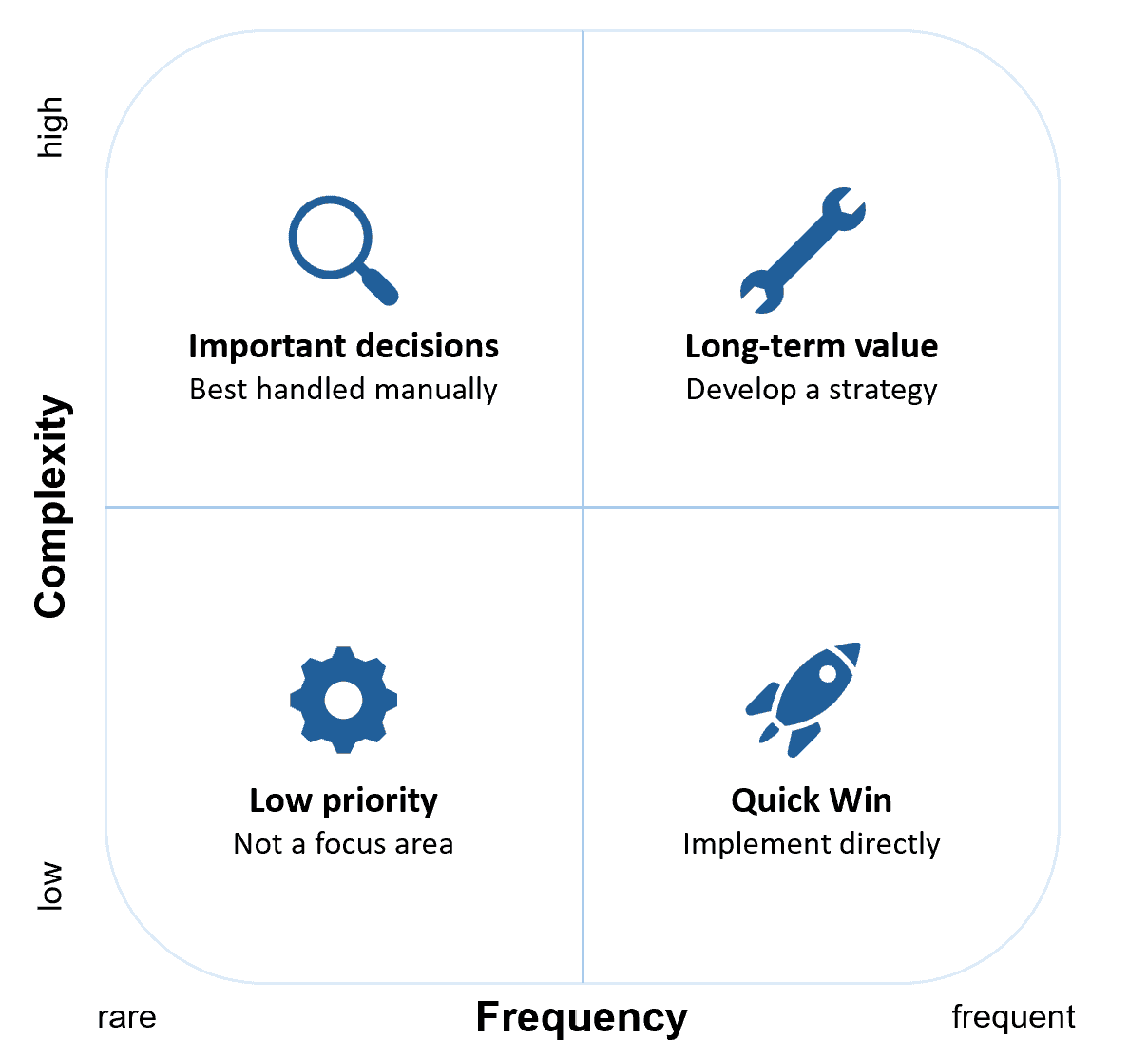
A simple division into four fields is helpful: a sort of task matrix:
Frequent & easy: Routine tasks – this is usually where the greatest potential for immediate use cases lies.
Frequent & hard: Processes that are complex but occur often: This requires a long-term strategy.
Rare & easy: not a focus area.
Rare & hard: usually better handled manually.
This leads to concrete approaches.
An example: “We spend hours each day searching documents – for resolutions, emails, or contracts. We always repeat the same search patterns.”
Such clear statements make problems tangible. They are the basis for a real use case. Ask the team and try to validate precisely such statements.
Step 2: Check Data and Team Readiness
Once a topic is established, it is time to check: Do we have the right data, and is the team ready to try something new? In document research, this means: Are the files digitised? Is there a central storage location?
Then it pays to identify early movers - that is, employees who are eager for something new and provide feedback. With them, initial user stories can be defined:
Before: “I spend half an hour searching in a declaration of division for the cost allocation.”
After: “I ask the AI and have the result in seconds.”
This creates motivation and acceptance and helps to precisely control whether the anticipated added value materialises.
Step 3: Assess Feasibility and Effort
Now comes the reality check. How much effort is the implementation? Which tools might fit?
Smaller administrations in particular benefit from seeking brief external support here. An expert can help realistically estimate effort, data situation, and benefits. Using the example of document research, it quickly becomes apparent: The technology is mature today, the integration is manageable - and the benefits are immediately noticeable. Often 90% of search times can be saved.
Step 4: Prioritise and Plan
Not every use case is immediately worthwhile. Therefore, a cost-benefit analysis follows now:
How much time does the solution save? How much effort is involved in implementation and training?
Then a simple roadmap is created:
Set target (e.g. „reduce search times by 50%“)
Define responsibilities
Start pilot
This is how an idea becomes a concrete project.
Step 5: Measure and Implement Results
In the end, what counts is whether the effort is worthwhile. Therefore, KPIs should be set early on:
How much time is saved? How quickly do employees find documents? How does team satisfaction change?
Based on these values, decisions can be made:
Will it remain a pilot or will the solution be rolled out?
The choice of partner is also crucial here. An experienced provider can help integrate solutions cleanly and continuously improve. Many companies offer free trial periods. These should be used intensively before making a purchasing decision.
Conclusion
Those who want to use AI sensibly should not start with technology, but with questions. Where is effort created? Which tasks repeat themselves? There lies the potential.
The described 5-step model helps bring structure to the process and avoid mistakes. Small tests, clear goals, and good data are all that's needed at the beginning.
👉 At DoNexus, we have already accompanied AI use cases for companies of all sizes and are happy to support you with your questions and projects.
In the next part of our AI Academy, we will specifically introduce how property managers can use ChatGPT to accomplish simple tasks.

How to Correctly Identify and Evaluate AI Use Cases
Many property management companies are currently at a turning point.
The tasks are increasing, time is getting tighter, and yet new AI solutions are constantly appearing. But where should one start? Which applications really provide relief and which are just for fun? This article shows step by step how to identify, assess, and implement meaningful AI use cases. In five easy steps that are used worldwide. To make it practical, we will look at it using the example of research tasks in property management.
Step 1: Recognise Problems and Opportunities
Before getting into technology, clarity is needed. Where is time lost in everyday life? Which tasks are annoying every single day?
A simple division into four fields is helpful: a sort of task matrix:
Frequent & easy: Routine tasks – this is usually where the greatest potential for immediate use cases lies.
Frequent & hard: Processes that are complex but occur often: This requires a long-term strategy.
Rare & easy: not a focus area.
Rare & hard: usually better handled manually.
This leads to concrete approaches.
An example: “We spend hours each day searching documents – for resolutions, emails, or contracts. We always repeat the same search patterns.”
Such clear statements make problems tangible. They are the basis for a real use case. Ask the team and try to validate precisely such statements.

Step 2: Check Data and Team Readiness
Once a topic is established, it is time to check: Do we have the right data, and is the team ready to try something new? In document research, this means: Are the files digitised? Is there a central storage location?
Then it pays to identify early movers - that is, employees who are eager for something new and provide feedback. With them, initial user stories can be defined:
Before: “I spend half an hour searching in a declaration of division for the cost allocation.”
After: “I ask the AI and have the result in seconds.”
This creates motivation and acceptance and helps to precisely control whether the anticipated added value materialises.
Step 3: Assess Feasibility and Effort
Now comes the reality check. How much effort is the implementation? Which tools might fit?
Smaller administrations in particular benefit from seeking brief external support here. An expert can help realistically estimate effort, data situation, and benefits. Using the example of document research, it quickly becomes apparent: The technology is mature today, the integration is manageable - and the benefits are immediately noticeable. Often 90% of search times can be saved.
Step 4: Prioritise and Plan
Not every use case is immediately worthwhile. Therefore, a cost-benefit analysis follows now:
How much time does the solution save? How much effort is involved in implementation and training?
Then a simple roadmap is created:
Set target (e.g. „reduce search times by 50%“)
Define responsibilities
Start pilot
This is how an idea becomes a concrete project.
Step 5: Measure and Implement Results
In the end, what counts is whether the effort is worthwhile. Therefore, KPIs should be set early on:
How much time is saved? How quickly do employees find documents? How does team satisfaction change?
Based on these values, decisions can be made:
Will it remain a pilot or will the solution be rolled out?
The choice of partner is also crucial here. An experienced provider can help integrate solutions cleanly and continuously improve. Many companies offer free trial periods. These should be used intensively before making a purchasing decision.
Conclusion
Those who want to use AI sensibly should not start with technology, but with questions. Where is effort created? Which tasks repeat themselves? There lies the potential.
The described 5-step model helps bring structure to the process and avoid mistakes. Small tests, clear goals, and good data are all that's needed at the beginning.
👉 At DoNexus, we have already accompanied AI use cases for companies of all sizes and are happy to support you with your questions and projects.
In the next part of our AI Academy, we will specifically introduce how property managers can use ChatGPT to accomplish simple tasks.
How to Correctly Identify and Evaluate AI Use Cases
Many property management companies are currently at a turning point.
The tasks are increasing, time is getting tighter, and yet new AI solutions are constantly appearing. But where should one start? Which applications really provide relief and which are just for fun? This article shows step by step how to identify, assess, and implement meaningful AI use cases. In five easy steps that are used worldwide. To make it practical, we will look at it using the example of research tasks in property management.
Step 1: Recognise Problems and Opportunities
Before getting into technology, clarity is needed. Where is time lost in everyday life? Which tasks are annoying every single day?
A simple division into four fields is helpful: a sort of task matrix:
Frequent & easy: Routine tasks – this is usually where the greatest potential for immediate use cases lies.
Frequent & hard: Processes that are complex but occur often: This requires a long-term strategy.
Rare & easy: not a focus area.
Rare & hard: usually better handled manually.
This leads to concrete approaches.
An example: “We spend hours each day searching documents – for resolutions, emails, or contracts. We always repeat the same search patterns.”
Such clear statements make problems tangible. They are the basis for a real use case. Ask the team and try to validate precisely such statements.

Step 2: Check Data and Team Readiness
Once a topic is established, it is time to check: Do we have the right data, and is the team ready to try something new? In document research, this means: Are the files digitised? Is there a central storage location?
Then it pays to identify early movers - that is, employees who are eager for something new and provide feedback. With them, initial user stories can be defined:
Before: “I spend half an hour searching in a declaration of division for the cost allocation.”
After: “I ask the AI and have the result in seconds.”
This creates motivation and acceptance and helps to precisely control whether the anticipated added value materialises.
Step 3: Assess Feasibility and Effort
Now comes the reality check. How much effort is the implementation? Which tools might fit?
Smaller administrations in particular benefit from seeking brief external support here. An expert can help realistically estimate effort, data situation, and benefits. Using the example of document research, it quickly becomes apparent: The technology is mature today, the integration is manageable - and the benefits are immediately noticeable. Often 90% of search times can be saved.
Step 4: Prioritise and Plan
Not every use case is immediately worthwhile. Therefore, a cost-benefit analysis follows now:
How much time does the solution save? How much effort is involved in implementation and training?
Then a simple roadmap is created:
Set target (e.g. „reduce search times by 50%“)
Define responsibilities
Start pilot
This is how an idea becomes a concrete project.
Step 5: Measure and Implement Results
In the end, what counts is whether the effort is worthwhile. Therefore, KPIs should be set early on:
How much time is saved? How quickly do employees find documents? How does team satisfaction change?
Based on these values, decisions can be made:
Will it remain a pilot or will the solution be rolled out?
The choice of partner is also crucial here. An experienced provider can help integrate solutions cleanly and continuously improve. Many companies offer free trial periods. These should be used intensively before making a purchasing decision.
Conclusion
Those who want to use AI sensibly should not start with technology, but with questions. Where is effort created? Which tasks repeat themselves? There lies the potential.
The described 5-step model helps bring structure to the process and avoid mistakes. Small tests, clear goals, and good data are all that's needed at the beginning.
👉 At DoNexus, we have already accompanied AI use cases for companies of all sizes and are happy to support you with your questions and projects.
In the next part of our AI Academy, we will specifically introduce how property managers can use ChatGPT to accomplish simple tasks.
Ready to lead your property management into the future?
Arrange a conversation now and find out how DoNexus can help you save time, reduce costs, and achieve better results.
No obligations. Free 30-minute chat with one of our founders.
Ready to lead your property management into the future?
Arrange a conversation now and find out how DoNexus can help you save time, reduce costs, and achieve better results.
No obligations. Free 30-minute chat with one of our founders.
Ready to lead your property management into the future?
Arrange a conversation now and find out how DoNexus can help you save time, reduce costs, and achieve better results.
No obligations. Free 30-minute chat with one of our founders.
Latest Posts
Discover more posts on our blog