AI-Academy
More clarity, fewer follow-ups
Artificial Intelligence at the interface between owner and property manager
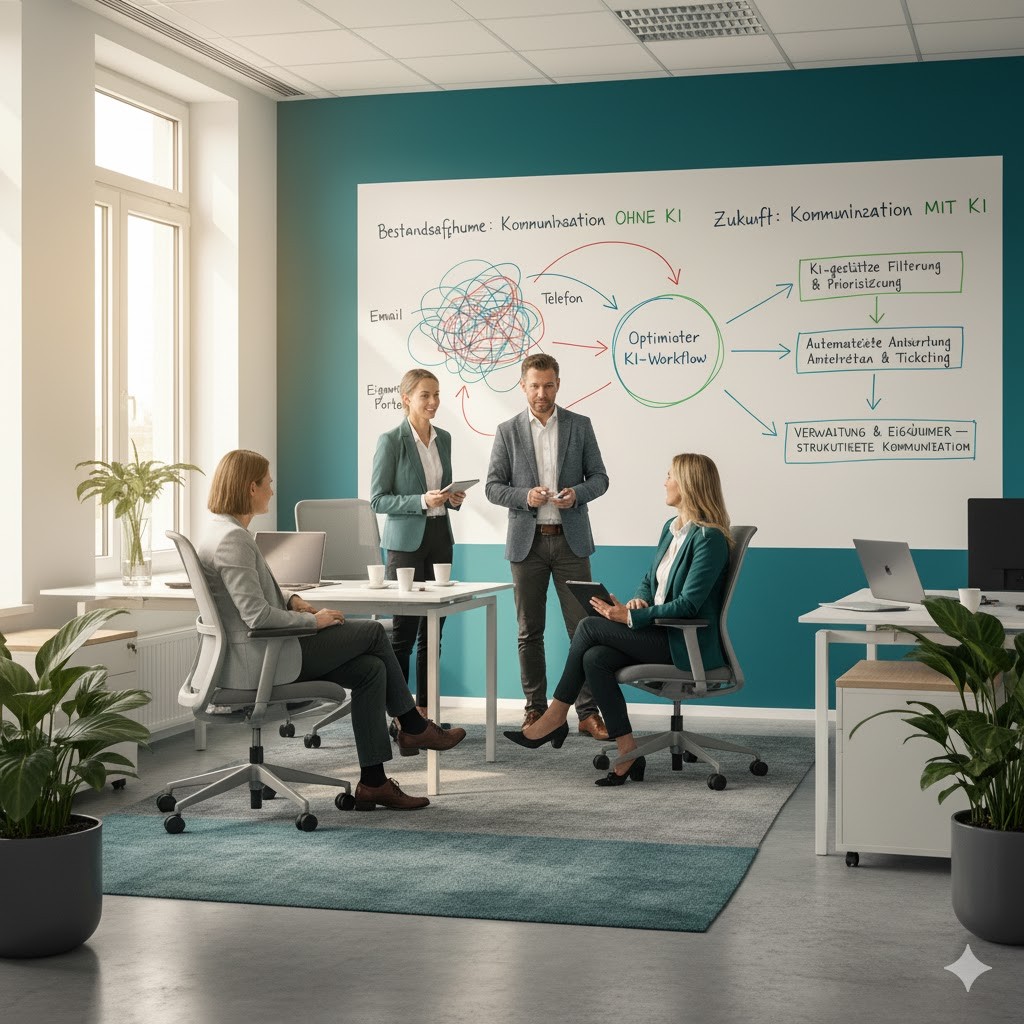
Why Portals Are Only Half the Battle and How AI Finally Structures Communication
Communication between property owners and property managers has changed significantly in recent years. Documents are digital, portals are established, and many processes run faster than before. Yet, management teams report that they are spending more and more time on follow-up questions. Owners find the documents but do not always understand what they say. Management teams, in turn, answer similar questions daily, sort inquiries, and try to bring structure to a communication flow that is continuously overflowing.
Many report that over half of the daily work time is used for communication, for questions that seem to have been long answered. An owner calls because they do not understand the bill. The next one asks about a resolution. A third is looking for a document that has long been on the portal. The topics repeat themselves. And that's exactly what eats up time – every single day. How often have you received a follow-up question from an owner about increased electricity costs or the peak of a bill?
Why Owners' Portals Are Important – But Not Enough Alone
Owners' portals have been very beneficial to the industry. They bundle bills, protocols, and messages, reduce paper, and create transparency. But they only solve one problem: access.
A PDF does not explain why an item has risen.
A protocol rarely provides the context of why a decision was made.
And a note on the portal does not prevent emails from being sent anyway.
Many owners do not want to search, they want to understand. If the portal fails in this, the question lands back with the manager. Whether the documents are available or not.
Additionally:
Many property owners do not call because they “can't find anything,” but because they feel uncertain.
They want confirmation, classification – someone who briefly says, “Yes, that's correct.”
Portals provide information, but they do not give a sense of security. And security is an underestimated factor in owner communication.
Rethinking the Interface
Between owner and management, there is much more than a document exchange. It is a relationship of questions, decisions, expectations, misunderstandings, and sometimes also pressure. Anyone who wants to improve this interface must consider both sides:
What does the owner need to immediately understand a question? - Orientation
What does management need to cleanly and quickly process inquiries? - Structure
The basic problem today:
Communication comes through all channels simultaneously – phone, email, portal messages, central calls, forwards, CC loops. No team can efficiently filter this in the long run without support.
Artificial intelligence steps in exactly there. It complements portals with what's been missing: understanding, explanation, and structure = It turns access into understanding and undirected inquiries into clear processes.
What AI Can Do for Owners
With AI, a portal is no longer just a storage place but a genuine contact. Owners can ask their questions in plain language, not search for documents or interpret technical terms.
For example, if someone asks:
“Why has my service charge increased?”
“What was decided last year regarding the roof repair?”
“What deadlines apply for measure X?”
then the AI automatically searches the relevant sections in the bill or protocol, shows the appropriate passages, and explains them in clear words. The owner gets the answer where they need it – without email, without callbacks, without time loss. This way, a file becomes a comprehensible answer, directly in the portal, without waiting time, even in the evenings or on weekends.
AI can also simplify legal or technical formulations. Technical terms become everyday explanations. If someone wants more details, they can click further into the source. If they only need the answer, they get it in two sentences.
Routine questions are answered by AI immediately, more sensitive concerns are cleanly passed on to a person. It's important: Management not only receives the inquiry but also a brief summary and the relevant document sections. No reading through PDFs, no email loops with five participants.
What AI Changes for Management Teams
The greatest effect occurs on the manager's side. Because today, every inquiry means: reading, assigning, forwarding, answering. This is exactly where AI relieves the burden. It automatically recognizes:
What's it about? Billing, technology, law, deadline
How urgent is it? Damage immediate, question later
Where does it belong? Which property, which manager, which expert area
What information is missing? Which documents are relevant
AI summarises long email chains, suggests response drafts, and points to the appropriate document sections. This saves time, prevents duplicate work, and leads to consistent answers.
If several owners find the same point unclear, the system recognizes the pattern. Instead of writing the same sentence ten times, a brief explanation or a note in the portal is generated. The repetition is eliminated, and the team has breathing space for the cases that really need time.
Experiences from other service areas show how strong this effect can be. In documented examples, call volumes have been reduced by AI by around 40 per cent – not because fewer questions existed, but because they were better structured and many could be answered automatically. The logic behind this effect is identical to property management: Accept, recognize, explain, clean handover.
When All Channels Work Together
The greatest impact occurs when portal, email, and phone work together.
In the portal, the AI answers questions directly in the context of the document.
In emails and messages, it sorts inquiries in advance and suggests answers.
On the phone, a voice assistant records standard messages, creates tickets with summaries, and forwards them as needed.
The result is no longer “every concern comes back via email,” but an organized communication chain with clear paths.
More Clarity for Owners, Less Stress for Managers
Owners receive fast, clear answers, in their language and at the moment of their inquiry. They don’t need to ask again, search, or guess. This increases trust, reduces frustration, and makes them satisfied!
Teams work more calmly because standard topics no longer need to be reworked every time. Knowledge stays in the system, not in the heads of individual people. Nothing is lost, even if someone is on holiday or changes positions.
Communication becomes predictable, decisions are traceable, and the truly demanding cases receive attention. And portals finally become what they are supposed to be: places where owners not only have access but also understand.
Outlook: A Real Change in Collaboration
The industry has been digitising for years, but many initiatives remain halfway. Although more documents are being made available, the communication behind them hardly changes. Therefore, the next step is not another tool, but a different handling of the information that already exists. Making documents accessible is one thing. AI makes them understandable and usable, directly for both sides.
The combination of portal and intelligent assistance ensures that both sides benefit. Owners understand what they want to know faster, and management retains an overview. AI complements owners' portals with explanations and integrates into existing processes. This creates a foundation where good service is possible, even with limited resources.
DoNexus is currently working on making exactly this type of connection a reality – a solution that integrates into existing processes and noticeably relieves everyday life.
Why Portals Are Only Half the Battle and How AI Finally Structures Communication
Communication between property owners and property managers has changed significantly in recent years. Documents are digital, portals are established, and many processes run faster than before. Yet, management teams report that they are spending more and more time on follow-up questions. Owners find the documents but do not always understand what they say. Management teams, in turn, answer similar questions daily, sort inquiries, and try to bring structure to a communication flow that is continuously overflowing.
Many report that over half of the daily work time is used for communication, for questions that seem to have been long answered. An owner calls because they do not understand the bill. The next one asks about a resolution. A third is looking for a document that has long been on the portal. The topics repeat themselves. And that's exactly what eats up time – every single day. How often have you received a follow-up question from an owner about increased electricity costs or the peak of a bill?
Why Owners' Portals Are Important – But Not Enough Alone
Owners' portals have been very beneficial to the industry. They bundle bills, protocols, and messages, reduce paper, and create transparency. But they only solve one problem: access.
A PDF does not explain why an item has risen.
A protocol rarely provides the context of why a decision was made.
And a note on the portal does not prevent emails from being sent anyway.
Many owners do not want to search, they want to understand. If the portal fails in this, the question lands back with the manager. Whether the documents are available or not.
Additionally:
Many property owners do not call because they “can't find anything,” but because they feel uncertain.
They want confirmation, classification – someone who briefly says, “Yes, that's correct.”
Portals provide information, but they do not give a sense of security. And security is an underestimated factor in owner communication.
Rethinking the Interface
Between owner and management, there is much more than a document exchange. It is a relationship of questions, decisions, expectations, misunderstandings, and sometimes also pressure. Anyone who wants to improve this interface must consider both sides:
What does the owner need to immediately understand a question? - Orientation
What does management need to cleanly and quickly process inquiries? - Structure
The basic problem today:
Communication comes through all channels simultaneously – phone, email, portal messages, central calls, forwards, CC loops. No team can efficiently filter this in the long run without support.
Artificial intelligence steps in exactly there. It complements portals with what's been missing: understanding, explanation, and structure = It turns access into understanding and undirected inquiries into clear processes.
What AI Can Do for Owners
With AI, a portal is no longer just a storage place but a genuine contact. Owners can ask their questions in plain language, not search for documents or interpret technical terms.
For example, if someone asks:
“Why has my service charge increased?”
“What was decided last year regarding the roof repair?”
“What deadlines apply for measure X?”
then the AI automatically searches the relevant sections in the bill or protocol, shows the appropriate passages, and explains them in clear words. The owner gets the answer where they need it – without email, without callbacks, without time loss. This way, a file becomes a comprehensible answer, directly in the portal, without waiting time, even in the evenings or on weekends.
AI can also simplify legal or technical formulations. Technical terms become everyday explanations. If someone wants more details, they can click further into the source. If they only need the answer, they get it in two sentences.
Routine questions are answered by AI immediately, more sensitive concerns are cleanly passed on to a person. It's important: Management not only receives the inquiry but also a brief summary and the relevant document sections. No reading through PDFs, no email loops with five participants.
What AI Changes for Management Teams
The greatest effect occurs on the manager's side. Because today, every inquiry means: reading, assigning, forwarding, answering. This is exactly where AI relieves the burden. It automatically recognizes:
What's it about? Billing, technology, law, deadline
How urgent is it? Damage immediate, question later
Where does it belong? Which property, which manager, which expert area
What information is missing? Which documents are relevant
AI summarises long email chains, suggests response drafts, and points to the appropriate document sections. This saves time, prevents duplicate work, and leads to consistent answers.
If several owners find the same point unclear, the system recognizes the pattern. Instead of writing the same sentence ten times, a brief explanation or a note in the portal is generated. The repetition is eliminated, and the team has breathing space for the cases that really need time.
Experiences from other service areas show how strong this effect can be. In documented examples, call volumes have been reduced by AI by around 40 per cent – not because fewer questions existed, but because they were better structured and many could be answered automatically. The logic behind this effect is identical to property management: Accept, recognize, explain, clean handover.
When All Channels Work Together
The greatest impact occurs when portal, email, and phone work together.
In the portal, the AI answers questions directly in the context of the document.
In emails and messages, it sorts inquiries in advance and suggests answers.
On the phone, a voice assistant records standard messages, creates tickets with summaries, and forwards them as needed.
The result is no longer “every concern comes back via email,” but an organized communication chain with clear paths.
More Clarity for Owners, Less Stress for Managers
Owners receive fast, clear answers, in their language and at the moment of their inquiry. They don’t need to ask again, search, or guess. This increases trust, reduces frustration, and makes them satisfied!
Teams work more calmly because standard topics no longer need to be reworked every time. Knowledge stays in the system, not in the heads of individual people. Nothing is lost, even if someone is on holiday or changes positions.
Communication becomes predictable, decisions are traceable, and the truly demanding cases receive attention. And portals finally become what they are supposed to be: places where owners not only have access but also understand.
Outlook: A Real Change in Collaboration
The industry has been digitising for years, but many initiatives remain halfway. Although more documents are being made available, the communication behind them hardly changes. Therefore, the next step is not another tool, but a different handling of the information that already exists. Making documents accessible is one thing. AI makes them understandable and usable, directly for both sides.
The combination of portal and intelligent assistance ensures that both sides benefit. Owners understand what they want to know faster, and management retains an overview. AI complements owners' portals with explanations and integrates into existing processes. This creates a foundation where good service is possible, even with limited resources.
DoNexus is currently working on making exactly this type of connection a reality – a solution that integrates into existing processes and noticeably relieves everyday life.

Ready to lead your property management into the future?
Arrange a conversation now and find out how DoNexus can help you save time, reduce costs, and achieve better results.
No obligations. Free 30-minute chat with one of our founders.
Ready to lead your property management into the future?
Arrange a conversation now and find out how DoNexus can help you save time, reduce costs, and achieve better results.
No obligations. Free 30-minute chat with one of our founders.
Latest Posts
Discover more posts on our blog