AI-Academy
Efficient property management thanks to modern property management software
Discover modern property management software for efficient...
Modern property management software is no longer a luxury investment, but a strategic necessity. Instead of struggling with Excel spreadsheets and overflowing inboxes, it bundles all operations into a central, intelligent system that automates processes and finally frees up time for what really matters: growth and first-class service.
10 steps to the right software: A checklist for your decision
Choosing the right software is a course-setting decision for the future. These ten criteria will help you separate the wheat from the chaff and find the solution that noticeably improves your daily work.
AI-powered process automation: The software must think with you. Can it understand emails, process invoices automatically and handle routine tasks independently?
Central communication platform: Put an end to the chaos. Does the solution bundle all enquiries (email, phone, portal) in one place and ensure complete traceability?
Scalability and flexibility: Your management is growing – your software must be able to do so too. Is it a flexible cloud solution that adapts without high investment?
Seamless integrations: No software is an island. Does it offer open interfaces (APIs) for trouble-free connection to your ERP system, your accounting or metering service providers?
Intuitive customer portal: A modern portal can reduce calls and emails by up to 40%. Does it allow owners and tenants to find information themselves and submit damage reports digitally?
Data security and GDPR compliance: The protection of sensitive data is a priority. Does the provider use servers in Germany or the EU that are certified to ISO 27001?
Mobile availability: Your work does not only take place at your desk. Is mobile access via smartphone or tablet to all important data and functions guaranteed?
Meaningful analysis functions: Make decisions based on data. Does the software provide clear dashboards to analyse processing times and identify bottlenecks?
Simple onboarding and support: A structured, fast implementation process is crucial. Does the provider guarantee fast onboarding and competent support?
Future-proofing through continuous development: Technology is developing rapidly. Is there a clear product roadmap showing that the platform is being continuously improved?
These criteria are crucial for making a sustainable decision. A platform like DoNexus was developed to meet precisely these points. It combines AI-powered automation, a central communication platform and seamless integrations to make your management proactive, scalable and future-proof.
Why Excel lists are no longer sufficient for property management
Do you know the feeling? The inbox is overflowing, endless Excel spreadsheets have to be maintained by hand and the box files on the shelf are bursting at the seams. This traditional way of working will inevitably reach its limits in 2026.
Constant cost pressure, rising expectations from tenants and owners and complex legal changes such as the WEG reform now require more than just reactive processing. Anyone who clings to old tools here risks not only inefficiency, but jeopardises their business in the long term.
The problem with data silos
The biggest weakness of the classic way of working is the lack of networking. Information is scattered everywhere: emails in Outlook, contact details in Excel, documents in physical folders and tasks on sticky notes. These data silos inevitably lead to problems:
High susceptibility to errors: Transferring data by hand is a ticking time bomb. A typo in a meter number or an outdated contact in a list can quickly lead to expensive corrections and annoyed customers.
Enormous loss of time: Employees spend a large part of their day searching for information instead of focusing on value-adding activities. Time that is urgently needed elsewhere.
Lack of transparency: Without a central overview, it is almost impossible to track the current status of a transaction. This frustrates not only the team, but also the customers, who wait forever for feedback.
The trend towards digitalisation is unstoppable. Already, 37 per cent of landlords in Germany manage their properties with specialised software. This change is only being accelerated by the WEG reform, which places higher demands on transparency and documentation. If you want to learn more about the digital future of property management, it is worth taking a look at current studies.
The path to proactive management
A modern property management software breaks down these silos. You can think of it like a central nervous system that bundles all information in one place and links it intelligently.
Instead of just storing data, a modern platform creates context. An email is not just received, but automatically assigned to the right property, the responsible employee and the matching transaction.
This shift is crucial: from a reactive to a proactive management. Instead of just reacting to problems, intelligent software makes it possible to actively control processes, recognise bottlenecks early on and offer first-class service.
A platform like DoNexus is designed exactly for this. It transforms the daily chaos of enquiries and tasks into structured, automated workflows, creating the basis for sustainable growth and satisfied customers.
The 10 most important criteria for selecting your software
The decision for a modern property management software is a course-setting decision for the future of your company. The market is full of providers promising the earth, and it is easy to get lost in technical details. Instead, focus on what really matters: criteria that noticeably improve your daily work and set up your business to be future-proof.
To make the right choice, you need a clear checklist. The following ten points will help you separate the wheat from the chaff. This is how you will find the software that fits you not only today, but also in the years to come. Ask the providers targeted questions and press them for answers until you are sure that the solution meets your specific requirements.
1. AI-powered process automation
Modern software should do more than just store data – it must think with you. Intelligent automation is the key to freeing yourself from time-consuming routine tasks. Look for features that automatically understand emails, evaluate documents for content and trigger recurring processes on their own. This is the real lever for more efficiency.
Question for the provider: How exactly does your AI help manage the daily flood of emails and process invoices automatically?
2. Central communication platform
Put an end to the chaos of emails, calls and notes on scraps of paper. A central platform, often referred to as a "Unified Inbox", bundles all communication in one place. Every single enquiry is automatically assigned to the correct property, transaction and employee. This creates seamless traceability where nothing gets lost.
Question for the provider: Does your platform support all relevant channels (email, phone, portal) and how does it ensure that no enquiry is lost?
3. Scalability and flexibility
Your management is growing – your software must be able to do so too. A cloud-based SaaS (Software as a Service) solution has a clear advantage here because it adapts flexibly. Whether you manage 100 or 10,000 units: the system should grow with you without expensive hardware investments or tedious re-installations.
Question for the provider: How easily can the software scale as we expand our portfolio? What cost structure is this based on?
4. Seamless integrations
No software is an island. A good solution must fit smoothly into your existing IT landscape. Open interfaces (APIs) are crucial, allowing a trouble-free connection to your ERP system, your accounting or metering service providers such as Techem or Ista.
Question for the provider: What standard integrations do you offer and how complex is the connection to our existing systems?
5. Intuitive customer portal
A modern customer portal can reduce the number of calls and emails by up to 40%. It gives owners and tenants 24/7 access to important documents, shows the status of enquiries and makes digital damage reporting child's play. Intuitive usability is the key to high acceptance here.
Question for the provider: Can we customise the customer portal to our branding and what features are available to users?
Modern property management software redefines service. It makes it possible to transition from reactive troubleshooting to proactive, transparent and appreciative customer care where all information is at your fingertips at all times.
6. Data security and GDPR compliance
The protection of sensitive data is an absolute priority. Make sure that the provider uses servers in Germany or the EU that are certified to ISO 27001. The software must also seamlessly meet all requirements of the GDPR, the WEG and the Heating Costs Ordinance (HKVO). There is no room for compromise here.
Question for the provider: Where is our data stored and what technical measures ensure GDPR compliance?
7. Mobile availability
Your work does not only take place at your desk. Mobile access to all important data and functions via smartphone or tablet is indispensable today. This allows you to access transactions, create tasks and retrieve information even during property inspections or appointments on site.
Question for the provider: Is there a dedicated mobile app or a web version of the software optimised for mobile devices?
8. Meaningful analysis functions
Make decisions based on data, not gut feeling. Good software provides you with clear dashboards and reports. Analyse processing times, identify bottlenecks and keep track of key performance indicators (KPIs) to continuously improve your processes.
Question for the provider: What analysis options does the software offer to measure and increase the efficiency of our management?
9. Simple onboarding and support
The greatest range of functions is of no use if the implementation takes months and the team is frustrated. A structured and fast onboarding process is crucial so that you can become productive quickly. Just as important is competent support that helps quickly and directly with any questions.
Question for the provider: What does your onboarding process look like and how quickly can we start using the software?
10. Future-proofing through continuous development
Technology is developing rapidly. Choose a partner that continuously improves its platform and responds to new legal requirements or technological trends. A clear product roadmap shows that the provider does not just think short-term, but has a long-term interest in the success of its customers.
Question for the provider: How do you ensure that your software is still state-of-the-art in five years' time?
The intelligent processing of documents is a central element in this. Learn more about how a document AI can revolutionise your work by automatically capturing and structuring content.
A solution like DoNexus was developed to meet exactly these criteria. It combines an AI-powered communication hub with intelligent task management and seamless integrations to make your management proactive and scalable.
How modern software changes your daily work
Imagine your property management software does not just stubbornly work through tasks, but actively thinks with you. It becomes the digital nervous system of your management, connecting all individual parts – communication, documents and tasks – into an intelligent whole. This is exactly how the daily chaos becomes an orderly, proactive and ultimately much more efficient workflow.
This concept map shows the three crucial pillars on which modern software stands today: AI-powered intelligence, a central communication basis and the ability to grow with your business.
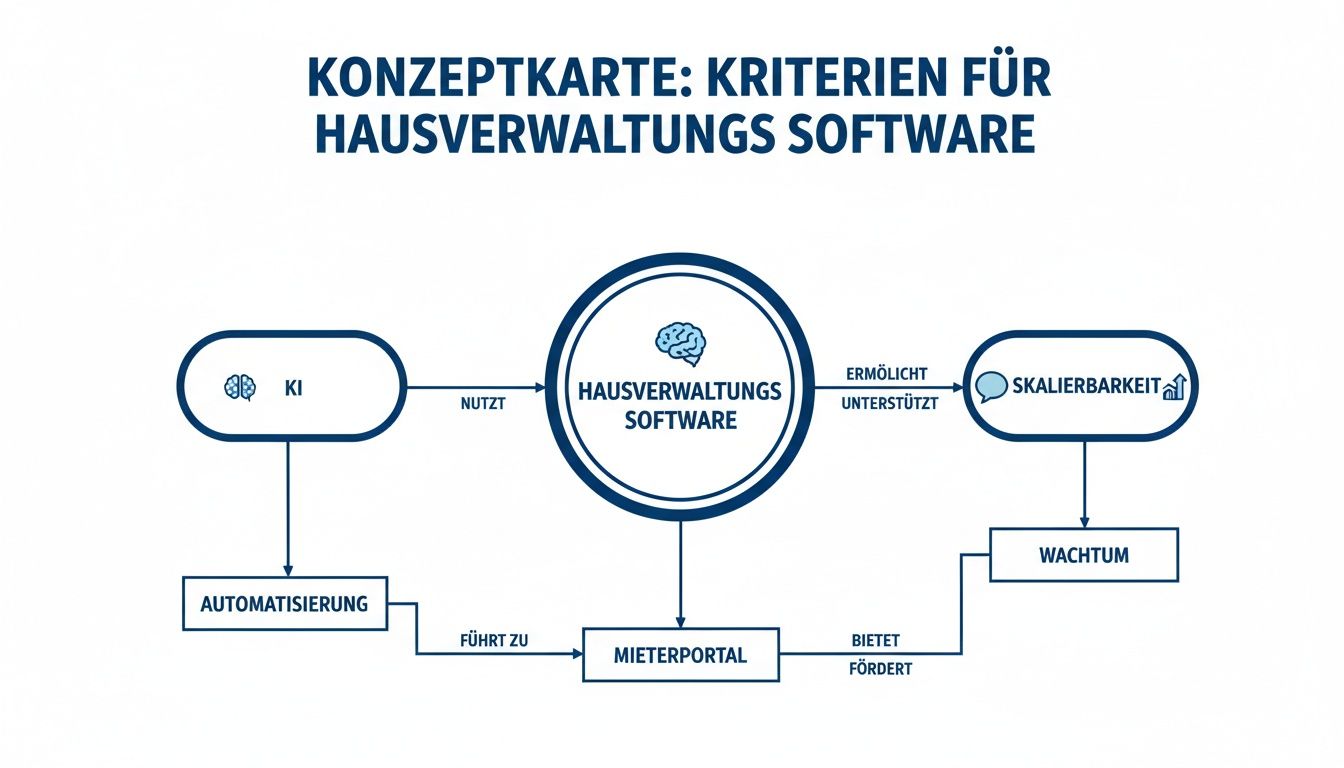
You can see well here how these elements interlock to create a management that does not just react, but acts with foresight. But what does that mean in concrete terms for your daily work?
This is how core functions really change your daily work
To understand the true value of modern software, we must break away from old ideas. It is no longer about simple to-do lists or a digital filing cabinet. It is about how intelligent features solve your daily challenges and simply make stupid, repetitive work redundant.
Let's look at 5 fundamental changes for your daily work:
1. The command centre instead of the overflowing inbox
A Unified Inbox is so much more than just a gathering place for emails. It is your intelligent command centre. Every incoming message is automatically analysed and immediately assigned to the correct property, the matching transaction and the responsible employee.
So an email with a damage report automatically starts a predefined process, informs the caretaker and creates a task for follow-up. Manual sorting and forwarding? Finally a thing of the past.
2. Document AI instead of manual data entry
Say goodbye to the tedious typing of invoice details or searching through old resolution minutes. A document AI reads and understands content. It automatically extracts invoice numbers, due dates and amounts or identifies important resolutions and deadlines in minutes.
This not only saves an enormous amount of time when processing invoices, but also reduces the error rate that is simply inevitable with manual transfer. Learn more about how it works in our guide on the role of AI automation in property management.
3. Proactive task management instead of passive to-do lists
Conventional to-do lists are purely reactive. Intelligent task management, on the other hand, thinks proactively. It automatically monitors deadlines from contracts or legal requirements, sends reminders and escalates completely on its own if necessary.
Imagine it like a digital assistant that ensures no termination deadline of a service contract is missed or the next owners' meeting is on the agenda in good time.
4. The customer portal as a 24/7 service point
A modern customer portal is your digital employee available around the clock. It noticeably relieves your team by reducing the number of calls and email queries by up to 40%.
Owners and tenants can independently view the status of their requests, download documents such as the latest billing statement or submit a damage report digitally. This creates transparency and increases satisfaction because information is accessible at all times.
5. Seamless integration instead of isolated data silos
A modern property management software is not a closed-off island. It connects seamlessly with your existing systems. Through open interfaces (APIs), data is automatically synchronised between your accounting software, the systems of metering service providers and your ERP system.
This means: no more manual data matching between different programs. Once entered, information is correctly available everywhere in real time, which increases data quality and efficiency throughout the company.
It is precisely these interlocking features that truly transform a management. A platform like DoNexus was developed exactly on this principle. It serves as an operational operating system that tames the daily flood of information and transforms reactive management tasks into proactive, scalable processes. This wins back valuable time for your employees to focus on what really matters: excellent service and the growth of your business.
The secure step into the cloud
The question of whether your own IT is better off in the cellar (on-premise) or in the cloud is one of the most important course-setting decisions for a property management company. It is the basis for how flexibly, securely and efficiently you will work in the coming years. What often feels like a huge technical hurdle is, on closer inspection, a clear strategic decision for more growth and security.
In short: switching to a modern, cloud-based property management software shifts your focus. Instead of worrying about IT infrastructure, you can concentrate fully on value-adding work for your customers. Instead of organising server updates, data backups and physical security, you use a professionally maintained platform that is always up to date and keeps your back free.
5 decisive factors for your decision
To make the choice between local software and the cloud, you shouldn't ponder over technical jargon. Better to compare the models based on the factors that truly shape your daily business.
Cost structure
On-Premise: Here, there is a high one-off investment at the beginning. You buy server hardware and software licenses. Added to this are ongoing costs for electricity, maintenance and, every few years, the renewal of hardware.
Cloud (SaaS): Instead of high upfront costs, you pay a flexible, monthly or annual fee. This covers everything: usage, maintenance, updates and support. The costs are therefore transparent, predictable and simply grow with your management.
Security and GDPR compliance
On-Premise: Complete responsibility for data security lies with you. This ranges from fire protection and anti-theft security to protection against cyberattacks and the correct implementation of all GDPR requirements. This requires enormous specialist knowledge and constant attention.
Cloud (SaaS): Professional providers use highly secure, ISO 27001-certified data centres in Germany. These are subject to the strictest security standards that a single management could hardly achieve on its own. Automatic updates ensure that security vulnerabilities are closed immediately and the software always remains compliant with the law.
Maintenance and administrative effort
On-Premise: Installation, updates, backups and troubleshooting are entirely in your hands or require expensive external IT service providers. This administrative effort binds valuable time and nerves that are needed elsewhere.
Cloud (SaaS): The entire maintenance effort is eliminated. The provider takes central care of the entire technology in the background. Your team can concentrate fully on the actual management work again.
Scalability and growth
On-Premise: If your company grows, your own servers quickly reach their limits. An expansion then means high investments in new hardware and complex installation processes again.
Cloud (SaaS): The software simply grows with you. If you need more performance or new employees are added, your subscription is easily adjusted. The system scales without you having to worry about the technology.
Mobile access and flexibility
On-Premise: Access from outside the office is often complicated, slow and questionable from a security perspective. Accessing all data quickly during a property inspection? Hardly practical.
Cloud (SaaS): You and your team can access all data securely from anywhere in the world and with any device – whether in the office, in the home office or directly at the customer's site. This is the basis for modern, flexible working.
The myth that your own servers are more secure is long outdated. Professional cloud providers invest sums in security technologies that are economically and technically unattainable for a single property management company.
The market data confirms this shift impressively. A current analysis shows that only 24.5% of property management companies in Germany rely on purely local systems – a significant decline compared to the previous year. Cloud and hybrid solutions are clearly on the rise and are becoming the first choice for the industry. If you want to dive deeper into the industry's trends, you can find further insights in the survey on digitalisation in property management on haufe.de.
A platform like DoNexus is designed from the ground up as a pure cloud solution to offer you precisely these advantages. With the central, secure and always up-to-date platform, IT becomes secondary so that you can focus entirely on first-class service. A good example of this is how a modern customer portal from DoNexus enables mobile access for your owners and tenants, thereby sustainably improving communication.
How the investment pays off for you
A modern property management software is not a pure cost item, but a strategic decision for the future of your management. Sure, there is the investment at the beginning. But the crucial question is: does the technology ultimately bring in more than it costs? The answer lies in a mix of tangible savings and valuable, indirect gains.
The true value is not only reflected in saved euros. It shows itself above all in the time your team suddenly has for growth and real service. Instead of binding staff to repetitive routine tasks, you create freedom for what really matters: inspiring your customers and expanding your portfolio. This is how software turns from a pure tool into a engine for your success.
Ten measurable benefits that determine your ROI
To make the return on investment (ROI) tangible, let's look at ten concrete benefits. Feel free to use these points as a checklist to evaluate the added value for your own management:
Lower staffing costs: Automated processes, such as sorting emails or processing invoices, massively reduce the time spent per transaction. This simply means: your existing team can manage more units without reaching its limits.
Fewer calls and emails: A good customer portal intercepts up to 40% of the query volume. Owners and tenants find answers to their questions themselves and relieve your team of standard queries like "Did you receive my email?".
Avoidance of error costs: Manual data transfer is a classic source of errors. A wrong IBAN, a transposed digit in the billing – all of this causes expensive correction effort and frustration. Automation minimises these errors and the associated costs.
No more missed deadlines: Clever task management automatically keeps track of termination deadlines for service contracts. This prevents expensive, unwanted contract extensions and gives you a better negotiating position.
Faster billing processes: Automated collection of consumption data and digital invoice verification enormously accelerate the creation of utility billings and WEG statements. This improves liquidity and takes the dread out of the year-end business.
Lower print and postage costs: Sending documents digitally via a customer portal saves real money – on every single letter. This adds up considerably over the year.
Switching to modern software transforms your management from a cost factor into a profit centre. Efficiency is directly converted into financial gains and growth opportunities.
Higher employee satisfaction: When your employees can concentrate on challenging tasks instead of monotonous routine, motivation rises. And satisfied employees are not only more productive, they also stay loyal to the company longer.
Better customer satisfaction and retention: Transparent processes and quick reactions lead to thrilled customers. Satisfied owners recommend you and stay loyal to you long-term – the strongest marketing there is.
Easier scalability: Due to the efficiency gains, you can expand your portfolio without having to hire new staff immediately. Your growth becomes more profitable and is much easier to control.
Data-driven decisions: Clear analyses and reports reveal where time and money are really being lost. You identify bottlenecks and can specifically improve processes, which lowers operating costs in the long run.
A platform like DoNexus was developed from the ground up to deliver exactly these benefits. By intelligently connecting communication, tasks and documents, DoNexus transforms reactive management work into a proactive, scalable process. This ensures that your investment in modern property management software pays off quickly and sustainably.
How DoNexus really drives your property management forward
Theory and checklists are a good thing. But only in daily work does it become clear what a modern property management software can really do. We have looked at what an ideal solution must achieve today – now let's look at how a platform like DoNexus solves these requirements in practice. DoNexus is more than just another tool. It is an operating system for your management that transforms reactive processing into a proactive, scalable and customer-centric process.
The core idea is simple: the daily chaos must be guided into orderly channels. Instead of just reacting to enquiries and problems, the platform actively controls your processes. This allows your team to finally focus on the tasks that truly create value again.
How DoNexus transforms your daily work
DoNexus was developed from the ground up to combine the key features of future-proof software into a single, seamlessly integrated solution. The platform addresses precisely where the biggest time-wasters in daily management lurk:
Taming the flood of communication: The AI-powered Unified Inbox is your central command centre. It doesn't just collect emails. It sorts and understands every enquiry, automatically assigns it to the correct property and transaction, and forwards it directly to the responsible employee. A simple damage report becomes a finished process without a single manual click.
Intelligently understanding documents: Our document AI reads and understands the content of your contracts, invoices or resolution minutes. In seconds, it extracts relevant data such as deadlines, amounts or tasks and files them in a structured way. The tedious searching and manual typing of data? A thing of the past.
Proactively managing tasks: Instead of a passive to-do list that just grows, the system actively monitors all deadlines arising from contracts or laws. Notice periods of service providers are kept in view just like dates for the next owners' meeting. This prevents expensive errors and embarrassing omissions.
DoNexus works like a brain for your business. It learns with every interaction and gets better over time at understanding emails, analysing documents and assigning tasks correctly.
These intelligent core functions interlock seamlessly and create a continuous, automated workflow. From first contact to processing and final filing, every step is made traceable and efficient.
A crucial point is the fast onboarding. Instead of months of implementation projects, you are ready to start with us within a few days. We import your previous data, enrich it, and your team feels the added value almost immediately. With DoNexus, you are not just investing in software, but in a system that increases your efficiency, relieves your staff and lays the foundation for sustainable growth.
Your questions, our answers on property management software
A software change naturally raises questions. That is completely normal. From our experience, we know exactly which concerns worry management companies most frequently.
In this section, we have summarised the most important points for you – brief, honest and to the point.
How long does the switch to a new software really take? This depends heavily on the provider. Classic, locally installed systems can sometimes take months. Modern cloud solutions are much faster. With us, for example, thanks to a standardised process, you are often ready to start after just a few days and see first results.
Is my data in the cloud really secure? Yes, absolutely. Leading providers like us exclusively use ISO 27001-certified data centres in Germany. These are subject to the strictest security and GDPR requirements. To be honest, these standards exceed what a single management company with its own servers in the cellar could ever achieve. This way, your sensitive data is professionally protected.
What is the biggest advantage of AI in property management? Quite clearly: the automation of stupid routine tasks. The AI sorts emails, reads invoices and automatically assigns documents. This might sound banal, but it frees your employees from repetitive work. This way, they win valuable time for tasks where the human element really matters. This increases not only efficiency, but also satisfaction in the team.
Is a new software also worth it for a small management company? In any case. Modern Software-as-a-Service models (SaaS) are flexible and adapt to your size. The costs are often based on the number of managed units. Especially small management companies feel the efficiency gain enormously, because with a lean team they can suddenly achieve much more and present themselves more professionally on the market.
The decision for modern software is not a question of company size, but a strategic investment in efficiency, security and future viability.
A platform like DoNexus was developed to meet exactly these requirements – from fast implementation and highest security standards to intelligent automation for management companies of any size.
Would you like to experience how an AI-powered platform makes your management proactive and scalable? Learn more about DoNexus and request a personal demo: https://www.donexus.ai

Daniel Parak
Founder & CEO
Latest Posts
Discover more posts on our blog