AI-Academy
Property Management Processes: Efficiency for Growth and Success
Optimise your property management processes with our strategies. Achieve...
Manual property management processes slow down your growth, frustrate your team and eat up valuable time. This article is your roadmap to setting the course for efficiency and success through the strategic optimisation of your workflows. We will show you where the greatest potential lies dormant and how you can unlock it using digital tools.
To noticeably increase efficiency, it is best to start by analysing your everyday workflows. Consider these points as your strategic launchpad:
Identify time-wasters: Which recurring tasks tie up the most manual working time? Often these are accepting damage reports, coordinating tradespeople or preparing service charge statements.
Analyse communication: Where does information get lost? The mix of telephone, emails and sticky notes quickly leads to misunderstandings and delays.
Evaluate transparency: Can tenants and owners track the status of their requests at any time? A lack of transparency creates constant queries and lowers satisfaction.
Review tools: Are you already using digital helpers? Outdated software or isolated stand-alone solutions often prevent an end-to-end process chain.
A clear organisation of your property management is the basis for every subsequent step. A platform like DoNexus was developed to solve these central challenges by bundling communication, controlling tasks intelligently and ensuring maximum transparency. Therefore, do not view optimised processes as a cost factor, but as your decisive engine for growth.
Efficiency as a growth engine for your property management
Imagine your management as an engine. When every part works together smoothly, it unfolds its full power. Inefficient processes are like sand in the gears: they create friction, lower performance and lead to expensive damage in the long run. This is exactly where targeted process optimisation comes in.
It is about breaking out of the reactive hamster wheel of pure administration and instead shaping things proactively. Instead of just reacting to inquiries, damage and billing, you create structured, traceable and semi-automated workflows. The result is much more than just pure time savings.
What you should focus on now
To noticeably increase efficiency, it is best to start by analysing your everyday workflows. Consider these points as your strategic launchpad:
Identify time-wasters: Which recurring tasks tie up the most manual working time? Often these are accepting damage reports, coordinating tradespeople or preparing service charge statements.
Analyse communication: Where does information get lost? The mix of telephone, emails and sticky notes quickly leads to misunderstandings and delays.
Evaluate transparency: Can tenants and owners track the status of their requests at any time? A lack of transparency creates constant queries and lowers satisfaction.
Review tools: Are you already using digital helpers? Outdated software or isolated stand-alone solutions often prevent an end-to-end process chain.
A clear organisation of your property management is the basis for every subsequent step. By shedding light on these areas, you uncover the greatest potential for real improvements.
This article is your roadmap to tackling exactly these points. A platform like DoNexus was developed to solve these central challenges by bundling communication, controlling tasks intelligently and ensuring maximum transparency. Therefore, do not view optimised processes as a cost factor, but as your decisive engine for growth.
The 10 core processes and where the greatest potential lies dormant for you
You can think of property management like a finely tuned clockwork. If even one small wheel does not run smoothly, the whole system quickly snags. This is exactly why an honest look at daily workflows is worthwhile.
We have broken down everyday life in property management into 10 core processes. Based on this list, you can immediately see where digital helpers make the biggest difference and can noticeably keep your back free.
Evaluation of the automation potential for core processes
This table shows you at a glance which of the 10 core processes in property management offer the greatest potential for automation and what direct benefit you get from them – be it through more time, lower costs or more satisfied customers.
Core process | Automation potential (High/Medium/Low) | Primary benefit (e.g. time savings, cost reduction, service quality) |
|---|---|---|
Tenant/owner communication | High | Service quality, time savings |
Damage management | High | Time savings, cost reduction, service quality |
Service charge/house charge billing | High | Time savings, legal certainty |
Accounting & payment transactions | High | Time savings, error minimisation |
Dunning system | High | Securing liquidity, time savings |
Offer & order management | Medium | Cost reduction, transparency |
Property handovers & handbacks | Medium | Legal certainty, time savings |
Maintenance planning | Medium | Value preservation, cost reduction |
Contract management | Medium | Legal certainty, risk minimisation |
Safety & risk assessment | Low | Legal certainty, risk minimisation |
The analysis is clear: processes with high communication overheads and many recurring tasks offer the fastest and biggest gains. This is where smart software solutions come in to take over routine work and create free space for the important topics.
The foundation: Commercial processes
This is about money – and thus about the heart of every management. But there is also enormous potential in these routines, because manual work costs an unnecessary amount of time and nerves here.
Accounting and payment transactions: Booking rents, paying invoices, managing HOA accounts. These are all recurring tasks that can be perfectly standardised. Here, the automation potential is extremely high.
Dunning system: Monitoring outstanding items is critical for liquidity, but is thankless, repetitive work. An automated system checks incoming payments on its own and starts predefined dunning runs in the event of default. This not only secures the money, but also saves unpleasant discussions.
Service charge and house charge billing: For many, by far the most time-consuming process in property management. Collecting receipts and allocation keys manually is not only tedious, but also extremely error-prone. Digital solutions can reduce the effort by up to 80% and ensure legally secure results.
Administration and communication – the direct line to the customer
Good communication is the glue that holds tenants, owners and management together. If things get stuck here, frustration quickly arises on all sides. This not only damages the reputation, but also costs money in the end.
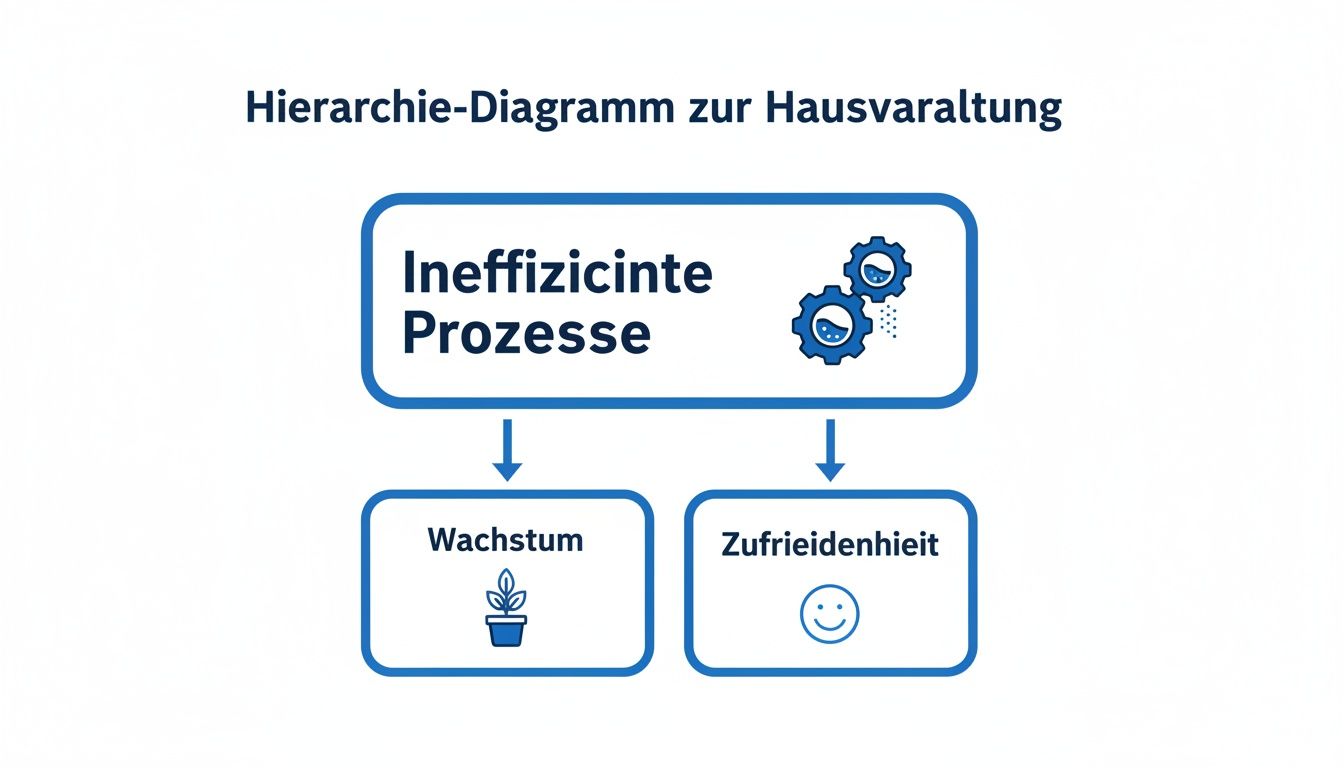
This image puts it in a nutshell: inefficient processes are like sand in the gears. They not only slow down growth, but also gnaw at the satisfaction of customers and employees. Only when these hurdles are gone can both unfold freely.
Tenant and owner communication: Calls, emails, messages from the portal – inquiries come in through all channels. If they are not bundled centrally, information is lost and processing is delayed. This is exactly where the biggest lever for better service and noticeable relief in the team lies.
Contract management: Tenancy agreements, service provider contracts, insurance policies – everything must be kept in view. A digital archive with automatic deadline monitoring is worth its weight in gold. This way, no cancellation deadline is missed and you save yourself expensive contract extensions.
Property handovers and handbacks: A process where seamless documentation is crucial to avoid later disputes about deposits and defects from the outset. Mobile apps, with which you can create protocols directly on site, attach photos and have them signed digitally, create clear conditions here and save a lot of paperwork.
Technical processes: Securing the value of the property
Technical management ensures that the property remains in good shape and its value is preserved. Optimised processes not only save real money here, but also increase safety and quality of life for everyone.
Damage management: From reporting to ordering through to invoice verification, many people are involved. Digital workflows that route a damage report directly to the appropriate tradesperson and keep everyone updated speed up the entire process enormously.
Maintenance planning: Instead of just reacting to damage, forward-looking planning makes it possible to actively secure the value of the property. A digital overview of the condition of all objects helps to tackle maintenance and renovations in good time and avoid expensive emergencies.
Offer and order management: Obtaining and comparing offers from tradespeople is often a sluggish process. Digital platforms can standardise and simplify this – from the inquiry to the final invoice approval.
Safety and risk assessment: Public safety duty is a central task that is often underestimated. To guarantee safety in the properties, you must know what a risk assessment is and how it is created. Digital checklists and automatic reminders help to carry out regular checks (e.g. on playgrounds or building services) in a verifiable manner.
The analysis of the 10 core processes makes clear where the biggest levers lie. A platform like DoNexus is built precisely for bundling these workflows instead of using a separate stand-alone solution for each process. It creates a central control centre that intelligently connects communication, tasks and documents with each other, thereby increasing efficiency throughout the entire company.
Practical examples that make the difference
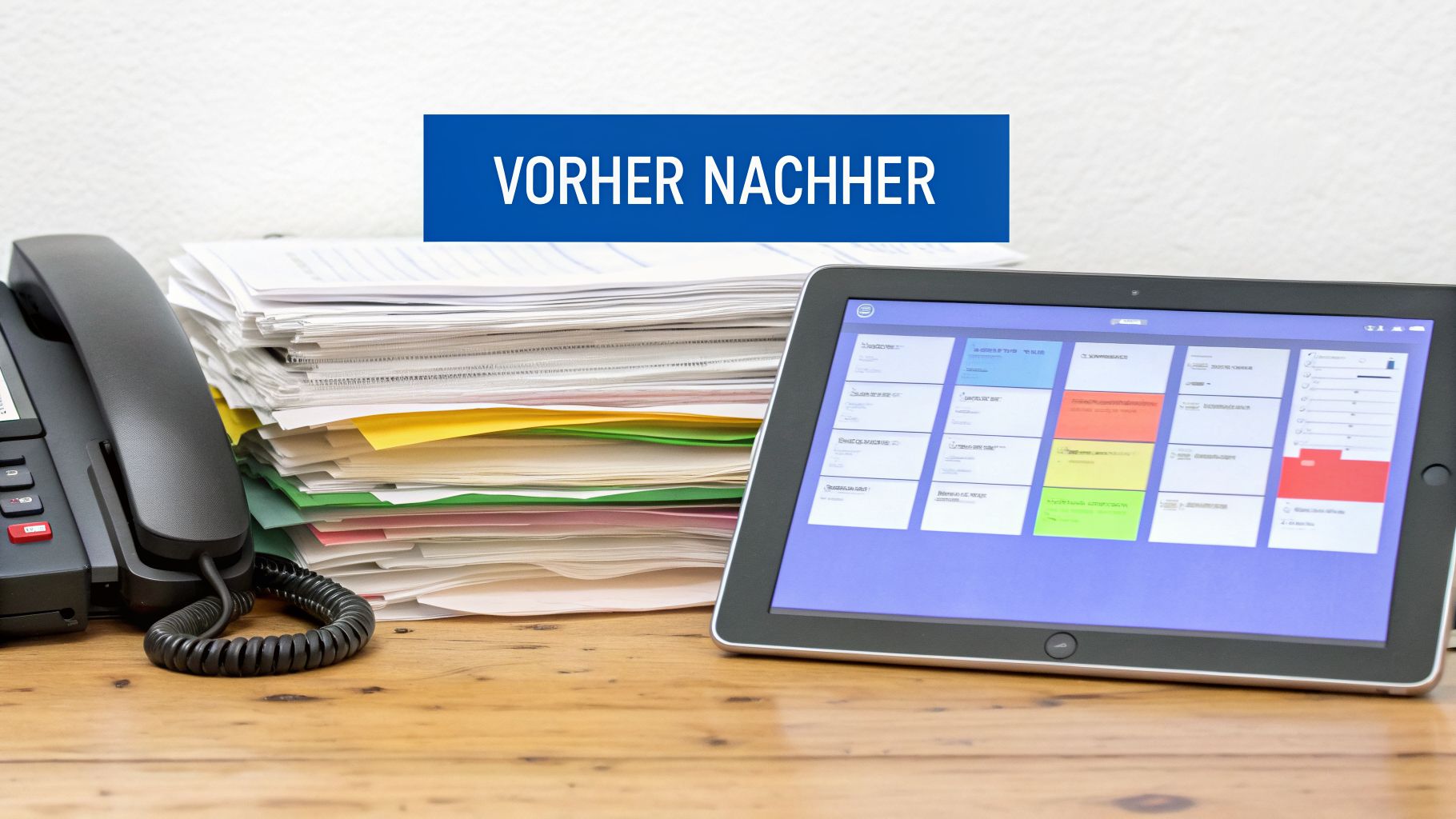
Theory is patient, but daily work does not forgive mistakes. The real value of optimised processes in property management does not show in strategy papers, but only when things get hectic.
That is exactly why we are now looking at two very classic cases: water damage and a property handover. These examples make the difference between the old, manual way and a clean, digital workflow tangible. They show how you not only save time and money, but also lift service quality and professionalism to a whole new level.
First the old way – characterised by paperwork and communication chaos. Then the modern, digital alternative.
Scenario 1: Resolving water damage
A classic that quickly escalates without clear processes. Here, tenant stress, tradesperson coordination and insurance questions clash – a perfect storm for any inefficient management.
The old way – chaos via telephone and email:
Reporting: A tenant calls in a panic. The property manager notes the details on a piece of paper and promises a call back. The information is now sitting isolated on a desk.
Finding a tradesperson: This is followed by a nerve-wracking round of phone calls with several plumbing companies. Reaching someone is a matter of luck, promised call backs fail to materialise.
Coordination: Appointments are painstakingly coordinated over the phone between the tenant and the tradesperson. If something changes, the game starts all over again. Nobody has a clear overview of the current status.
Documentation: The tradesperson sends photos via email, the invoice arrives days later by post. Everything must be manually assigned to the correct process and filed in the physical folder.
Information: A week later, the owner calls and asks for an update. The employee must first search through their notes and emails to be able to give a vague answer.
The result is a frustrating process for everyone. Delays occur, important information is lost and the manual effort is enormous. The average resolution time is often extended by several days.
The new way – a central, digital workflow:
Reporting: The tenant reports the damage via an online portal and uploads photos directly. The system automatically creates a ticket and assigns it to the correct property manager.
Ordering: Suitable tradespeople from the stored pool are suggested, including framework agreements and availabilities. With two clicks, the order is sent digitally.
Coordination: The tradesperson confirms the order in the system. Tenants, managers and tradespeople see the status and all appointments in real time in the portal.
Documentation: The tradesperson uploads their report and the invoice directly in the transaction. The documents are immediately available for accounting and seamlessly archived.
Information: The owner can view the entire progress at any time in the portal – from the first report to the completed repair. Absolute transparency.
Scenario 2: Coordinating a property handover
A legally sensitive moment. Seamless documentation is crucial here to avoid later disputes about deposits and defects from the outset.
The old way – protocol on paper:
Preparation: The manager prints out a blank protocol. Important data from the tenancy agreement are transferred by hand – a classic source of errors.
Execution: On site, defects are noted by hand. Photos are taken with a private mobile phone and must be painstakingly assigned later.
Follow-up: The signed protocol is scanned in the office, the photos are laboriously downloaded from the phone and everything is manually stored in different folders. The data is not searchable.
The new way – digital protocol via tablet:
Preparation: The app automatically pulls all relevant data from the system: tenants, rooms, known meter readings.
Execution: Defects are recorded directly on the tablet in a checklist and documented with photos that are immediately assigned to the correct item. Tenant and manager sign digitally on the display.
Follow-up: With one click, the completed, legally secure PDF protocol is sent to all parties involved and archived in the system in an audit-proof manner.
These examples make it clear: it is not about replacing people. It is about finally giving them the right tools so they can do their work well.
Especially with communication-intensive tasks like damage management, it becomes clear how much targeted digitalisation can reduce the daily flood of emails in property management.
A platform like DoNexus is precisely designed to make such scenarios the new normal. It bundles communication, automates the assignment of tasks and creates a central, reliable source of information for all processes. As a result, not only are processes in property management more efficient, but the entire collaboration becomes noticeably more professional and transparent.
Making success measurable with the right KPIs
Gut feeling is good, data is better. To really move the processes in your property management forward, you must also be able to prove the success of your measures. Without clear key performance indicators (KPIs), you are navigating blindly.
It is about making improvements visible. KPIs translate soft goals like "better service" or "greater efficiency" into hard, comparable numbers. Only in this way can you see which changes are actually making an impact and where you might need to make adjustments.
The most important KPIs for your property management
In the beginning, focus on a few but meaningful key figures. Choose the ones that you and your team can directly influence. They give an honest insight into how well your core processes are really running.
10 KPIs that every data-driven property management should keep an eye on:
Average resolution time for inquiries: How quickly is a transaction – from the tenant's first call to final completion – actually closed? A direct measurement for your service speed.
First-contact resolution rate: How many issues do your employees resolve directly in the first conversation or with the first email? A high rate is a strong signal of competent teams and well-established processes.
Cost per maintenance transaction: What does handling an average claim actually cost you when you add up internal working time and external tradesperson costs? Use this to evaluate efficiency in damage management.
Vacancy rate: What percentage of your space is currently vacant? One of the most important key figures for the financial health of your portfolio.
Tenant or owner satisfaction (NPS/CSAT): Ask actively, for example with a short survey after a completed transaction. The Net Promoter Score (NPS) or Customer Satisfaction Score (CSAT) are proven, simple methods here.
Punctuality of payments: What share of rents and house charges arrives on time? This tells you a lot about the effectiveness of your dunning system and payment morale.
Number of open transactions per employee: How many "balls" does an employee have in the air at the same time right now? This number helps to distribute the workload fairly and detect overload early.
Processing time of invoices: How long does an incoming invoice take from inbox to payment? Long times cost early payment discounts and annoy important service providers.
Inquiries per communication channel: Where does most come in – phone, email, portal? This analysis is crucial for putting the right resources in the right place.
Adherence to maintenance schedules: Are planned maintenance tasks, such as on heating or lifts, completed reliably and on time? A strong indicator of proactive action and compliance with your public safety duty.
Anyone who records this data systematically replaces assumptions with facts. You can objectively prove successes, pinpoint weak spots precisely and make smart decisions based on a solid foundation.
How to systematically record and use this data
Defining KPIs is the first step. The second, decisive step is to find a method to collect this data reliably and without huge effort. Otherwise, tracking itself becomes a time-waster.
This is exactly where modern management platforms come into play. They record many of these data points automatically in the background while your team simply goes about its daily work. Every email, every task, every document thus becomes a data point for meaningful reports. You can see at a glance where you stand.
A platform like DoNexus is designed to create exactly this transparency. Because all processes – from damage reporting to invoice approval – run centrally in the system, the KPIs are generated virtually on the side. You get dashboards that show you in real time how resolution times are developing or where tasks are piling up. In this way, you finally steer your management on the basis of knowledge instead of just gut feeling.
Your 5-step roadmap to process digitalisation
The digitalisation of processes in property management does not have to be an unmanageable mammoth project. Quite the opposite. A clear roadmap is the best way to not only get started, but also achieve measurable success. With a good structure, you keep control and ensure that your investment in new technology pays off in the end.
With the following five steps, we provide you with a tried-and-tested guide. It takes you from an honest inventory to final implementation and helps you avoid typical stumbling blocks. Think of this plan as a compass that navigates your management safely and efficiently into the digital future.
The path to successful digitalisation
This 5-step plan is a clear, actionable guide. It helps you approach your digitalisation project methodically, avoid pitfalls and take your team with you right from the start.
1. Analysis and prioritisation (Where do we really stand?)
The first step is always an honest inventory. Take a close look at your current processes in property management and find the biggest pain points. Where is most time lost? Which workflows repeatedly lead to errors or annoyed customers? Very important: involve your team. No one knows daily friction losses better. Then evaluate the processes found according to effort and benefit. This naturally creates a clear priority list.
Start with a process that represents a real pain point, but at the same time promises quick, visible success. Damage management is often the ideal candidate. The improvement is immediately felt by everyone and increases motivation in the team.
2. Define goals and check tools (What do we want to achieve?)
Based on your analysis, you now set clear, measurable goals. Do you want to reduce processing times for damage reports by 30%? Or demonstrably increase owner satisfaction? Once the goals are set, the search for the appropriate tool begins. Create a checklist of the most important requirements (e.g. central communication, mobile app for handovers, automatic task creation) and compare different providers.
3. Start a pilot project (Test in small scale)
Never introduce new software all at once across the entire company. That often goes wrong. Instead, start a manageable pilot project with a dedicated team and a clearly defined process – for example, digital processing of water damage for a specific property portfolio. This allows you to test the new workflow in a controlled environment, iron out teething troubles and collect valuable feedback without bringing the entire business to a standstill.
4. Train and involve the team (Accompanying the change)
The best software is useless if nobody uses it. Therefore, take time for good training. Explain not only the "how", but above all the "why". Show each employee concretely how the new solution makes their daily work easier: less searching, fewer queries, more time for the really important tasks. Appoint "key users" in the team to serve as the first point of contact for colleagues and pass on positive experiences.
5. Scale and optimise (Expanding success)
Was the pilot project successful? Perfect. Then roll out the solution step-by-step to other teams and processes. The experiences and success stories from the pilot phase are your best argument to convince even sceptical employees. Keep an eye on the KPIs you defined at the beginning to make success measurable. Do not view digitalisation as a one-off project, but as an ongoing process of improvement.
This structured approach takes the dread out of digitalisation and makes it a manageable task. Through step-by-step implementation and consistent involvement of the team, you ensure that the change is sustainable and supported by everyone.
A platform like DoNexus is ideal for such a step-by-step introduction. You can start with a single module, such as centralising communication, to achieve quick wins. Later, the platform can be easily extended to other processes in property management, such as task management or document processing, to unfold the full benefit for your entire organisation.
Intelligent process control with DoNexus
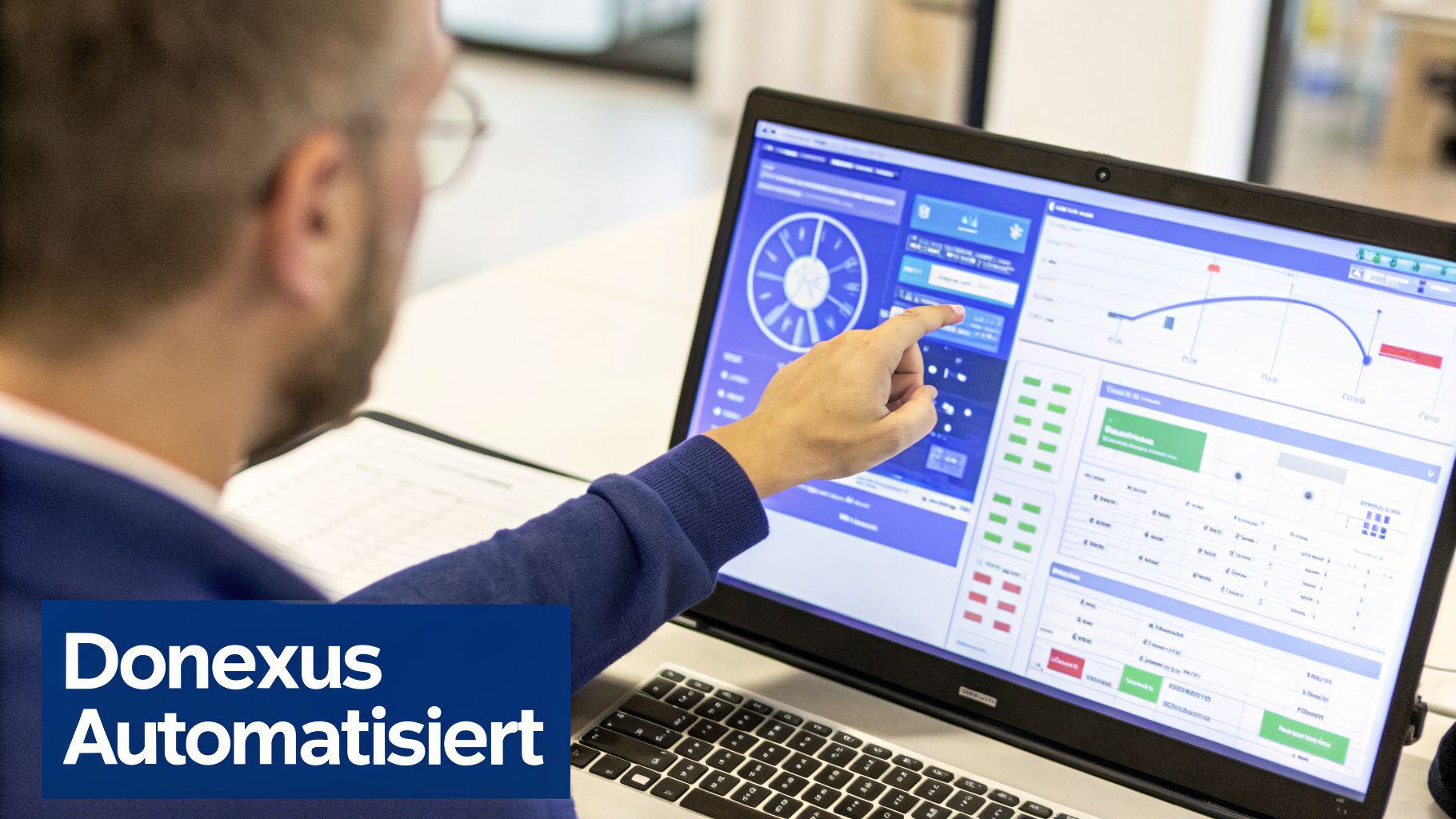
Once the strategy is set and the roadmap is clear, the decisive question follows: which tool brings theory into practice? A central platform is key to not only digitally mapping processes in property management, but directing them intelligently. This is exactly where DoNexus comes in.
The software transforms reactive management tasks into proactive, automated workflows. Instead of just managing problems, the platform gives you back control to manage them prospectively and efficiently.
You can think of DoNexus as the central nervous system of your administration. It channels all incoming inquiries, prioritises them using AI logic and automatically links them to the correct employees, documents and objects. The result? Your team finally has their heads free for value-adding tasks and first-class service, instead of wasting time searching for information.
How to concretely improve your processes with DoNexus
An intelligent platform like DoNexus directly impacts the KPIs we discussed. This finally makes the success of your digitalisation measurable. Here are concrete steps on how you can redesign key workflows:
Centralise communication: Put an end to channel chaos. Bring emails, phone calls and portal messages together in a single inbox. DoNexus's AI pre-sorts every inquiry and forwards it directly to the responsible employee. This noticeably shortens reaction times.
Automate damage management: Set up fixed workflows once. A damage report then automatically triggers the ordering of a tradesperson, notification of the owner and tracking of appointments.
Create transparency: Via a customer portal, you give tenants and owners insight into the status of their concerns at any time. This reduces typical queries by up to 40% and increases satisfaction.
Assign tasks intelligently: Leave fair and efficient work distribution to the system. Based on rules and availabilities, DoNexus decides which employee is best suited to take on a new task.
Monitor deadlines automatically: Never overlook an important deadline again. The platform keeps an eye on all current transactions and escalates automatically if a task is left pending for too long.
Find documents in context: No more endless searching in folder structures. The AI links contracts, protocols and invoices directly to the correct transaction, property or contact. Information is thus available in seconds, not minutes.
With DoNexus, you exchange reactive chaos for proactive control. You give your team not just a tool, but a system that thinks along and helps to get work done better and with less stress.
Introducing such a platform is the decisive step towards sustainably optimising processes in property management. You not only increase efficiency, but also lay the foundation for profitable growth and a service that delights your customers. Learn more about how to take your property management to the next level with AI.
The most frequently asked questions about process optimisation
Anyone starting to think about digitalisation in property management quickly runs into the same basic questions. The answers to these are often simpler than expected and help to overcome initial hurdles and win over your own team for the change.
Which process should we digitalise first?
Start where the shoe pinches most. In almost every administration, this is the area with the highest communication overhead: inquiry and damage management.
If you bundle all channels here – emails, calls, app messages – in a central system, you and your team will feel immediate relief. This quick win is the best motivation for all subsequent steps because the benefit arrives directly in everyday life.
How do I convince my team of new processes?
The key is to make the benefit tangible for each individual. It is not about technology, but about less stress: no more mindless typing, no searching for emails and finally more time for personal support.
Involve early: Let your team have a say in selecting the software and designing the new workflows. Those who help decide also support the change.
Demonstrate benefits: Show concretely how a digital workflow makes an annoying, recurring task simply disappear.
Start with a pilot project: Nothing convinces more than proof in practice. Test the new process in a small, manageable framework. Positive experiences are the best way to reduce concerns.
Is special software worth it for a small management company?
Yes, absolutely. Efficiency is a decisive competitive advantage, not a luxury, especially for smaller management companies with limited staff resources.
Modern, cloud-based software is scalable today and comes without expensive initial investments. The time you win through clean task management and automated communication can be invested directly in growth. This allows even small teams to manage more units professionally and profitably. The investment often pays off after a short time through less manual effort and noticeably better service.
A platform like DoNexus was developed to answer exactly these practical questions. It allows for an uncomplicated start by first centralising communication and then step-by-step automating other processes in property management. This way, you too can quickly benefit from the advantages. Find out more at https://www.donexus.ai.

Daniel Parak
Founder & CEO
Latest Posts
Discover more posts on our blog