AI-Academy
Find and successfully use the right property management software
Discover how the right property management software optimises your processes, improves communication and increases efficiency.
Modern property management software is the strategic nerve centre for increasing efficiency, reducing costs and satisfying clients. Instead of relying on isolated solutions that lock data in silos, managers need a well-thought-out IT strategy. The foundation is formed by specialised ERP systems for commercial processes and DMS solutions for legally compliant document archiving. However, the decisive step is to connect these systems with an intelligent, overarching platform that centralises communication, automates processes and links data intelligently to unlock the full potential of digitalisation.
Your path to digital property management: 10 decisive steps
Selecting and implementing the right software is a strategic decision. Take a structured approach to build a future-proof and efficient IT landscape.
Perform AS-IS analysis: Where do you lose the most time? Identify manual, repetitive tasks and communication bottlenecks.
Define digital strategy: Set clear goals. Do you want to reduce costs, increase customer satisfaction or grow faster?
Check foundation (ERP & DMS): Evaluate your existing commercial (ERP) and document management systems (DMS). Are they modern and open to interfaces?
Create specification sheet: Define the core requirements for all areas: accounting, document management, communication and process automation.
Look for open interfaces (APIs): This is the most critical point. Only open systems allow specialised solutions to be connected flexibly and avoid isolated systems.
Demand industry specialisation: Choose software developed explicitly for the German real estate industry that understands the logic of HOA and tenancy management.
Ensure scalability: The software must be able to grow with your company without performance or costs exploding.
Centralise communication: Plan a central hub that bundles all channels (email, portal, phone) and converts enquiries into structured tickets.
Use AI potential: Rely on an intelligent layer that automatically understands documents, extracts data and proactively initiates processes.
Focus on networking instead of replacement: Instead of replacing proven systems, connect them with an intelligent platform that merges and self-maintains data.
Building the foundation of your digital property management
Before talking about fancy communication tools or AI-powered analytics, the basics must be right. Every truly functioning digital property management stands on two indispensable pillars: an ERP system for commercial processes and a DMS for the legally compliant archiving of all documents. Without this foundation, all further digitisation steps are shaky and error-prone.
You can think of it like building a house: nobody would cover the roof before the foundation is poured and the walls are raised. It is exactly the same here.
The path from paper piles and Excel chaos to a modern cloud solution is a fundamental change. The following graphic illustrates this process very clearly.
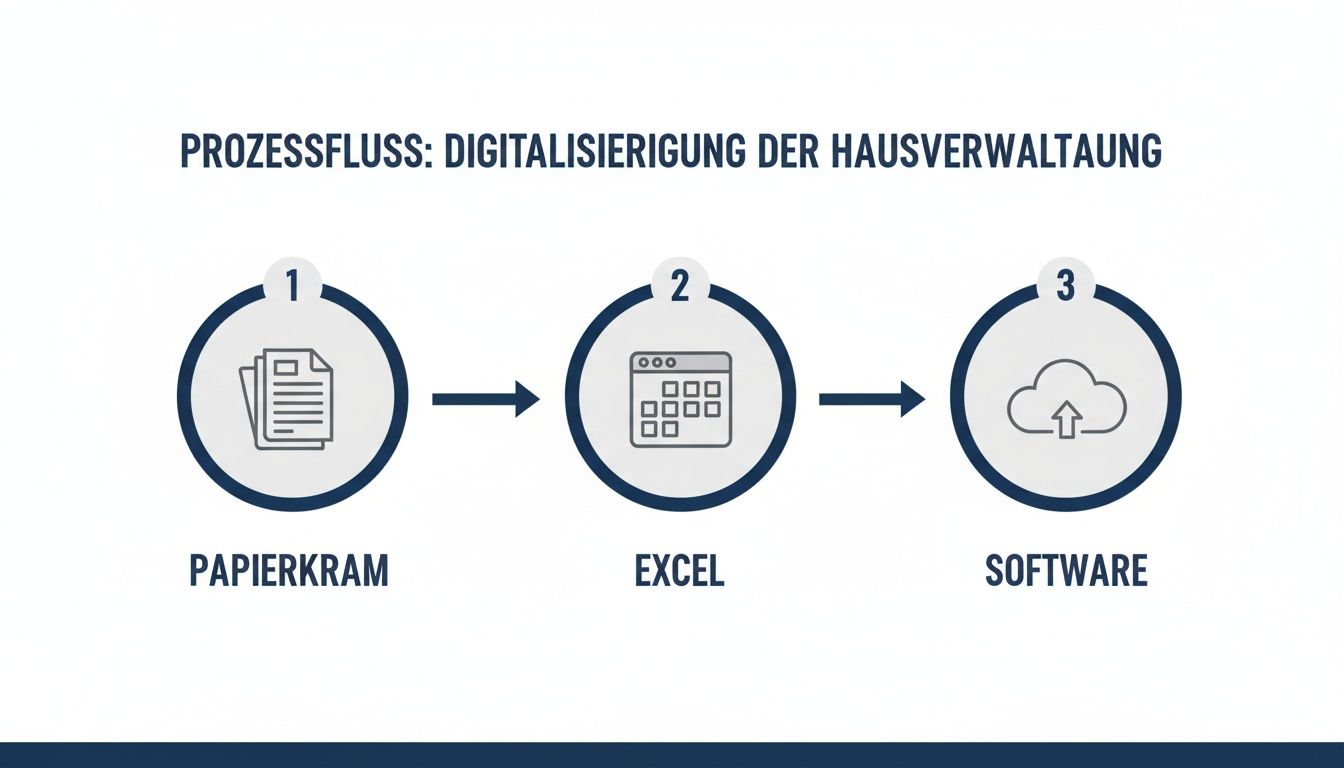
You can see immediately: this is not a small step, but a fundamental change in the way of working that requires a solid foundation.
The ERP system: Your commercial core
An ERP system (Enterprise Resource Planning) is the business backbone of your management. This is where all the threads come together: master data of properties, owners and tenants, the entire accounting, the HOA and service charge billing, and dunning.
Think of it as the single source of truth for all numbers. Without a strong ERP system, you are navigating blind. Manual errors in Excel lists or outdated contact details lead not only to unhappy clients, but quickly to serious legal problems too.
A property management company needs on average 75 days per 1,000 units just for invoice processing. A process cleanly mapped in the ERP system can reduce this effort to just nine days.
This shows how crucial a clean commercial system is as a foundation. A good ERP solution automates routine tasks like posting payments or creating budget plans. This frees up time that your team urgently needs for personal support and more complex cases.
The DMS: For legally compliant and structured documents
Just as important as the ERP is a DMS (Document Management System). While the ERP handles the numbers, the DMS takes care of everything written: contracts, resolutions, invoices, insurance policies and all correspondence.
But a DMS is much more than just a digital filing cabinet. It ensures audit-proof archiving. This means documents are stored unalterably and traceably – an absolute necessity to comply with statutory retention periods or to be on the safe side in legal disputes. Along the way, a clear structure makes finding information child's play and speeds up daily work enormously.
To set up this digital foundation cleanly, tasks and responsibilities must be clearly defined. A professional Property Management Specification Template can help standardise processes that are later to be mapped in the software.
The following table summarises the core requirements for both systems and helps you evaluate potential solutions.
Checklist of core requirements for ERP and DMS systems
Use this table to evaluate the essential functions of ERP and DMS solutions and make the right choice for your property management.
Functional Area | ERP System (Commercial Management) | DMS (Document Management) | Why it is crucial |
|---|---|---|---|
Data Management | Central master data (properties, units, people), accounting accounts | Structured filing (digital file), metadata, versioning | Ensures a single, reliable source of data and prevents redundancies. |
Core Processes | HOA billing, service charge billing, dunning, payment transactions | Audit-proof archiving, digital incoming mail processing | Automates the key commercial and administrative tasks. |
Legal Compliance | GoBD compliance, correct billing logic | Compliance with retention periods, immutability of documents | Ensures statutory guidelines are met and minimises liability risks. |
Access & Search | Evaluations, financial reports, owner lists | Full-text search, quick retrieval of documents via metadata | Allows quick access to critical information and speeds up the ability to provide info. |
Integration | Open interfaces (APIs) for banking, portals, other tools | Interfaces to ERP, email systems and portals | Is the prerequisite for a networked IT landscape and future extensions. |
A careful review of these points ensures you build a future-proof base upon which further digitisation steps can be established.
What you should really look out for during selection
Choosing the basic systems is a strategic decision that will accompany you for years. Here are the points that are most important from practice:
Scalability: Will the software grow with you? A solution that is great for 500 units might reach its limits at 5,000 units. Check whether performance and costs remain reasonable as you grow.
Open Interfaces: This is the most critical point of all. Ensure that the ERP and DMS have open interfaces (APIs). This is the only way you can connect special tools for communication, AI or other areas later. Closed systems are a dead end.
Industry Focus: Choose systems made for the real estate industry. They understand the logic of HOA and tenancy management natively and save you costly and tedious customisations.
Data Security: Where is your data located? Ideally in certified data centres in the EU. Clarify what measures are taken to protect sensitive owner and tenant data.
The perfect basic IT is not the one that can do everything, but the one that blends seamlessly into a larger system landscape.
Finally centralising communication and task management
A good ERP and DMS system is the technical backbone, no doubt. But the pulse of daily life in property management beats elsewhere: in communication. Countless emails, constant phone calls, sticky notes on the desk – this daily information chaos is not just inefficient. It frustrates your team and your clients. This is precisely where perhaps the biggest opportunity lies that suitable property management software can offer.
Imagine a normal damage report: a tenant reports water damage by email. What often follows is an confusing process. The email is forwarded, there are queries by phone, quotes from craftsmen arrive as separate messages. In the end, nobody has a clear overview of the current status anymore.
A central platform for communication and tasks breaks this cycle.
The report lands directly in a central system. It is automatically assigned to the correct property and processor and given a clear deadline. Problem solved.
The end of paper chaos
The core concept is simple but effective: every case – from a simple enquiry to complex damage claims – is treated as an independent "ticket". This ticket bundles all relevant information in a single place: the original report, the entire communication with owners and service providers, uploaded photos, estimates and all deadlines.
This approach brings decisive advantages:
Complete transparency: Everyone on the team can see at a glance the processing status of a case. The question "Who is taking care of this right now?" is a thing of the past.
Traceable history: Every action is logged. This creates legal certainty and helps to completely reconstruct the process in case of later queries.
Efficient task distribution: Enquiries are no longer forwarded manually. Instead, based on predefined rules, they land automatically with the responsible employee or team.
A central ticket system does not only drastically reduce email volume. It also ensures a measurable increase in service quality. Enquiries no longer get lost and are traceably processed faster and in a more structured way.
This structured approach is the basis for professional and scalable operations. It not only relieves your team but also noticeably increases the satisfaction of your clients, because their concerns are finally processed reliably and transparently.
What matters when choosing
Not every task management tool fits the special needs of a property management company. When evaluating suitable software, you should look out for a few key features. They make the difference between a simple to-do list and real process optimisation.
Consider the following points as indispensable criteria for your decision:
1. Central inbox (Omnichannel approach)
Communication happens everywhere today. A good software bundles all incoming messages – whether email, call, WhatsApp or a message from the portal – in a single, clear inbox. This guarantees nothing gets lost.
2. Automated assignment and ticketing
The system should be intelligent enough to analyse incoming enquiries. It must automatically assign them to the correct property, the responsible person and the matching process category (e.g. "damage report"). Manual sorting work is thus reduced to a minimum.
3. Integrated client portal
A modern portal is more than just a digital business card. It should allow owners and tenants to view the status of their enquiries independently at any time. This transparency significantly reduces phone and email queries and strengthens trust in your work. Read more about how thought-out customer communication in property management increases satisfaction.
4. Escalation management and deadline monitoring
What happens when a deadline is about to expire? The software must warn proactively and allow automatic escalations, for example by notifying the team leader. This ensures no important tasks are left undone.
From reactive to proactive management
A central platform for communication and tasks fundamentally changes your way of working. You move away from a reactive mode, where you are constantly responding to new emails and calls, towards a proactive, managed process.
This structuring is the key to efficiency. Instead of laboriously gathering information from various sources, your team has everything they need right at hand.
Using documents intelligently with AI support
Modern property management software today can do much more than just archive documents. While a classic document management system (DMS) ensures legally compliant storage, the true potential of your documents only unfolds with AI support. It transforms static files into dynamic sources of knowledge that are immediately available to your team.
The decisive difference lies in contextual understanding. Instead of just capturing metadata like file names or dates, an artificial intelligence analyses the content of your contracts, minutes and invoices. It understands connections, extracts the most important information and prepares it exactly when you need it in daily work.
What used to take hours of manual searching and analysis now takes only a few seconds. At the same time, the risk of missing critical details decreases.
What an intelligent document AI really has to deliver
For your document management to become not just digital, but truly intelligent, it needs specific capabilities tailored precisely to the real estate industry. Simply view the following points as a checklist when evaluating such a function:
1. Automated content recognition and extraction
The software must recognize document types on its own – whether it is a tenancy agreement, a declaration of division or an insurance policy. In the next step, it then automatically reads relevant data points:
Tenancy agreements: Who are the contracting parties? When does the tenancy begin? What notice periods or indexation clauses apply?
Resolutions: Who made which resolution when and what deadlines are tied to it?
Invoices: Who is the invoice from, what is the amount, when is it due and which cost centre does it belong to?
2. Contextual linking with processes
The extracted data is only useful if it is in the right place at the right time. A good AI solution must link information directly with the matching properties, people and ongoing cases.
A practical example: A scanned craftsman's invoice is not just archived. It is automatically assigned to the correct damage case ticket and immediately triggers the next step in the approval process.
3. Proactive reminders and task control
The true strength of an AI is shown when the system thinks ahead for you. It should act independently based on document contents.
A practical example: The AI detects a cancellation period in an insurance contract and creates a task on its own for the responsible manager. This makes timely review a matter of course.
From static archive to active knowledge store
Just think back to preparing the last owners' assembly. How long does it normally take to find all relevant resolutions of the last five years on a specific topic? With an AI search, you simply ask a question like: "Show me all resolutions on facade renovation for property XY." Within seconds, you have a precise list.
This technology turns your DMS into more than just a passive data store – it becomes the active, intelligent brain of your management. The benefits are obvious:
Enormous time savings: Searching for information is radically faster.
Risk minimisation: Important deadlines and contract clauses no longer slip through.
Better service: You are immediately able to provide information to owners and tenants.
This is no longer future music, but a central building block of modern property management software. How deep such an integration can go today becomes clear when looking at how to make optimal use of documents with DoNexus AI.
Connecting your systems with a central intelligence
You have built a functioning system for your commercial processes over years? Alongside this, a solid document storage exists? Perfect, because that is an excellent starting point. Many property management companies mistakenly believe they have to turn their entire, proven IT landscape upside down for digitalisation. But that is not only an enormously complex project, it is usually not necessary at all.
The much cleverer way: keep what works and simply make it smarter. Instead of replacing everything, extend your existing systems with an overarching, connecting intelligence layer.
How an overarching intelligence works
Imagine software that does not compete with your infrastructure, but upgrades it in a targeted way. This layer works like a central hub that brings the threads together. It accesses data from your ERP system (such as accounting data) and your DMS (such as contracts or minutes), understands them and sets them in the right context.
The best AI is useless if the work processes are not aligned with it. Successful automation relies on a clean system landscape and connects it intelligently instead of replacing it.
So instead of continuing to work in isolated data silos, you create a networked ecosystem. Every piece of information is captured only once and is then available across systems exactly where it is needed.
10 points that a connecting intelligence should deliver
Such a central platform must be able to do more than just push data from A to B. To unleash the full potential of your existing property management software, look out for these capabilities:
Seamless connection: The platform must connect smoothly via open interfaces (APIs) with your established ERP and DMS solutions.
Automatic understanding: If someone uploads a document, the system must analyse the content immediately – completely without human intervention.
Intelligent linking: The AI extracts information like an invoice number or a cancellation period and automatically assigns it to the correct case, property or person.
Process control: The system must be able to independently trigger processes from the obtained information. A good example: a change of owner in the ERP automatically triggers the distribution of information to all relevant places.
Self-directed learning: The platform should learn with every interaction. Every manual correction or new case trains the AI and makes it increasingly precise over time.
Centralisation of communication: All channels – email, phone, portal – converge in this central hub. There, they are directly enriched with matching data from ERP and DMS.
Contextual processing: Information is not just displayed, but intelligently prepared. Upon a call, an employee immediately sees the entire history of the caller, including open cases and recent documents.
Self-maintaining data: Through continuous synchronisation, your data remains up-to-date and consistent across all systems. Manual data maintenance becomes practically redundant.
Reduction of manual tasks: The core goal is to drastically reduce repetitive activities like data entry, sorting emails or searching for documents.
Creating free space: By the software taking over the administrative legwork, your team wins back valuable time – time for complex problems and personal customer care.
Frequently asked questions about property management software
Choosing new property management software is a big deal. Logically, many questions arise, after all, you are setting a strategic course for the future. We have collected the most common questions we encounter again and some in practice to give you some more clarity on the way.
What kind of software does property management actually need?
The digital foundation of any professional property management rests on two pillars. Firstly, there is the ERP system (Enterprise Resource Planning) – virtually the commercial core. This is where accounting, the preparation of billings and master data maintenance for properties and people come together. It is the single, reliable source for everything related to numbers.
Equally indispensable is a DMS (Document Management System). This system takes care of the legally compliant and orderly archiving of all important documents – from contracts to resolutions and invoices. It ensures that legal deadlines are met and that any document can be found immediately when needed.
The real power only unfolds, however, when an intelligent layer connects these two basic systems. A layer that understands the context of the data and simply automates processes across system boundaries.
What should I look out for particularly when selecting software?
When choosing new software, it is about much more than just a long list of features. From practice, three points have emerged as absolutely crucial:
Open Interfaces (APIs): This is by far the most important point. Your software must be able to talk to other systems. Closed "all-in-one" solutions might feel easy at first, but quickly lead to a technological dead end. That way you cannot react flexibly to new requirements.
Industry Specialisation: Go for software that was clearly built for the real estate industry. It understands the complex requirements of HOA and tenancy management natively and saves you costly and nerve-wracking customisations.
Scalability: Your management will grow – and your software must handle that without grumbling. Neither performance must drop nor costs explode. Ask specifically how the solution behaves when your managed units double or triple.
Do I have to completely replace my existing systems?
No, absolutely not – and this is a very crucial point. Replacing the entire IT landscape all at once is a mammoth project with enormous costs and risks. A much cleverer approach is to keep your proven ERP and DMS systems and extend them with an intelligent, overarching platform.
This connecting layer simply docks onto your existing infrastructure and makes it smarter. It centralises communication, automates workflows and ensures data flows seamlessly between systems. This way you get the best of modern technology without having to throw your functioning core processes overboard.
This path not only protects the budget. It also allows for a much faster implementation and ensures much more acceptance in the team because employees can continue working in their familiar core environment.
DoNexus connects seamlessly with your existing ERP and DMS systems and acts as the intelligent layer that brings everything together. The platform virtually maintains itself: A new document is uploaded? DoNexus recognises the content, learns from it and automatically assigns it to the correct case. A change of owner is pending? The process is simply initiated via DoNexus and synchronised with all connected systems, without manual double entry. Discover at https://www.donexus.ai how you can make your existing software smarter and create free space for your team for what matters most.

Zeno Woywood
Founder & CTO
Latest Posts
Discover more posts on our blog