AI-Academy
Software for property management that really relieves the burden
Discover how modern property management software can streamline your processes...
Modern, AI-powered property management software is not a luxury, but a crucial step to meet growing customer expectations, exploding administrative effort and the tight housing market. This guide shows how digital tools transform reactive processes into proactive, efficient workflows, thus relieving teams, increasing service quality and securing the future viability of property administrations.
10 steps to the right software for your property management
Choosing the right software is a strategic decision. Instead of getting lost in feature lists, follow this practical plan to find a solution that genuinely eases your daily work and supports your business goals.
Analyse the current state: Identify the true bottlenecks. Where do your employees lose the most time? Talk to your team to uncover the biggest pain points.
Define clear goals: Formulate measurable goals, e.g. "reduce processing time for repair requests by 40%", instead of vague wishes like "better communication".
Prioritise core functions: Focus on the tools that have the greatest leverage: a central inbox for all channels, intelligent task management and seamless ERP integration.
Narrow down the supplier list: Create a shortlist of just 2-3 providers who meet your core requirements. Quality over quantity.
Request personalised demos: Do not just look at glossy presentations. Run through your own real-life use cases and demand concrete solution approaches for your problems.
Check integrations: Clarify bindingly whether the software integrates seamlessly with your existing ERP and accounting system. An isolated system only creates new problems.
Calculate ROI: Translate the benefits into concrete numbers. How much time and money do you save through less manual work, faster processes and lower error rates?
Evaluate the onboarding process: Look for a provider that guarantees fast data import and structured training. A modern solution should be ready for use in days, not months.
Ensure team acceptance: Communicate the added value internally. Show your team how the new system reduces daily stress and frees up space for more important tasks.
Pay attention to scalability: Choose a platform that can grow with your business without immediately causing new cost explosions.
A platform like DoNexus was developed precisely to transfer these reactive processes into structured, proactive workflows. It bundles communication, tasks and documents intelligently in one place, enabling future-proof and scalable administration.
How digital tools are truly changing property management
Does this sound familiar? The email inbox is overflowing and important inquiries get lost. The phone rings continuously. And somewhere between paper notes and Excel spreadsheets, you lose track of which tasks are actually open. Many teams spend the day fighting fires instead of acting with foresight. This reactive mode is not only terribly inefficient – it also causes frustration for everyone involved: employees, tenants and owners.
At the same time, external pressure is growing. The German housing market suffers from a structural shortage. Forecasts suggest that the number of completed apartments could fall to just around 175,000 units by 2026, while the demand is over 300,000. The German Property Federation (ZIA) even expects a new construction gap of 830,000 apartments by 2027. For administrations, this means in very concrete terms: existing properties must be managed even better with fewer resources. You can find more on the current dynamics of the real estate market in this analysis on intelligent-investors.de.
Choosing the right software for your administration
Choosing the right software for your property management is a strategic decision. It is not just an IT acquisition, but a strategic direction that will shape the success of your administration for years to come.
Instead of getting lost in endless feature lists, a different approach is far more decisive: Which tool solves your team's real problems? It is about finding a solution that not only looks good on paper, but noticeably eases your daily work and truly supports your business goals.
The key lies in first honestly analysing your own workflows. Where do your employees lose the most time? Which repetitive tasks regularly cause frustration? Often, it is disjointed communication across dozens of channels or the tedious search for the right document that paralyses the working day. This is precisely where you need to start.
Your roadmap to the right software decision
In order not to lose track of the abundance of providers, you should approach the process structurally. With these steps, you ensure that you make an informed decision that ultimately pays off.
1. Analyse the current state and define clear goals Before you look at even a single demo, you must know your own weak spots.
Identify the bottlenecks: Where do things really get stuck in daily life? Is it manual data entry, the time-consuming allocation of emails or the laborious coordination of tradespeople? Talk to your team – they know the pain points best.
Define measurable goals: Formulate concrete, quantifiable goals. Instead of a vague wish like "better communication", set a clear target: "We want to reduce the average processing time for repair requests by 40%." Such goals make success measurable in the end.
2. Prioritise core functions instead of wanting everything Not every function is equally important. Focus on the tools that have the greatest impact on your previously defined goals.
A central communication platform: A unified inbox that bundles emails, phone calls and portal messages is often the most important lever to eliminate daily chaos.
Intelligent task management: Can the software automatically create tasks from emails, assign them to the right people and monitor deadlines? That is a real game-changer.
Seamless integrations: Be sure to clarify whether the software connects easily with your existing ERP and accounting system. An isolated system that does not talk to your other tools only creates new problems and more manual work.
The best property management software is not the one with the most features, but the one that offers the right features for your specific challenges. It is about solving your problems, not ticking off a checklist.
3. Evaluate providers in a targeted and systematic way Create a short list of just 2–3 providers that truly meet your core requirements. Then request personalised demos in which you can run through your own, real-life use cases.
Do not be impressed by generic glossy presentations. Ask specifically how the software addresses your biggest pain points. Demand concrete solution approaches. For example, a powerful document AI that independently analyses contracts, resolutions and minutes and provides information at the touch of a button is a decisive efficiency booster for many administrations. Learn more about how AI for documents in property management can speed up your processes.
In the end, the result is what matters
The comparison of software solutions should always be made with the result in mind. How does the platform help you achieve your goals and make work easier for your team? The selection process is also a great opportunity to critically question and sustainably improve your own ways of working.
A platform like DoNexus was developed for exactly this reason – to tackle the key challenges of property management at their root with intelligent, networked features. Instead of just treating symptoms, DoNexus transforms reactive, chaotic processes into structured and proactive workflows that noticeably ease the work for your entire team.
The core functions of modern management software
Modern property management software has long been more than a digital filing cabinet. It is the operational heart of a well-run business. Instead of struggling with countless isolated solutions that do not talk to each other, these platforms offer a single point of contact for all key workflows.
What exactly makes up such software? At its core, there are five crucial areas that interlock to bring order to daily chaos. Each of these functions solves a problem that most administration teams are only too familiar with.
1. The central inbox as the nervous system of your communication
We all know the scenario: inquiries arrive via countless channels. Emails land in personal inboxes, phone calls are scribbled on post-it notes, and messages from the customer portal go to a general address. This is how important information gets lost, holiday coverage becomes a nightmare, and no one has a real overview.
A central inbox is the solution. Think of it as the brain or nervous system of all communication. It bundles all channels into a single place that can be viewed by the whole team.
No lost inquiries: Every email, phone call and portal message is cleanly captured and can be tracked at any time.
Transparent processing: Everyone in the team can see immediately who is working on an inquiry and what the current status is.
Efficient collaboration: Instead of awkward email chains, inquiries can simply be assigned to a colleague or forwarded for comment.
This centralisation is the first and most important step to get a grip on the daily flood of information again. It is the foundation for everything that follows.
The following diagram shows what a good selection process looks like. You quickly see: defining such core functions comes right at the beginning.
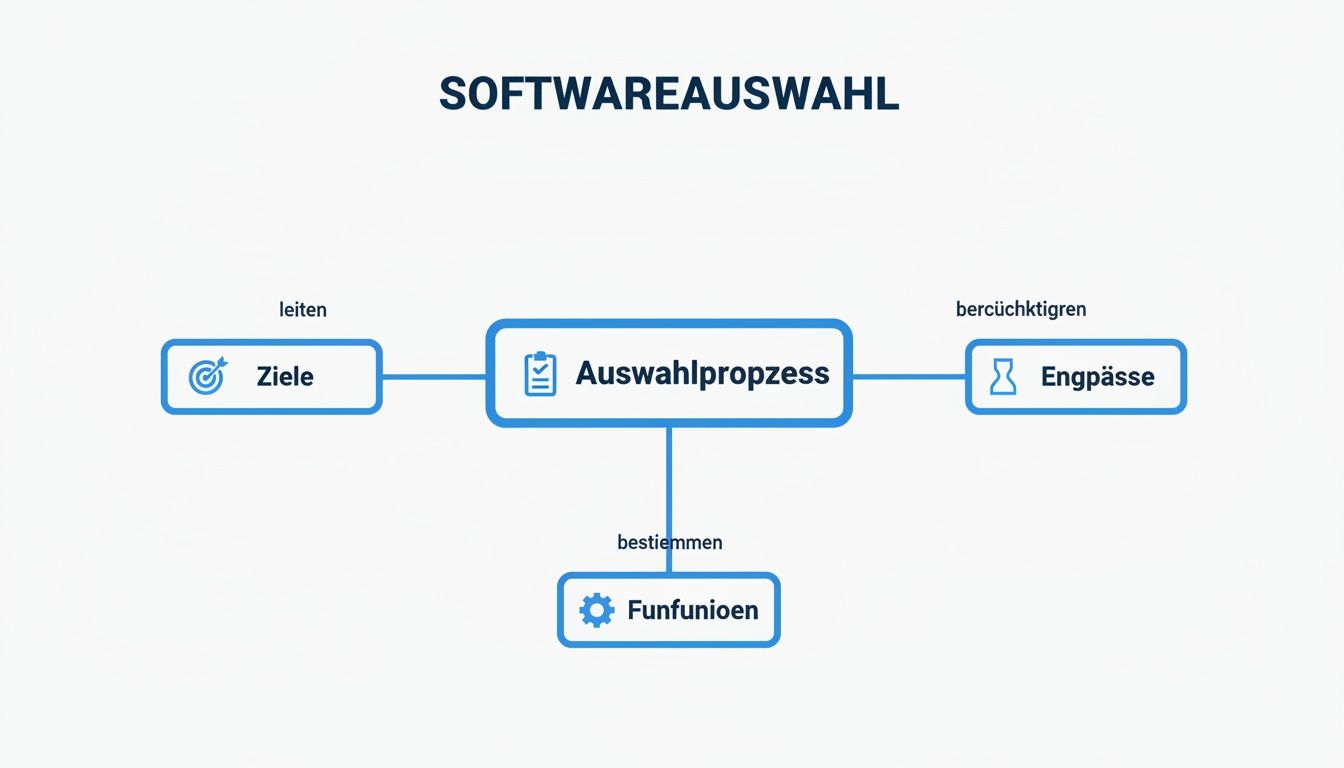
The graphic makes it clear: you can only find the right software if you first analyse your own goals and bottlenecks. Only then do you move on to evaluating the features.
2. Intelligent task management for proactive control
Once an inquiry is in the system, the actual work begins. This is where intelligent task management comes into play, acting like a digital project manager. It does not just ensure that tasks are assigned; it proactively monitors deadlines, reminds of open cases and alerts when something is left unattended for too long.
Instead of relying on manual follow-ups or Excel lists, the software creates an automated and seamless process. The system automatically converts a damage report into a task, assigns it to the responsible technician and sets a deadline. If the deadline is missed, the team leader receives a notification.
Intelligent task management transforms reactive processing into proactive steering. It ensures that nothing is forgotten and that you maintain control at all times.
3. Document AI as your personal archivist
Searching for information in contracts, minutes or invoices is a massive time-waster. A document AI is like a personal archivist with superpowers. It does not just store documents, it also reads and understands their content.
Do you need the notice period from a lease agreement or the agreed allocation key from the last property owners' association minutes? The AI finds this information in seconds. You no longer have to sift through piles of documents; you simply ask a question. Learn more about the possibilities of such AI automation in our detailed product overview.
4. Customer portals as a 24/7 service desk
A modern customer portal is much more than just a digital business card. It is a service desk that is open around the clock, offering tenants and owners transparency at any time. They can view the status of their inquiries, download important documents such as the annual statement or report damage directly online. This noticeably relieves your team of routine phone calls and emails.
5. Seamless integrations for a smooth data flow
The best property management software is useless if it stands alone. Seamless integrations are the crucial link that unites your entire IT landscape. They ensure a smooth flow of data between the management platform, your ERP system and the accounting software. This means: no more duplicate data entry and always consistent master data across all systems.
This networked approach is crucial, especially in the fragmented German market. In 2022, there were around 25,159 taxable companies in Germany managing real estate for third parties. For this enormous number of administrations, uniform processes are a direct path to greater efficiency. You can read more about the structure of the German property management market on de.statista.com.
This is precisely where a platform like DoNexus comes in. It combines these core functions into a well-thought-out solution to noticeably relieve administration teams and make their processes future-proof.
Absolutely. Here is the revised section that matches the style, tone and human writing requirements of the provided examples.
For whom is the software truly worthwhile?
Good property management software is more than just a digital tool – it is an engine that drives the entire company. However, the benefits manifest differently for each role. While the operational team feels immediate relief in their daily work, managing directors and asset managers primarily see the strategic advantages that secure long-term success.
The crucial point is: a powerful solution does not just solve individual problems. It creates an ecosystem in which everyone collaborates better. The efficiency of an employee directly impacts customer satisfaction, which in turn strengthens the profitability and growth of the entire company. Let us look at what this means in practice for the various roles.
The benefit for managing directors
For the management, the big picture matters. It is about growth, profitability and the future viability of the business. A modern software platform is the key to achieving these strategic goals in the first place.
Scalability without cost explosion: Due to efficiency gains, more units can be managed without having to immediately hire new staff. Automated workflows lay the foundation for sustainable growth.
Higher profitability: Less manual work means lower operating costs. At the same time, faster responses and better service lead to higher customer retention – which directly translates into revenue.
Data-driven decisions: Instead of relying on gut feeling, central dashboards and reports provide clear insights into performance. You can see at a glance where processes stall and how busy your team really is.
Risk minimisation: Seamless documentation of all cases and secure compliance with deadlines significantly reduce legal and financial risks.
The advantages for asset managers
Asset managers are responsible for the strategic development of the real estate portfolio. Their decisions depend on precise data and reliable analyses. An integrated software solution provides exactly this solid foundation.
Through centralised data and intelligent evaluations, they gain a clear overview of the performance of each individual property. Instead of painstakingly gathering information from different systems, all relevant key figures are available to them at the touch of a button. This enables a faster and more precise assessment of investment opportunities and risks.
For asset managers, good software turns data into knowledge. They identify trends earlier, maximise portfolio performance and make informed decisions for the future.
The relief for the operational team
The operational team – the administrators and property managers who keep daily business running – benefits most directly. Here, the relief is felt immediately because the software takes over the most frustrating and time-consuming tasks.
Practical example: processing a rent reduction Imagine a typical case: a tenant reports mould and announces a rent reduction.
Without software: The email gets lost in the inbox. Days later it is found, a task is manually created, the lease is searched for, tradespeople are contacted by phone and emails are sent back and forth. The whole process is chaotic, error-prone and takes weeks.
With software: The tenant's email is automatically captured as a task and assigned to the right administrator. The AI links the task directly with the lease and the correct property. The administrator commissions a tradesperson with two clicks via the system, and the tenant can check the status at any time in the customer portal. The processing time is cut in half.
This daily relief leads to less stress, higher motivation and finally frees up time again for what matters: personal care for owners and tenants. A well-designed customer portal, in particular, helps to further simplify communication. Find out here how a modern customer portal can increase satisfaction and relieve your team.
A platform like DoNexus was developed to create precisely these synergies. It provides each role with the appropriate tools to work more efficiently, strategically and ultimately more successfully.
How to measure the ROI of your new software in practice
An investment in modern property management software is not just a cost item – it is a strategic lever. But how do you actually measure the value of this lever? The return on investment (ROI) becomes tangible when you stop just talking about theoretical benefits and start translating them into concrete numbers. It is about clearly quantifying time saved, avoided costs and increased revenue.
In practice, it quickly becomes clear where the greatest potential lies. Whether it is the automated processing of a deposit release or the fast coordination of complex water damage – modern systems turn time-consuming, manual procedures into lean and trackable workflows. This is precisely where the gain for your company becomes visible. And plannable.
How to calculate the value of your new software
To determine the ROI, compare the gains against the costs. The costs are usually clear: licence fees, perhaps a one-off setup fee. The actual key, however, lies in calculating the gain accurately. And that is made up of very different, direct and indirect benefits.
Let us look at four factors that determine the gain:
Time savings on administrative tasks: Ask yourself: where are the biggest time-wasters in the team? How many hours per week are spent on manually sorting emails, searching for documents or typing data into Excel sheets? Multiply these hours by your employees' average hourly rate, and you already have a first tangible cost saving.
Fewer errors, lower costs: Manual processes are error-prone. A incorrectly processed invoice, an overlooked deadline – this can quickly become expensive. Estimate what costs arise each year from such errors. Good software reduces this rate by up to 90%.
Faster processes, less vacancy: How quickly do you react to a damage report? How quickly do you handle a tenant changeover? Faster workflows mean less loss of rent and more satisfied owners. If you shorten the vacancy period by just a few days through rapid re-letting, the gain across the entire portfolio quickly adds up.
Happier customers who stay: Satisfied owners remain customers longer and recommend you to others. Although this factor is harder to grasp in terms of cash, it has an enormous impact on long-term company value.
The true ROI is often not just in pure time savings. It lies in the ability to provide better service with the same resources, thereby sustainably increasing growth and profit.
A simple formula for your ROI
A simple formula to calculate the potential ROI looks like this:
(Annual Savings + Additional Revenue) - Annual Software Costs _________________________________________________________________ x 100 = ROI in % Annual Software Costs
Also include external factors. Rent development in Germany shows a clear upward trend for 2025 and beyond. With rent increases of around 4.5% compared to the previous year, which in some cases are twice as strong as inflation, communication efforts are also growing significantly. Tenants have more questions about adjustments and service charges. Here, an intelligent platform that automatically pre-sorts and answers such inquiries is an invaluable advantage. You can find further insights on the rental market forecasts in this analysis on YouTube.
A platform like DoNexus was developed precisely to deliver measurable added value in all these areas. By automating routine tasks and speeding up processes, the ROI is felt not in years, but often after just a few months. This quickly turns the investment into a gain for your entire business.
How to shape the future of your property management with DoNexus
The decisive change for any property management firm lies in the transition from pure reaction to proactive action. It is no longer just about waiting for inquiries. Rather, processes must be designed so that problems do not escalate in the first place. This requires a rethink – away from isolated tools and disjointed inboxes, towards a networked, intelligent platform. This is precisely the key to growing your business while improving service quality.
The switch to such a system is not just an IT project, but a strategic decision that affects the entire company. It gives teams the right tools, increases efficiency and delivers measurable added value that directly impacts economic viability. The transition is not a leap into cold water, but a planned, structured process that makes your company future-proof.
Your path into a proactive future
The transition to a modern way of working succeeds best with a clear roadmap. These steps help you to master the change successfully and take your team with you from the very beginning.
1. Assess your current pain points: Honestly analyse where the biggest bottlenecks lie. Is it overloaded email inboxes, a lack of transparency in ongoing tasks or the tedious search for documents?
2. Define clear goals: Set measurable goals, such as reducing response time by 50% or automating 80% of recurring inquiries. This makes success tangible.
3. Choose a platform, not just software: Look for a solution that combines communication, tasks and documents in one place. A central platform that thinks along is crucial.
4. Plan a fast onboarding: Modern systems should be ready for use within a few days. Look for a provider that guarantees fast data import and structured training.
5. Communicate the value internally: Show your team how the new system eases daily work. Acceptance increases when the personal benefit becomes clear – less stress, more focus.
Taking the step towards proactive administration is the most important decision you can make for the future viability of your business. It is the basis for growth, efficiency and satisfied customers.
Shape your future with DoNexus
A platform like DoNexus was developed precisely to make this transition possible. We do not just offer property management software, but a strategic solution that empowers your teams and solves key challenges from the ground up.
The combination of a central inbox for all channels, AI-powered task and document management, and seamless integrations creates measurable value – in days, not months.
Are you ready to take the first step towards a more modern, scalable and profitable future for your property management? Request a personalised demo of DoNexus and discover how we can transform your reactive processes into proactive, efficient workflows.
Absolutely! Here is the revised version of the section, matching the style, tone and voice of the sample blog posts.
The three most important questions about property management software
When selecting and introducing new software for property management, the same questions pop up again and again. Here we provide practical answers to help you make the right decisions for your business and clear up typical concerns.
How do I know that my administration needs new software?
The signs are usually hard to miss: the email inbox is overflowing, no one has a real overview of open tasks, and deadlines are missed again and again. A very clear warning signal is also when dissatisfaction grows among tenants or owners because responses simply take too long.
If your team spends the day only fighting fires and chasing administrative tasks instead of shaping things proactively, it is high time for an upgrade. The change is then no longer an option, but a necessity.
How quickly can a modern platform be implemented?
Unlike traditional IT projects, which often drag on for months, a modern SaaS solution is usually ready for use within a few days. The key to this is a well-structured onboarding process.
This ensures that your existing data is imported and ready to use quickly and securely. This way, your team feels the added value immediately and can continue working productively without long interruptions.
Is AI-powered software also worthwhile for smaller administrations?
Absolutely. Modern, cloud-based platforms are deliberately built to be scalable. This makes advanced technology accessible and, above all, affordable even for smaller teams. You do not have to make a huge initial investment.
Such systems help to achieve more with fewer staff, significantly increase service quality and thus successfully compete with larger companies. They create efficiency gains that were previously reserved only for major corporations.
As you can see, the path to a more efficient administration is closer than you often think. DoNexus offers exactly such fast, scalable and intelligent solutions. See for yourself how you can optimize your processes. Request your personalised demo at donexus.ai.

Daniel Parak
Founder & CEO
Latest Posts
Discover more posts on our blog