AI-Academy
Start a property management company: your practical guide to success
Do you want to start a property management company? Our guide shows you practical steps, business models and digital tools for a successful start.
Do you want to start a property management company? An excellent idea. The demand for professional managers is huge and will remain so. However, the path to self-employment requires more than industry knowledge: a clear roadmap from the business idea through the legal hurdles to digital tools is crucial. This guide will lead you through all the important stages, show you how to avoid typical mistakes, and set your business on a growth course from the very beginning.
10 steps to starting your property management company
Sharpen the business idea: Decide clearly between WEG (homeowners' association) and rental property management. Define your target group and your range of services.
Choose a legal form: Weigh the pros and cons of a sole proprietorship, UG, and GmbH (liability, starting capital, administrative effort).
Create a business plan: Calculate starting capital, ongoing costs, and create a realistic turnover plan.
Secure financing: Clarify how you will cover the starting costs and bridge the initial period without income.
Apply for a trade licence (§ 34c GewO): Gather all necessary documents (certificate of good conduct, Schufa credit report, etc.) and submit the application to the regulatory office.
Register the business: Register your company with the responsible trade office after receiving the licence.
Take out insurance: It is mandatory to take out professional indemnity insurance and, ideally, public liability insurance.
Build your tech stack: Choose modern property management software, a document management system, and a customer portal.
Define processes: Establish standardised procedures for core tasks such as property onboarding, meetings, and damage reports.
Win your first customers: Use your network, build a professional website, and establish contacts with estate agents and tradespeople.
The most important steps to starting your property management company
Anyone who wants to start a property management company needs more than just a good idea. Success stands and falls with a solid legal and strategic foundation. It is about setting the right course from the very beginning – regarding the legal form, permits, and insurance protection.
This roadmap will guide you through the crucial stages and help you to directly avoid typical start-up mistakes.
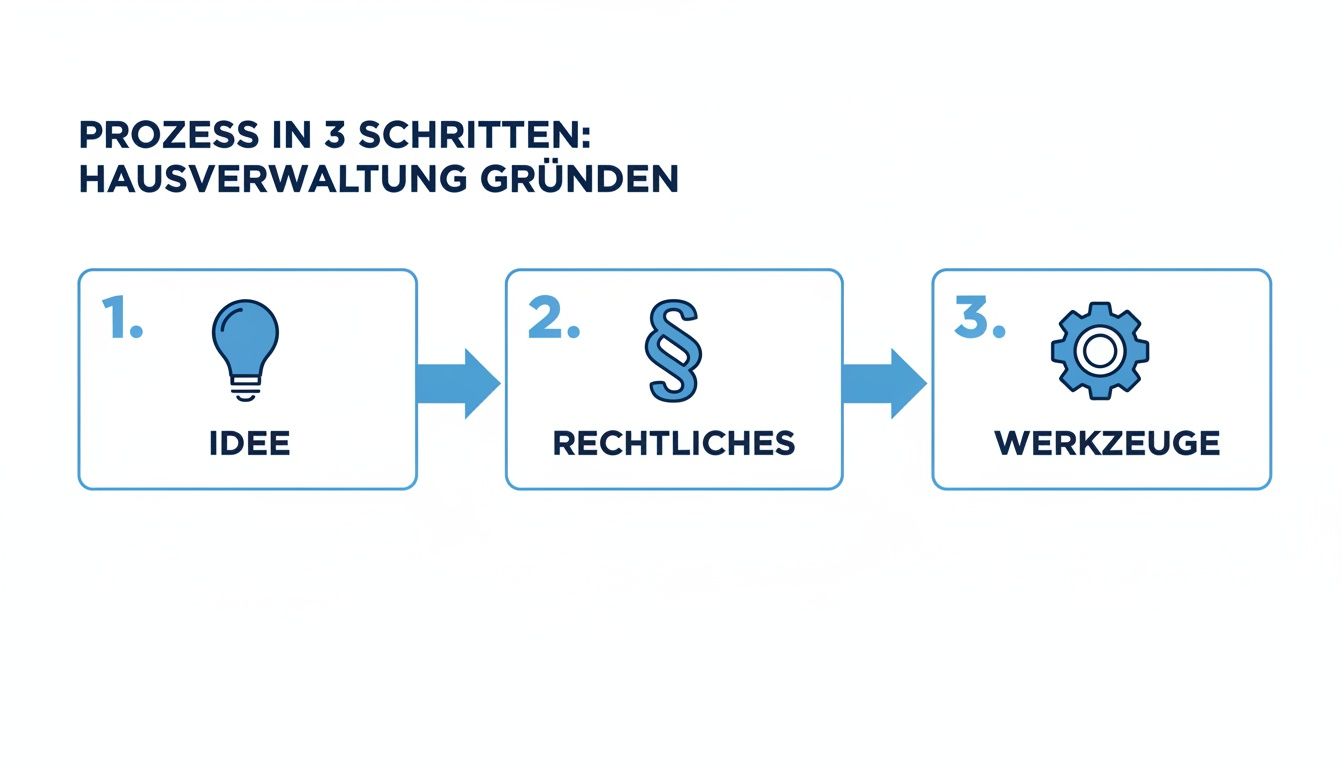
It is easy to see: a successful start-up is no coincidence, but the result of strategic, legal, and operational decisions that fit together neatly.
Choosing the right legal form as a foundation
The first big decision is choosing the legal form. It has direct consequences for your liability, the required starting capital, and the bureaucratic effort. There is no one-size-fits-all "best" solution – it depends entirely on your personal willingness to take risks and your financial resources.
In practice, three options have proven successful:
Sole proprietorship: This is the fastest and cheapest way to self-employment. No minimum capital, uncomplicated setup. However, the catch is major: you have unlimited liability with your entire private assets.
Entrepreneurial company (UG) (limited liability): Often referred to as a "Mini-GmbH", it can be founded with a symbolic share capital of just €1. The advantage is the limitation of liability to the company's assets. In return, however, you must save profits until the share capital of €25,000 for a fully-fledged GmbH is reached.
Limited liability company (GmbH): The GmbH looks professional and builds trust. However, it requires a share capital of at least €25,000, half of which must be paid in immediately. Here too, liability is limited to the company's assets.
A practical tip: The legal form is not set in stone. Many founders start as sole proprietors to keep costs low. If the business grows and with it the risk, they later convert their company into a GmbH.
Comparison of legal forms for your property management company
This table compares the most common legal forms for starting a property management company in terms of liability, share capital, setup effort, and tax aspects.
Legal form | Liability | Share capital | Setup effort | Tax aspects |
|---|---|---|---|---|
Sole proprietorship | Unlimited with private assets | No minimum capital | Low, no notarisation required | Income tax on profits |
UG (limited liability) | Limited to company assets | From €1 | Medium, notarisation required | Corporate tax, trade tax |
GmbH | Limited to company assets | Min. €25,000 | Higher, notarisation required | Corporate tax, trade tax |
Ultimately, the choice depends on your individual situation. A GmbH offers the highest level of security, while a sole proprietorship allows for the most uncomplicated start.
Mastering bureaucratic hurdles
Once the legal form is settled, it is time for the "paperwork". Two things are absolutely essential: the trade licence and the registration with the trade office. Without these official stamps, you are not allowed to run a property management company in Germany.
Trade licence according to § 34c GewO Anyone who manages real estate on a commercial basis needs a licence according to § 34c of the German Trade Regulations (GewO). This is to ensure that you as a manager are reliable and that consumers are protected.
For the application to the responsible regulatory office, you must prove:
Personal reliability: A police certificate of good conduct with no relevant entries is mandatory.
Orderly financial circumstances: For this, you need a Schufa credit report as well as certificates from the insolvency court and the tax office.
Professional indemnity insurance: Since 2018, proof of professional indemnity insurance is required by law.
Certification: Depending on which type of management you choose, you should also think about getting certified. This is a mandatory requirement, especially for managing medium to large homeowners' associations (WEGs).
The trade registration With the licence in hand, you go to the trade office. Registration is a formal act that also informs the tax office of your start-up. Shortly afterwards, you will receive mail and must fill out the questionnaire for tax registration.
Protecting the company properly
By far the most important insurance for any property management company is professional indemnity insurance. It is not just a legal obligation, but your financial lifeline. A typo in the annual statement, a missed deadline for a renovation – mistakes happen and can be extremely expensive.
Imagine you overlook a gross error during an invoice audit, which results in an additional payment of €20,000 for the homeowners' association. Without insurance, you would have to pay this out of your own pocket – which often means the end for a young business.
In addition, public liability insurance makes absolute sense. It covers personal injury and property damage. A classic example: a customer trips over a cable in your office and gets injured.
Defining a clear strategic direction
The legal framework is in place – now it is about your positioning in the market. Who do you actually want to win as customers?
Specialisation in WEG management: Here you look after homeowners' associations. The job revolves around organising meetings, implementing resolutions, and managing the common property. This requires diplomatic skill and a deep understanding of the German Condominium Act (WEG).
Focus on rental property management: Here you are the service provider for individual landlords. Your tasks include re-letting, service charge statements, and all communication with tenants. Efficiency and crystal-clear processes are key here.
One issue will significantly influence your success: the shortage of skilled workers. It is currently the biggest structural problem in the industry and will continue to worsen. This not only drives up salaries but also makes the job increasingly complex due to new laws. For founders, this means: investing early in digital automation is not an option, but a necessity in order to be able to work efficiently and remain competitive. Read more about this in the theses on the future of property management on hausverwalter-angebote.de.
Winning first customers and growing
Your company is ready to go, now all that is missing are the orders. Start in your immediate circle. Talk to friends, family, and former colleagues. Often, the very first mandates arise here.
Other proven ways of acquisition are:
Networking: Establish contacts with estate agents, notaries, and trade businesses. They are often the first to hear about new construction projects or dissatisfied owners.
Local presence: A professional website with good local search engine optimisation (Local SEO) makes you visible to owners in your region.
Direct approach: Keep your eyes open. Identify self-managed or obviously poorly maintained properties in your area and actively offer your services.
Your strongest selling point is modern, customer-oriented management with lean processes. A platform like DoNexus helps you to establish professional and AI-supported procedures from the very beginning. This allows you to focus on excellent service and growth instead of getting bogged down in repetitive administrative tasks.
Developing a profitable business model and the right pricing
A solid business model is the heart of your property management company. It decides whether your business not only survives, but grows and is profitable in the long term. Before you even think about prices, a sound business analysis is the first step to aligning your model correctly from the start.
The strategic design of your services and prices is the decisive lever to succeed in the market. It is about putting together a clear service portfolio that is tailored precisely to the needs of your target group, covers your costs, and ultimately allows for a profit.
The cornerstones of your business model
A viable business model relies on several pillars. It goes far beyond simply setting prices and requires a strategic direction from the very start. Take your time with these points to find your niche and position yourself successfully in the market.
Establish specialisation: Will you focus on WEG management or rental property management? The operational processes differ significantly. In WEG management, you need strong moderation skills and deep legal knowledge. Rental property management, on the other hand, thrives on efficient, scalable processes for tenant communication and billing.
Define core services: What exactly is included in your standard package? List crystal-clearly which tasks are covered by the monthly flat rate – from bookkeeping and organising meetings to hiring tradespeople. Transparency builds trust and saves you later discussions.
Additional services as a source of income: Standard tasks secure your basic income, but it is the additional services that increase your margin. Offer optional services that are billed separately. This can be a special letting service, handling complex insurance claims, or coordinating major renovation projects.
Determine target group: Who do you want to address? Small homeowners' associations, huge residential complexes, or private property investors? Your target group decides your marketing strategy and the type of your services.
Calculating realistic prices
Calculating your management fees is one of the biggest hurdles when starting out. If you set prices too low, you will not work profitably. If they are too high, you will scare off potential customers. The key lies in a mix of market analysis and an honest cost calculation.
The industry is currently going through a phase of significant price adjustments, which is both an opportunity and a challenge for founders. The acute shortage of skilled workers is driving up costs and thus also prices. Current studies show that average management costs are between €27.37 and €41.65 gross per residential unit and month – and the trend is rising. For new applications from large management companies, over €44 is sometimes already being demanded. This indicates that the market accepts higher prices, but is also shaped by enormous cost pressure.
Practical tip: Your prices should never be based solely on what the competition charges. Calculate your own costs per unit: how much time do you need on average for bookkeeping, communication, and property inspections? Take into account all fixed costs such as rent, software, and insurance. This is the only way to ensure that your pricing model is sustainable.
The right software can significantly increase your efficiency and positively influence your cost base. You can find out more about this in our article on the best software for property management companies.
Unlocking additional income
In addition to the monthly basic fee, you should strategically plan for additional sources of income. These often make the difference between an average and a highly profitable business.
Some proven examples of additional services are:
Letting service: From the exposé and viewings to the final handover of the flat – an all-round worry-free package for landlords.
Handling insurance claims: Coordination with assessors, tradespeople, and insurance companies is time-consuming and can be billed fairly based on hourly effort.
Project management for renovations: Actively support major modernisation measures and get paid for this extra effort.
A clear and fair pricing model that includes both basic services and optional additional services is a crucial success factor. It allows you to react flexibly to customer wishes while ensuring your economic viability. Platforms like DoNexus support you in managing these processes efficiently and keeping track of all billable services, so that no income is lost.
Building efficient processes and the right tech stack
If you want to start a property management company and be profitable quickly, efficiency is the key factor. Instead of getting lost in manual tasks, you must rely on lean, standardised processes and the right technology from the very start. This is your biggest lever to counteract the shortage of skilled workers while offering first-class service.
A well-thought-out tech stack is no longer a luxury today, but the operational backbone of any modern management company. It minimises sources of error, bundles communication, and creates transparency that will delight your customers.
Standardised processes as a foundation
Before you invest even a single euro in software, your core procedures must be in place. Standardisation does not mean being rigid and inflexible – quite the opposite. You create clear guidelines that give your team security and drastically speed up the onboarding of new employees.
So define clear, step-by-step procedures for everything that happens repeatedly:
Onboarding new properties: Create a checklist for taking over all relevant master data, contracts, and technical documents. What needs to be recorded by whom and when?
Organising homeowners' meetings: Establish a fixed schedule for invitations, minuting, and implementing resolutions.
Processing damage reports: Define the path of a report from recording and forwarding to tradespeople to the final completion check.
These standard processes are the perfect blueprint for later automation through technology. You know exactly what needs to happen – the software then ensures that it also happens reliably.
The modern tech stack of a property management company
A modern tech stack consists of several tools that interlock perfectly and each solve a specific task optimally. The times when a single software could do everything are over. Today, successful management companies rely on an ecosystem of specialised solutions.
An early investment in the right technology is not an expense, but the best protection for your future growth. You not only save costs in the long term, but also secure a decisive competitive advantage over companies that still work with Excel and paper folders.
The three indispensable pillars of your tech stack are a central property management software, an intelligent document management system, and a portal for your customers.
Indispensable tools for your modern property management company
This table provides an overview of the essential software categories and their main functions that a newly founded property management company needs for efficient operations.
Software category | Main functions | Examples |
|---|---|---|
Property management software (ERP) | Bookkeeping, contract management, master data maintenance, billing (WEG/service charges) | Haufe PowerHaus, immoware24, Domus |
Document Management System (DMS) | Audit-proof archiving, full-text search, workflow automation | SharePoint, DocuWare, d.velop |
Digital customer portal (CRM) | Transparent communication, online reporting, document access 24/7 | DoNexus, casavi, etg24, iDWELL |
The crucial thing is that these systems communicate seamlessly with each other. A classic example: an owner reports damage via the customer portal. The report automatically lands in the property management software, where a ticket is created. At the same time, all relevant documents, such as the handover protocol, are linked to the ticket from the DMS. This way, no one has to transfer data manually.
Why technology determines your success
The right technology solves the biggest pain points known to every property management company. It reduces the proportion of repetitive, administrative tasks many times over.
Imagine your software automatically reminding you of expiring contracts, independently creating payment reminders for late payments, or preparing the annual service charge statement at the touch of a button. This is not future talk, but the standard in a digitised company. The time you gain as a result can be invested by you and your team in what is essential: personal support for your customers and the strategic development of your business.
By centralising all data and communication channels, you avoid information silos. Everyone in the team has access to the current status of a ticket at any time, regardless of whether the inquiry came by email, phone, or via the portal. This not only increases internal efficiency, but also ensures a professional and consistent appearance to the outside world.
To maximise this efficiency gain from the start, platforms like DoNexus offer solutions specifically designed to minimise manual processes. Discover how you can take your management to a new level with the right KI-Automation from DoNexus, by transforming reactive tasks into proactive, automated workflows.
Growth through proactive and AI-driven property management with DoNexus
The property management company is founded, the first structures are in place – now begins the truly decisive phase: offering excellent service and expanding the business sustainably. It is no longer just about reacting to inquiries, but about acting foresightfully. This is exactly where modern, AI-powered platforms come in, giving founders a real competitive advantage from the very start.
Proactive management means identifying problems before they escalate. It means informing customers transparently before they even have to ask. The best way to achieve this is to transform the many reactive, manual tasks into clean, automated workflows.
From reactive management to automated workflows
The classic management workday is often a race against time: replying to emails, taking calls, juggling deadlines. This reactive mode eats up valuable resources – time and energy that are urgently needed for the growth of the business. Anyone who wants to grow needs proactive, future-oriented methods. The targeted use of artificial intelligence in business is a decisive lever for this.
DoNexus was developed precisely to break this cycle. The platform transforms daily management tasks into lean, largely automated processes:
Central workspace: DoNexus bundles all communication channels – email, telephone, WhatsApp – in a single, clear overview. Every inquiry is automatically captured and intelligently assigned to the correct property and the matching ticket. No more searching.
Intelligent task management: The system automatically keeps track of deadlines, flags urgent tasks, and helps with prioritisation. This way, nothing gets lost and escalations are avoided before they even arise.
Document AI: Instead of laboriously going through contracts or protocols by hand, the DoNexus AI analyses documents in seconds. Important information such as deadlines, contract partners, or resolutions are cleanly extracted and made directly usable.
You can immediately see how a central platform reduces complexity. The manager has all relevant information at a glance. The result: a faster, more precise, and significantly less error-prone way of working.
Customer service as a growth driver
Ultimately, the biggest benefit of a digitised management company lies in the customer experience. Today, a modern customer portal is no longer a nice extra, but is simply expected by owners and tenants.
Transparency is the new currency in customer service. Those who offer their customers easy access to all relevant information at any time build trust and secure long-term mandates.
A digital portal, like the one offered by DoNexus, delivers exactly that:
24/7 access: Owners and tenants can view the status of their inquiries, download documents, or make new reports at any time – whenever it suits them.
Proactive communication: Status updates on repairs or other processes are sent automatically. Customers are kept informed without having to ask.
Flawless traceability: The entire communication is cleanly documented and visible to all parties involved.
This degree of transparency not only significantly reduces the number of follow-up questions by phone and email, but also positions your property management company as a modern, customer-oriented partner.
Setting up for the future and seizing opportunities
The German housing market is undergoing a deep transformation. The German Property Federation (ZIA) expects a gap of 830,000 homes in new construction by 2027, while the population continues to grow. At the same time, legal requirements, for example through the Building Energy Act (GEG) or ESG obligations, are becoming increasingly complex.
These developments create enormous potential for property management companies that work in a specialised and efficient manner.
Those who rely on a platform like DoNexus from the very start set up their business for the future. Thanks to easy integration into existing systems and a fast onboarding process, you can scale your management without compromising on service quality. Find out how you can get started with the DoNexus AI for property management companies and focus on what really matters: the growth of your business.
The last remaining questions before starting
You are close to setting up your own property management company, but there are still a few question marks? Perfect. This last section is designed precisely for that: we clarify the typical questions that almost every founder has shortly before reaching the finish line. Think of it as a final check-up to start with a good feeling and full clarity.
From the legal form and the first customers to the most important insurance – here are the answers straight to the point.
The most important answers for founders
Some questions come up again and again. Here you will find the answers that will help you clear up any final uncertainties and consolidate your knowledge.
Do I need a special qualification to start a property management company?
That depends on what type of management you are aiming for. Generally: no, a specific training path is not legally required except for WEG management, where in some cases a certification according to §26a WEG is necessary. However, the trade licence according to § 34c of the German Trade Regulations is absolutely indispensable. To get this, you must primarily prove two things: your personal reliability and orderly financial circumstances.
Even if no formal qualification is mandatory – sound knowledge of the real estate industry is the key to success. Whether training as a real estate agent or a suitable degree: specialist knowledge not only builds trust with customers, but is also the basis for a professional and, above all, legally secure management.
How much starting capital should I plan for?
This depends heavily on the legal form you choose. A sole proprietorship has the lowest hurdle here, as there is no legally prescribed minimum capital.
But beware, that is only half the story. Be sure to think about the other costs that will definitely arise:
GmbH: Here you must plan for a share capital of €25,000. When founding the company, at least half of this, i.e. €12,500, must be paid in.
Additional costs: Regardless of the legal form – you need money for office equipment, a good property management software, the mandatory insurances, initial marketing, and of course the setup itself.
Strategic and operational questions
Once the legal and financial foundations are in place, it is time to get down to business. These strategic points will decide on your long-term success.
How do I find my first customers for property management?
In the beginning, a mix of different paths works best. Start in your immediate circle: talk to friends, family, and former business contacts. This is often where the first valuable mandates are hidden, making it easier for you to start.
At the same time, you should focus on visibility and a good network from the very beginning:
Local presence: A professional website optimized for local search queries (Local SEO) is mandatory today. Owners in your region must be able to find you online.
Networking: Actively build contacts with estate agents, notaries, and tradespeople. They are often the first to hear about new construction projects or dissatisfied homeowners' associations.
Direct approach: Keep your eyes open in your area. Do you see self-managed or obviously poorly maintained properties? Actively offer your professional services.
Property management companies: Many management companies receive inquiries that they cannot serve themselves. Establish contact with other companies early on and offer to take on surplus demand.
Are you ready to align your management with efficiency and excellent customer service from the very start? DoNexus offers you the AI-powered platform to transform reactive tasks into proactive, automated workflows. Discover on https://www.donexus.ai how you can accelerate your growth with a central solution for communication, tasks, and documents.
Do you want to start a property management company? An excellent idea. The demand for professional managers is huge and will remain so. However, the path to self-employment requires more than industry knowledge: a clear roadmap from the business idea through the legal hurdles to digital tools is crucial. This guide will lead you through all the important stages, show you how to avoid typical mistakes, and set your business on a growth course from the very beginning.
10 steps to starting your property management company
Sharpen the business idea: Decide clearly between WEG (homeowners' association) and rental property management. Define your target group and your range of services.
Choose a legal form: Weigh the pros and cons of a sole proprietorship, UG, and GmbH (liability, starting capital, administrative effort).
Create a business plan: Calculate starting capital, ongoing costs, and create a realistic turnover plan.
Secure financing: Clarify how you will cover the starting costs and bridge the initial period without income.
Apply for a trade licence (§ 34c GewO): Gather all necessary documents (certificate of good conduct, Schufa credit report, etc.) and submit the application to the regulatory office.
Register the business: Register your company with the responsible trade office after receiving the licence.
Take out insurance: It is mandatory to take out professional indemnity insurance and, ideally, public liability insurance.
Build your tech stack: Choose modern property management software, a document management system, and a customer portal.
Define processes: Establish standardised procedures for core tasks such as property onboarding, meetings, and damage reports.
Win your first customers: Use your network, build a professional website, and establish contacts with estate agents and tradespeople.
The most important steps to starting your property management company
Anyone who wants to start a property management company needs more than just a good idea. Success stands and falls with a solid legal and strategic foundation. It is about setting the right course from the very beginning – regarding the legal form, permits, and insurance protection.
This roadmap will guide you through the crucial stages and help you to directly avoid typical start-up mistakes.
It is easy to see: a successful start-up is no coincidence, but the result of strategic, legal, and operational decisions that fit together neatly.
Choosing the right legal form as a foundation
The first big decision is choosing the legal form. It has direct consequences for your liability, the required starting capital, and the bureaucratic effort. There is no one-size-fits-all "best" solution – it depends entirely on your personal willingness to take risks and your financial resources.
In practice, three options have proven successful:
Sole proprietorship: This is the fastest and cheapest way to self-employment. No minimum capital, uncomplicated setup. However, the catch is major: you have unlimited liability with your entire private assets.
Entrepreneurial company (UG) (limited liability): Often referred to as a "Mini-GmbH", it can be founded with a symbolic share capital of just €1. The advantage is the limitation of liability to the company's assets. In return, however, you must save profits until the share capital of €25,000 for a fully-fledged GmbH is reached.
Limited liability company (GmbH): The GmbH looks professional and builds trust. However, it requires a share capital of at least €25,000, half of which must be paid in immediately. Here too, liability is limited to the company's assets.
A practical tip: The legal form is not set in stone. Many founders start as sole proprietors to keep costs low. If the business grows and with it the risk, they later convert their company into a GmbH.
Comparison of legal forms for your property management company
This table compares the most common legal forms for starting a property management company in terms of liability, share capital, setup effort, and tax aspects.
Legal form | Liability | Share capital | Setup effort | Tax aspects |
|---|---|---|---|---|
Sole proprietorship | Unlimited with private assets | No minimum capital | Low, no notarisation required | Income tax on profits |
UG (limited liability) | Limited to company assets | From €1 | Medium, notarisation required | Corporate tax, trade tax |
GmbH | Limited to company assets | Min. €25,000 | Higher, notarisation required | Corporate tax, trade tax |
Ultimately, the choice depends on your individual situation. A GmbH offers the highest level of security, while a sole proprietorship allows for the most uncomplicated start.
Mastering bureaucratic hurdles
Once the legal form is settled, it is time for the "paperwork". Two things are absolutely essential: the trade licence and the registration with the trade office. Without these official stamps, you are not allowed to run a property management company in Germany.
Trade licence according to § 34c GewO Anyone who manages real estate on a commercial basis needs a licence according to § 34c of the German Trade Regulations (GewO). This is to ensure that you as a manager are reliable and that consumers are protected.
For the application to the responsible regulatory office, you must prove:
Personal reliability: A police certificate of good conduct with no relevant entries is mandatory.
Orderly financial circumstances: For this, you need a Schufa credit report as well as certificates from the insolvency court and the tax office.
Professional indemnity insurance: Since 2018, proof of professional indemnity insurance is required by law.
Certification: Depending on which type of management you choose, you should also think about getting certified. This is a mandatory requirement, especially for managing medium to large homeowners' associations (WEGs).
The trade registration With the licence in hand, you go to the trade office. Registration is a formal act that also informs the tax office of your start-up. Shortly afterwards, you will receive mail and must fill out the questionnaire for tax registration.
Protecting the company properly
By far the most important insurance for any property management company is professional indemnity insurance. It is not just a legal obligation, but your financial lifeline. A typo in the annual statement, a missed deadline for a renovation – mistakes happen and can be extremely expensive.
Imagine you overlook a gross error during an invoice audit, which results in an additional payment of €20,000 for the homeowners' association. Without insurance, you would have to pay this out of your own pocket – which often means the end for a young business.
In addition, public liability insurance makes absolute sense. It covers personal injury and property damage. A classic example: a customer trips over a cable in your office and gets injured.
Defining a clear strategic direction
The legal framework is in place – now it is about your positioning in the market. Who do you actually want to win as customers?
Specialisation in WEG management: Here you look after homeowners' associations. The job revolves around organising meetings, implementing resolutions, and managing the common property. This requires diplomatic skill and a deep understanding of the German Condominium Act (WEG).
Focus on rental property management: Here you are the service provider for individual landlords. Your tasks include re-letting, service charge statements, and all communication with tenants. Efficiency and crystal-clear processes are key here.
One issue will significantly influence your success: the shortage of skilled workers. It is currently the biggest structural problem in the industry and will continue to worsen. This not only drives up salaries but also makes the job increasingly complex due to new laws. For founders, this means: investing early in digital automation is not an option, but a necessity in order to be able to work efficiently and remain competitive. Read more about this in the theses on the future of property management on hausverwalter-angebote.de.
Winning first customers and growing
Your company is ready to go, now all that is missing are the orders. Start in your immediate circle. Talk to friends, family, and former colleagues. Often, the very first mandates arise here.
Other proven ways of acquisition are:
Networking: Establish contacts with estate agents, notaries, and trade businesses. They are often the first to hear about new construction projects or dissatisfied owners.
Local presence: A professional website with good local search engine optimisation (Local SEO) makes you visible to owners in your region.
Direct approach: Keep your eyes open. Identify self-managed or obviously poorly maintained properties in your area and actively offer your services.
Your strongest selling point is modern, customer-oriented management with lean processes. A platform like DoNexus helps you to establish professional and AI-supported procedures from the very beginning. This allows you to focus on excellent service and growth instead of getting bogged down in repetitive administrative tasks.
Developing a profitable business model and the right pricing
A solid business model is the heart of your property management company. It decides whether your business not only survives, but grows and is profitable in the long term. Before you even think about prices, a sound business analysis is the first step to aligning your model correctly from the start.
The strategic design of your services and prices is the decisive lever to succeed in the market. It is about putting together a clear service portfolio that is tailored precisely to the needs of your target group, covers your costs, and ultimately allows for a profit.
The cornerstones of your business model
A viable business model relies on several pillars. It goes far beyond simply setting prices and requires a strategic direction from the very start. Take your time with these points to find your niche and position yourself successfully in the market.
Establish specialisation: Will you focus on WEG management or rental property management? The operational processes differ significantly. In WEG management, you need strong moderation skills and deep legal knowledge. Rental property management, on the other hand, thrives on efficient, scalable processes for tenant communication and billing.
Define core services: What exactly is included in your standard package? List crystal-clearly which tasks are covered by the monthly flat rate – from bookkeeping and organising meetings to hiring tradespeople. Transparency builds trust and saves you later discussions.
Additional services as a source of income: Standard tasks secure your basic income, but it is the additional services that increase your margin. Offer optional services that are billed separately. This can be a special letting service, handling complex insurance claims, or coordinating major renovation projects.
Determine target group: Who do you want to address? Small homeowners' associations, huge residential complexes, or private property investors? Your target group decides your marketing strategy and the type of your services.
Calculating realistic prices
Calculating your management fees is one of the biggest hurdles when starting out. If you set prices too low, you will not work profitably. If they are too high, you will scare off potential customers. The key lies in a mix of market analysis and an honest cost calculation.
The industry is currently going through a phase of significant price adjustments, which is both an opportunity and a challenge for founders. The acute shortage of skilled workers is driving up costs and thus also prices. Current studies show that average management costs are between €27.37 and €41.65 gross per residential unit and month – and the trend is rising. For new applications from large management companies, over €44 is sometimes already being demanded. This indicates that the market accepts higher prices, but is also shaped by enormous cost pressure.
Practical tip: Your prices should never be based solely on what the competition charges. Calculate your own costs per unit: how much time do you need on average for bookkeeping, communication, and property inspections? Take into account all fixed costs such as rent, software, and insurance. This is the only way to ensure that your pricing model is sustainable.
The right software can significantly increase your efficiency and positively influence your cost base. You can find out more about this in our article on the best software for property management companies.
Unlocking additional income
In addition to the monthly basic fee, you should strategically plan for additional sources of income. These often make the difference between an average and a highly profitable business.
Some proven examples of additional services are:
Letting service: From the exposé and viewings to the final handover of the flat – an all-round worry-free package for landlords.
Handling insurance claims: Coordination with assessors, tradespeople, and insurance companies is time-consuming and can be billed fairly based on hourly effort.
Project management for renovations: Actively support major modernisation measures and get paid for this extra effort.
A clear and fair pricing model that includes both basic services and optional additional services is a crucial success factor. It allows you to react flexibly to customer wishes while ensuring your economic viability. Platforms like DoNexus support you in managing these processes efficiently and keeping track of all billable services, so that no income is lost.
Building efficient processes and the right tech stack
If you want to start a property management company and be profitable quickly, efficiency is the key factor. Instead of getting lost in manual tasks, you must rely on lean, standardised processes and the right technology from the very start. This is your biggest lever to counteract the shortage of skilled workers while offering first-class service.
A well-thought-out tech stack is no longer a luxury today, but the operational backbone of any modern management company. It minimises sources of error, bundles communication, and creates transparency that will delight your customers.
Standardised processes as a foundation
Before you invest even a single euro in software, your core procedures must be in place. Standardisation does not mean being rigid and inflexible – quite the opposite. You create clear guidelines that give your team security and drastically speed up the onboarding of new employees.
So define clear, step-by-step procedures for everything that happens repeatedly:
Onboarding new properties: Create a checklist for taking over all relevant master data, contracts, and technical documents. What needs to be recorded by whom and when?
Organising homeowners' meetings: Establish a fixed schedule for invitations, minuting, and implementing resolutions.
Processing damage reports: Define the path of a report from recording and forwarding to tradespeople to the final completion check.
These standard processes are the perfect blueprint for later automation through technology. You know exactly what needs to happen – the software then ensures that it also happens reliably.
The modern tech stack of a property management company
A modern tech stack consists of several tools that interlock perfectly and each solve a specific task optimally. The times when a single software could do everything are over. Today, successful management companies rely on an ecosystem of specialised solutions.
An early investment in the right technology is not an expense, but the best protection for your future growth. You not only save costs in the long term, but also secure a decisive competitive advantage over companies that still work with Excel and paper folders.
The three indispensable pillars of your tech stack are a central property management software, an intelligent document management system, and a portal for your customers.
Indispensable tools for your modern property management company
This table provides an overview of the essential software categories and their main functions that a newly founded property management company needs for efficient operations.
Software category | Main functions | Examples |
|---|---|---|
Property management software (ERP) | Bookkeeping, contract management, master data maintenance, billing (WEG/service charges) | Haufe PowerHaus, immoware24, Domus |
Document Management System (DMS) | Audit-proof archiving, full-text search, workflow automation | SharePoint, DocuWare, d.velop |
Digital customer portal (CRM) | Transparent communication, online reporting, document access 24/7 | DoNexus, casavi, etg24, iDWELL |
The crucial thing is that these systems communicate seamlessly with each other. A classic example: an owner reports damage via the customer portal. The report automatically lands in the property management software, where a ticket is created. At the same time, all relevant documents, such as the handover protocol, are linked to the ticket from the DMS. This way, no one has to transfer data manually.
Why technology determines your success
The right technology solves the biggest pain points known to every property management company. It reduces the proportion of repetitive, administrative tasks many times over.
Imagine your software automatically reminding you of expiring contracts, independently creating payment reminders for late payments, or preparing the annual service charge statement at the touch of a button. This is not future talk, but the standard in a digitised company. The time you gain as a result can be invested by you and your team in what is essential: personal support for your customers and the strategic development of your business.
By centralising all data and communication channels, you avoid information silos. Everyone in the team has access to the current status of a ticket at any time, regardless of whether the inquiry came by email, phone, or via the portal. This not only increases internal efficiency, but also ensures a professional and consistent appearance to the outside world.
To maximise this efficiency gain from the start, platforms like DoNexus offer solutions specifically designed to minimise manual processes. Discover how you can take your management to a new level with the right KI-Automation from DoNexus, by transforming reactive tasks into proactive, automated workflows.
Growth through proactive and AI-driven property management with DoNexus
The property management company is founded, the first structures are in place – now begins the truly decisive phase: offering excellent service and expanding the business sustainably. It is no longer just about reacting to inquiries, but about acting foresightfully. This is exactly where modern, AI-powered platforms come in, giving founders a real competitive advantage from the very start.
Proactive management means identifying problems before they escalate. It means informing customers transparently before they even have to ask. The best way to achieve this is to transform the many reactive, manual tasks into clean, automated workflows.
From reactive management to automated workflows
The classic management workday is often a race against time: replying to emails, taking calls, juggling deadlines. This reactive mode eats up valuable resources – time and energy that are urgently needed for the growth of the business. Anyone who wants to grow needs proactive, future-oriented methods. The targeted use of artificial intelligence in business is a decisive lever for this.
DoNexus was developed precisely to break this cycle. The platform transforms daily management tasks into lean, largely automated processes:
Central workspace: DoNexus bundles all communication channels – email, telephone, WhatsApp – in a single, clear overview. Every inquiry is automatically captured and intelligently assigned to the correct property and the matching ticket. No more searching.
Intelligent task management: The system automatically keeps track of deadlines, flags urgent tasks, and helps with prioritisation. This way, nothing gets lost and escalations are avoided before they even arise.
Document AI: Instead of laboriously going through contracts or protocols by hand, the DoNexus AI analyses documents in seconds. Important information such as deadlines, contract partners, or resolutions are cleanly extracted and made directly usable.
You can immediately see how a central platform reduces complexity. The manager has all relevant information at a glance. The result: a faster, more precise, and significantly less error-prone way of working.
Customer service as a growth driver
Ultimately, the biggest benefit of a digitised management company lies in the customer experience. Today, a modern customer portal is no longer a nice extra, but is simply expected by owners and tenants.
Transparency is the new currency in customer service. Those who offer their customers easy access to all relevant information at any time build trust and secure long-term mandates.
A digital portal, like the one offered by DoNexus, delivers exactly that:
24/7 access: Owners and tenants can view the status of their inquiries, download documents, or make new reports at any time – whenever it suits them.
Proactive communication: Status updates on repairs or other processes are sent automatically. Customers are kept informed without having to ask.
Flawless traceability: The entire communication is cleanly documented and visible to all parties involved.
This degree of transparency not only significantly reduces the number of follow-up questions by phone and email, but also positions your property management company as a modern, customer-oriented partner.
Setting up for the future and seizing opportunities
The German housing market is undergoing a deep transformation. The German Property Federation (ZIA) expects a gap of 830,000 homes in new construction by 2027, while the population continues to grow. At the same time, legal requirements, for example through the Building Energy Act (GEG) or ESG obligations, are becoming increasingly complex.
These developments create enormous potential for property management companies that work in a specialised and efficient manner.
Those who rely on a platform like DoNexus from the very start set up their business for the future. Thanks to easy integration into existing systems and a fast onboarding process, you can scale your management without compromising on service quality. Find out how you can get started with the DoNexus AI for property management companies and focus on what really matters: the growth of your business.
The last remaining questions before starting
You are close to setting up your own property management company, but there are still a few question marks? Perfect. This last section is designed precisely for that: we clarify the typical questions that almost every founder has shortly before reaching the finish line. Think of it as a final check-up to start with a good feeling and full clarity.
From the legal form and the first customers to the most important insurance – here are the answers straight to the point.
The most important answers for founders
Some questions come up again and again. Here you will find the answers that will help you clear up any final uncertainties and consolidate your knowledge.
Do I need a special qualification to start a property management company?
That depends on what type of management you are aiming for. Generally: no, a specific training path is not legally required except for WEG management, where in some cases a certification according to §26a WEG is necessary. However, the trade licence according to § 34c of the German Trade Regulations is absolutely indispensable. To get this, you must primarily prove two things: your personal reliability and orderly financial circumstances.
Even if no formal qualification is mandatory – sound knowledge of the real estate industry is the key to success. Whether training as a real estate agent or a suitable degree: specialist knowledge not only builds trust with customers, but is also the basis for a professional and, above all, legally secure management.
How much starting capital should I plan for?
This depends heavily on the legal form you choose. A sole proprietorship has the lowest hurdle here, as there is no legally prescribed minimum capital.
But beware, that is only half the story. Be sure to think about the other costs that will definitely arise:
GmbH: Here you must plan for a share capital of €25,000. When founding the company, at least half of this, i.e. €12,500, must be paid in.
Additional costs: Regardless of the legal form – you need money for office equipment, a good property management software, the mandatory insurances, initial marketing, and of course the setup itself.
Strategic and operational questions
Once the legal and financial foundations are in place, it is time to get down to business. These strategic points will decide on your long-term success.
How do I find my first customers for property management?
In the beginning, a mix of different paths works best. Start in your immediate circle: talk to friends, family, and former business contacts. This is often where the first valuable mandates are hidden, making it easier for you to start.
At the same time, you should focus on visibility and a good network from the very beginning:
Local presence: A professional website optimized for local search queries (Local SEO) is mandatory today. Owners in your region must be able to find you online.
Networking: Actively build contacts with estate agents, notaries, and tradespeople. They are often the first to hear about new construction projects or dissatisfied homeowners' associations.
Direct approach: Keep your eyes open in your area. Do you see self-managed or obviously poorly maintained properties? Actively offer your professional services.
Property management companies: Many management companies receive inquiries that they cannot serve themselves. Establish contact with other companies early on and offer to take on surplus demand.
Are you ready to align your management with efficiency and excellent customer service from the very start? DoNexus offers you the AI-powered platform to transform reactive tasks into proactive, automated workflows. Discover on https://www.donexus.ai how you can accelerate your growth with a central solution for communication, tasks, and documents.

Ready to lead your property management into the future?
Arrange a conversation now and find out how DoNexus can help you save time, reduce costs, and achieve better results.
No obligations. Free 30-minute chat with one of our founders.
Ready to lead your property management into the future?
Arrange a conversation now and find out how DoNexus can help you save time, reduce costs, and achieve better results.
No obligations. Free 30-minute chat with one of our founders.
Latest Posts
Discover more posts on our blog