AI-Academy
Property Management AI as a Game-Changer for Your Efficiency
Learn how property management AI transforms your processes. Save...
A property management AI is an intelligent software that automates repetitive tasks such as email sorting and data entry. It relieves your team, accelerates processes and increases service quality by acting as a tireless digital assistant. Instead of replacing employees, it creates free space for complex and strategic tasks.
Top 10 steps for the successful introduction of property management AI
Analyse pain points: Identify the biggest time-wasters, such as manual email processing or document filing.
Define measurable goals: Set clear goals, e.g. "reduce response times by 50%".
Involve the team early on: Communicate openly that the AI serves as a supportive tool, not as a replacement.
Prepare the database: Ensure clean, digitalised property and contact data as a foundation.
Choose the right partner: Pay attention to industry understanding, easy integration and GDPR compliance.
Start with a pilot project: Implement the AI first in a small, manageable area to gain experience.
Measure and share success: Evaluate the results of the pilot and communicate the successes within the company.
Roll out gradually: Expand the AI solution to other departments after a successful pilot.
Ensure continuous training: Train your team regularly and offer support in using the new tools.
Optimise and scale processes: Use the insights gained to constantly improve your workflows.
What property management AI can really do for you
In modern property management, tasks are piling up. Hundreds of emails a day, rising regulatory requirements and the omnipresent shortage of skilled labor make everyday work increasingly complex. This is precisely where property management AI comes into play – not as an abstract future vision, but as a very concrete, strategic partner.
Instead of replacing human expertise, the AI works more like a tireless assistant. It takes care of the time-consuming routine tasks that tie up valuable capacities. Just think of the pre-sorting of tenant enquiries, the automatic capturing of invoice data or the detection of important deadlines in contracts.
Relief in everyday life through intelligent automation
By automating these processes, an AI platform creates genuine free space for your team. Your employees can focus again on what really matters: personal support for owners and tenants, solving complex problems and the strategic development of the portfolio.
AI is the strategic response to the shortage of skilled labor. It makes it possible to achieve more with the existing team, increase service quality and at the same time boost employee satisfaction because monotonous tasks are eliminated.
Anyone who introduces an AI solution can act not only more efficiently, but also more proactively. Instead of just reacting to enquiries, you can finally take action again.
From pain point to smart solution
To make the benefits more tangible, let's look at typical challenges in direct comparison with the appropriate AI solutions.
AI in practice: Typical problems and smart solutions
The following table shows how a property management AI like DoNexus transforms everyday pain points into genuine strengths.
Challenge in everyday life | Traditional manual process | AI-supported automated solution |
|---|---|---|
Overflowing email inbox | Employees manually screen, sort and forward every email. This can take hours. | AI analyses content, detects urgency and automatically assigns enquiries to the correct property and agent. |
Slow response times | Enquiries often lie unattended for days because the responsible person is overloaded or absent. | Enquiries are captured immediately, and the AI can even suggest standard responses or send them directly. |
Manual data entry | Invoice or contract data is painstakingly transferred by hand into the ERP system, which is prone to errors. | The AI extracts relevant data from documents and transfers it in a structured format into the target systems. |
An intelligent software like DoNexus transforms precisely these pain points into strengths. Find out more about how such AI automation can make your administration future-proof.
Your roadmap to the successful introduction of AI
The idea of introducing a property management AI often sounds like a huge IT project that ties up resources for months. But it doesn't have to be. The key is not to turn everything upside down at once, but to think in small, targeted steps. This way, the first successes quickly become visible, and gradually the entire organisation becomes fit for the future.
The thought of an AI implementation can be intimidating at first. But as with any journey, this one also begins with the first step. The following roadmap is a tried-and-tested path that shows you how to systematically integrate AI solutions into your workflows – whilst taking your entire team with you.
This graphic gets straight to the core process: How daily email chaos is transformed into a structured, efficient way of working through the targeted use of property management AI.
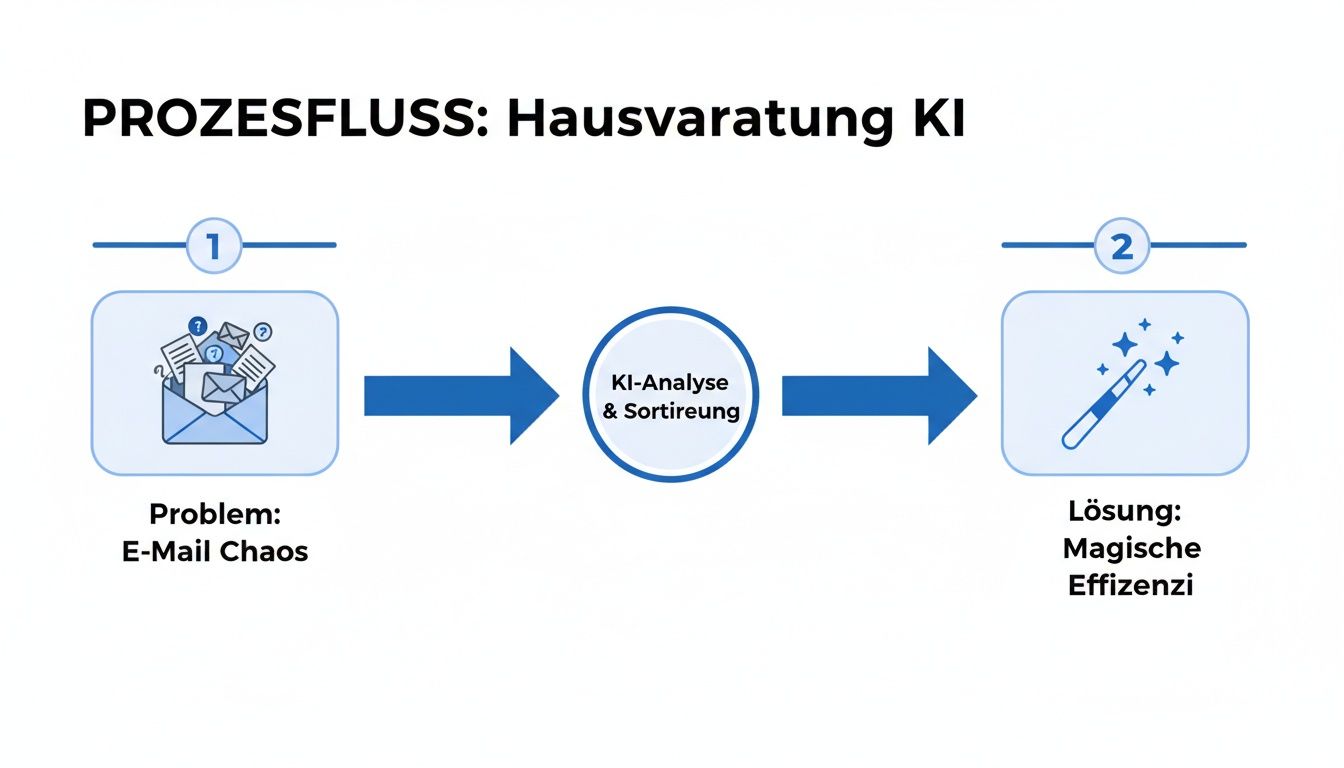
One can immediately see how the AI functions as an intelligent filter. It channels the flood of information and transforms it into valuable, directly actionable tasks.
In 10 steps to AI-supported administration
A structured approach is everything. This plan guides you safely through the process – from the first idea to the sustainable integration of AI in your company.
Identify pain points: Where exactly do you and your team lose the most time? Is it the manual processing of hundreds of tenant enquiries or the endless document filing? Find the real time-wasters.
Define measurable goals: Formulate crystal-clear, quantifiable goals. For example: "We want to reduce the average response time to enquiries by 50%" or "The manual capturing effort for invoices should decrease by 80%."
Involve the team early: Communication is key. Explain to your team from the very beginning that the AI is not a replacement, but a supportive colleague. Show them concretely how the technology relieves them and creates free space for more important tasks.
Prepare the database: Good AI needs good data. Ensure that property data, contacts and documents are available in a digital and cleanly structured format. This is the foundation for everything else.
Select the right partner: Look for a provider who truly understands property management. Crucial factors are simple integration into your existing systems (ERP, DMS) and an uncompromising focus on data protection and GDPR compliance.
Start with a pilot project: Start small. Implement the AI first only for a manageable area, such as the automatic email sorting of a single team. This is how you gather valuable experience without changing everything at once.
Measure and communicate success: Evaluate the results of the pilot project based on your goals. Share the positive results and experience reports throughout the company. This builds trust and increases acceptance enormously.
Roll out step-by-step: After a successful pilot, expand the AI solution to other departments or processes. Proceed gradually and continually adjust the configuration based on feedback from practice.
Ensure continuous training: Ensure that your team is trained regularly and can use the new tools confidently. Offer open Q&A sessions and uncomplicated support.
Optimise and scale processes: AI is a learning system. Use the data and insights gained to constantly improve your internal processes and drive automation forward.
A structured plan prevents you from getting stuck in the pilot phase. It ensures that a good start turns into sustainable success that moves the entire company forward.
In fact, a study by JLL shows that although 93% of German real estate companies run AI pilot projects, only 5% have largely achieved their goals. Among the biggest hurdles are data protection, lack of skills and poor change management – which highlights how important a clear roadmap is. Read more about the results of the JLL study on AI in the real estate sector.
The step-by-step introduction transforms the transition from a burden into a motivating process. Platforms like DoNexus are built exactly for this approach. They enable a quick start with clear, immediately visible benefits and guide you in transforming your property management piece by piece into a proactive and future-proof organisation. Read also how to master the step from a pure tool to an integrated system in property management.
The core features of a modern AI for property management
What exactly does a property management AI actually do in daily operations? Forget abstract concepts. It's about very concrete tools that take time-consuming, repetitive tasks off your hands. Think of the AI as a digital operations manager. It doesn't just gather incoming information, it understands it instantly, classifies it and converts it into clear, actionable tasks.
This is how the daily chaos of emails, calls and messages becomes a clean, proactive workflow.
In the end, you win back the most valuable thing: time for the tasks that really count – the strategic support of your properties and personal conversations with owners and tenants.
1. Intelligent communication management
The heart of any property management AI is its ability to bundle and understand all communication in one place. Emails, WhatsApp messages, even transcripts of calls – everything flows together in a single system.
The AI then "reads" these messages and instantly captures the content, intent and urgency. A damage report is recognized as such without detours, while a simple question about the service charge statement receives a completely different category.
This intelligent pre-sorting is a real efficiency booster. In practice, this can eliminate up to 80% of manual screening and forwarding.
2. Automatic case creation and assignment
Once the AI has understood a message, the next step is to automatically create a new case or assign the information to an existing one. This happens lightning fast.
Example damage report: An email comes in with the subject "Water damage in the cellar, property Musterstraße 1". The AI analyses the text, detects the keyword "water damage" and the property address.
Automatic action: Seconds later, a new task with high priority is created, assigned to the correct property and forwarded directly to the responsible technician or property manager. All important property data is already attached.
A process that often takes a human several minutes and various clicks is thus completed in an instant.
3. AI-supported document analysis
Another key feature is the intelligent analysis of documents. Contracts, invoices, minutes or insurance policies are scanned by the AI, and the crucial information is filtered out.
An AI for property management works like a tireless assistant who reads contracts around the clock, keeps track of deadlines and ensures that no information is lost. It builds up a knowledge base that is available to the entire team.
This allows, for example, the following tasks to be automated:
Deadline management: The AI finds notice periods in lease agreements or maintenance intervals in service provider contracts and creates reminders on its own.
Data extraction: Invoice data such as amount, supplier and service date are simply read out and prepared for bookkeeping.
Content analysis: From long meeting minutes, the AI extracts specifically all resolutions or tasks and presents them clearly.
This not only saves enormous manual effort, but also significantly reduces the risk of human error.
4. Predictive task and process control
A really good property management AI does not just react, it acts predictively. It can schedule recurring tasks, define escalation levels if a task is overdue, and even suggest appropriate text templates for standard responses.
The system learns with every interaction and becomes more accurate over time. It detects patterns and can proactively alert your team to potential problems before they escalate. How this intelligent customer communication works in practice can be best understood through real examples.
All these core features together result in an ecosystem where information flows and processes run cleanly. A platform like DoNexus bundles exactly these capabilities and provides them to your administration in a simple interface. This turns reactive problem solving into a proactive and scalable process landscape that makes your company fit for the future.
How the investment in AI pays off for your administration
The introduction of a property management AI is not a purely technological decision, but above all an entrepreneurial one. The return on investment (ROI) is measured not only in euros saved, but also in time gained, better service and more satisfied employees. At the end of the day, AI is not a simple cost item, but a lever with which you can completely rethink profitability and growth.
An investment in AI technology often pays off faster than expected. Why? Because it starts precisely where the biggest time and cost eaters lurk: in the manual processing of routine enquiries and laborious data entry. It transforms unstructured emails and calls into clear, traceable processes, creating measurable value for your entire business.
The ROI calculation in practice
To make this financial benefit tangible, let's look at a simple sample calculation. It shows how even small efficiency gains with a high volume of enquiries quickly add up to tangible savings.
How to calculate the potential ROI:
Step 1: Analyse time spent per case: Track the time: How long does an employee need on average for a standard process? Let's take the processing of a simple tenant enquiry as an example – from the first viewing of the email to the final filing. Let's assume this takes 10 minutes.
Step 2: Determine personnel costs: What does this time cost you? Calculate the average personnel costs per hour, including all non-wage labor costs. A realistic value here is often €30 per hour, so €0.50 per minute.
Step 3: Apply AI efficiency: A good property management AI can radically shorten the processing time for such standard cases. A reduction of 80% is absolutely realistic here, as the AI takes over the screening, proper assignment and documentation. For the employee, only 2 minutes remain for checking and approval.
Step 4: Calculate savings per case: The time savings thus amount to 8 minutes per enquiry. At €0.50 per minute, that is €4 savings per single process.
Step 5: Project onto total volume: An administration with 1,000 units easily processes 250 such enquiries per month. This results in a monthly saving of €1,000 (250 processes x €4). Projected over the year, that is already €12,000.
And that is just a single process. If you transfer this to other areas such as the analysis of resolutions, invoice verification or automated appointment finding, it quickly becomes clear what potential is slumbering here.
More than just numbers: the soft factors
In addition to hard, measurable cost savings, there are other advantages that are often even more important for business success and further increase the value of an AI investment.
A property management AI pays off on two levels: It lowers operational costs through automation and at the same time increases company value through better service and happier employees.
These "soft" factors are often the true drivers of long-term success:
Higher satisfaction among tenants and owners: Anyone who gets fast and transparent answers to their enquiries feels valued. The service experience becomes noticeably better.
Stronger employee retention: If monotonous, often frustrating routine work is eliminated, your team can concentrate on truly demanding tasks. This boosts motivation and is a strong argument against the shortage of skilled labor.
Better scalability: With AI support, you can manage more units with the same team – without quality suffering. Your business can grow without costs exploding.
The shortage of skilled labor is a massive challenge for German property managers. 70% report difficulties in finding staff, while the administrative burden continues to grow. Automation is thus turning from a "nice-to-have" into a survival factor. AI-supported systems can reduce costs and processing times for enquiries by up to 60%, which directly boosts ROI and cushions personnel bottlenecks.
However, for an AI to unfold its full power, it needs a solid digital foundation. Many benefits build on clean data structures and clear processes – as created, for example, by modern management software or optimised digital bookkeeping.
A platform like DoNexus was developed precisely to maximise this ROI. It does not just automate individual steps, but optimises entire process chains and provides you with the data to prove the success of your investment in black and white.
How DoNexus makes your administration future-proof
Theory is good, but at the end of the day, only what works in practice matters. A modern property management AI must not be a complicated collection of features. It must fit seamlessly into your daily workflows and make a noticeable difference. It is about moving from reactively handling problems to proactive, scalable processes – and strategically relieving your team.
This is exactly where DoNexus comes in. We translate the theoretical benefits of AI into a tangible, effective solution for your everyday work. Let's look at how that looks in concrete terms.
From tenant enquiry to resolved case
Imagine a completely normal process: A tenant reports a broken lift by email. Without a smart solution, a manual process of screening, forwarding, querying and documenting begins. With DoNexus, it works differently:
Everything in one place: The tenant's email lands directly in the central inbox of DoNexus. If they also call or send a WhatsApp message, that too is bundled in the same place.
Intelligent analysis: The AI reads the content of the message. It detects keywords like "lift broken", understands the urgency and instantly assigns the enquiry to the correct property and rental unit based on the sender's address.
Automatic assignment: Based on your process rules, a high-priority case is automatically created and assigned directly to the responsible technician team or property manager.
Seamless documentation: The entire process – from the first report to communication with the service provider to the completion message – is documented transparently and traceably. Everyone involved has a full overview at all times.
This automated workflow ensures that nothing is lost and every step is clearly traceable for everyone.
A system that thinks with you and learns
The real highlight of DoNexus is that it is a learning system. With every processed enquiry, every interaction and every completed case, the AI becomes more precise. It learns to understand your specific processes and priorities, and suggests increasingly better solutions over time. In this way, the platform relieves your team not just once, but a little bit more every day.
DoNexus is more than a tool. It is your strategic partner that thinks with you, learns and helps you to become master of your processes again, instead of being driven by the daily flood of enquiries.
In Germany, over 61% of property managers already work with digital tools and increase their productivity by up to 80%. However, only around 20% currently rely on real AI. Platforms like DoNexus close precisely this gap by reducing response times by up to 60% through central communication and automatic classification. Read more about current developments in the article on trends in digital property management.
With our fast, three-stage onboarding process, you are ready to start in no time. We import your existing data and enrich it intelligently so that the AI delivers real value from day one. This is how your administration becomes fit for the future.
Frequently asked questions about introducing AI in property management
The idea of introducing a property management AI often raises questions and is sometimes surrounded by myths. Here we clear up the most common concerns – briefly, concisely and straight from practice. This way, you can better assess the real opportunities.
Does AI replace employees in my administration?
No, that is one of the biggest myths. Do not view AI as a replacement, but as a digital assistant. Its main task is to take over the time-consuming, repetitive routine tasks that eat up valuable resources.
This finally frees up your specialists' minds for what really counts: personal support for owners, solving tricky cases or the strategic development of the portfolio. These are all tasks where human judgement and empathy are irreplaceable.
Is implementing an AI solution complicated and expensive?
This concern stems from times when software projects were huge, long-winded and capital-intensive. The picture has completely changed. Modern, cloud-based platforms are designed to start quickly and easily. Often you will see the first results after just a few days.
AI is no longer an unaffordable major project. Flexible pricing models and fast implementations make the technology accessible and profitable for medium-sized property managers today too.
High initial investments are eliminated thanks to flexible pricing models, which are usually based on the number of managed units. So you only pay for what you actually use. This significantly lowers the financial barrier.
How secure is my data in an AI cloud?
With reputable providers, data security is the top priority. The level of protection is often even higher than with an own server in the basement office. Professional AI platforms use certified data centers located in the EU or directly in Germany.
These providers strictly adhere to the requirements of the General Data Protection Regulation (GDPR). Regular security audits and state-of-the-art encryption ensure that your sensitive corporate and customer data is perfectly protected at all times. Anyone wanting to look into the topic in general will find useful answers to general AI questions here.
Does the AI also learn our individual processes?
Yes, exactly that is the decisive advantage of a good property management AI. It is not standard software off the shelf. Instead, the platform is trained specifically on the knowledge and workflows of your company.
The system learns with every new email, every processed case and every document. Over time, the AI becomes increasingly precise and provides support that is tailored exactly to the way your team works and their needs.
Would you like to see how an AI can solve your specific challenges and optimise your processes? DoNexus offers you a platform tailored exactly to the needs of modern property management companies. Discover how to relieve your team, increase service quality and make your business future-proof. Visit us at https://www.donexus.ai and request a personal demo.
A property management AI is an intelligent software that automates repetitive tasks such as email sorting and data entry. It relieves your team, accelerates processes and increases service quality by acting as a tireless digital assistant. Instead of replacing employees, it creates free space for complex and strategic tasks.
Top 10 steps for the successful introduction of property management AI
Analyse pain points: Identify the biggest time-wasters, such as manual email processing or document filing.
Define measurable goals: Set clear goals, e.g. "reduce response times by 50%".
Involve the team early on: Communicate openly that the AI serves as a supportive tool, not as a replacement.
Prepare the database: Ensure clean, digitalised property and contact data as a foundation.
Choose the right partner: Pay attention to industry understanding, easy integration and GDPR compliance.
Start with a pilot project: Implement the AI first in a small, manageable area to gain experience.
Measure and share success: Evaluate the results of the pilot and communicate the successes within the company.
Roll out gradually: Expand the AI solution to other departments after a successful pilot.
Ensure continuous training: Train your team regularly and offer support in using the new tools.
Optimise and scale processes: Use the insights gained to constantly improve your workflows.
What property management AI can really do for you
In modern property management, tasks are piling up. Hundreds of emails a day, rising regulatory requirements and the omnipresent shortage of skilled labor make everyday work increasingly complex. This is precisely where property management AI comes into play – not as an abstract future vision, but as a very concrete, strategic partner.
Instead of replacing human expertise, the AI works more like a tireless assistant. It takes care of the time-consuming routine tasks that tie up valuable capacities. Just think of the pre-sorting of tenant enquiries, the automatic capturing of invoice data or the detection of important deadlines in contracts.
Relief in everyday life through intelligent automation
By automating these processes, an AI platform creates genuine free space for your team. Your employees can focus again on what really matters: personal support for owners and tenants, solving complex problems and the strategic development of the portfolio.
AI is the strategic response to the shortage of skilled labor. It makes it possible to achieve more with the existing team, increase service quality and at the same time boost employee satisfaction because monotonous tasks are eliminated.
Anyone who introduces an AI solution can act not only more efficiently, but also more proactively. Instead of just reacting to enquiries, you can finally take action again.
From pain point to smart solution
To make the benefits more tangible, let's look at typical challenges in direct comparison with the appropriate AI solutions.
AI in practice: Typical problems and smart solutions
The following table shows how a property management AI like DoNexus transforms everyday pain points into genuine strengths.
Challenge in everyday life | Traditional manual process | AI-supported automated solution |
|---|---|---|
Overflowing email inbox | Employees manually screen, sort and forward every email. This can take hours. | AI analyses content, detects urgency and automatically assigns enquiries to the correct property and agent. |
Slow response times | Enquiries often lie unattended for days because the responsible person is overloaded or absent. | Enquiries are captured immediately, and the AI can even suggest standard responses or send them directly. |
Manual data entry | Invoice or contract data is painstakingly transferred by hand into the ERP system, which is prone to errors. | The AI extracts relevant data from documents and transfers it in a structured format into the target systems. |
An intelligent software like DoNexus transforms precisely these pain points into strengths. Find out more about how such AI automation can make your administration future-proof.
Your roadmap to the successful introduction of AI
The idea of introducing a property management AI often sounds like a huge IT project that ties up resources for months. But it doesn't have to be. The key is not to turn everything upside down at once, but to think in small, targeted steps. This way, the first successes quickly become visible, and gradually the entire organisation becomes fit for the future.
The thought of an AI implementation can be intimidating at first. But as with any journey, this one also begins with the first step. The following roadmap is a tried-and-tested path that shows you how to systematically integrate AI solutions into your workflows – whilst taking your entire team with you.
This graphic gets straight to the core process: How daily email chaos is transformed into a structured, efficient way of working through the targeted use of property management AI.
One can immediately see how the AI functions as an intelligent filter. It channels the flood of information and transforms it into valuable, directly actionable tasks.
In 10 steps to AI-supported administration
A structured approach is everything. This plan guides you safely through the process – from the first idea to the sustainable integration of AI in your company.
Identify pain points: Where exactly do you and your team lose the most time? Is it the manual processing of hundreds of tenant enquiries or the endless document filing? Find the real time-wasters.
Define measurable goals: Formulate crystal-clear, quantifiable goals. For example: "We want to reduce the average response time to enquiries by 50%" or "The manual capturing effort for invoices should decrease by 80%."
Involve the team early: Communication is key. Explain to your team from the very beginning that the AI is not a replacement, but a supportive colleague. Show them concretely how the technology relieves them and creates free space for more important tasks.
Prepare the database: Good AI needs good data. Ensure that property data, contacts and documents are available in a digital and cleanly structured format. This is the foundation for everything else.
Select the right partner: Look for a provider who truly understands property management. Crucial factors are simple integration into your existing systems (ERP, DMS) and an uncompromising focus on data protection and GDPR compliance.
Start with a pilot project: Start small. Implement the AI first only for a manageable area, such as the automatic email sorting of a single team. This is how you gather valuable experience without changing everything at once.
Measure and communicate success: Evaluate the results of the pilot project based on your goals. Share the positive results and experience reports throughout the company. This builds trust and increases acceptance enormously.
Roll out step-by-step: After a successful pilot, expand the AI solution to other departments or processes. Proceed gradually and continually adjust the configuration based on feedback from practice.
Ensure continuous training: Ensure that your team is trained regularly and can use the new tools confidently. Offer open Q&A sessions and uncomplicated support.
Optimise and scale processes: AI is a learning system. Use the data and insights gained to constantly improve your internal processes and drive automation forward.
A structured plan prevents you from getting stuck in the pilot phase. It ensures that a good start turns into sustainable success that moves the entire company forward.
In fact, a study by JLL shows that although 93% of German real estate companies run AI pilot projects, only 5% have largely achieved their goals. Among the biggest hurdles are data protection, lack of skills and poor change management – which highlights how important a clear roadmap is. Read more about the results of the JLL study on AI in the real estate sector.
The step-by-step introduction transforms the transition from a burden into a motivating process. Platforms like DoNexus are built exactly for this approach. They enable a quick start with clear, immediately visible benefits and guide you in transforming your property management piece by piece into a proactive and future-proof organisation. Read also how to master the step from a pure tool to an integrated system in property management.
The core features of a modern AI for property management
What exactly does a property management AI actually do in daily operations? Forget abstract concepts. It's about very concrete tools that take time-consuming, repetitive tasks off your hands. Think of the AI as a digital operations manager. It doesn't just gather incoming information, it understands it instantly, classifies it and converts it into clear, actionable tasks.
This is how the daily chaos of emails, calls and messages becomes a clean, proactive workflow.
In the end, you win back the most valuable thing: time for the tasks that really count – the strategic support of your properties and personal conversations with owners and tenants.
1. Intelligent communication management
The heart of any property management AI is its ability to bundle and understand all communication in one place. Emails, WhatsApp messages, even transcripts of calls – everything flows together in a single system.
The AI then "reads" these messages and instantly captures the content, intent and urgency. A damage report is recognized as such without detours, while a simple question about the service charge statement receives a completely different category.
This intelligent pre-sorting is a real efficiency booster. In practice, this can eliminate up to 80% of manual screening and forwarding.
2. Automatic case creation and assignment
Once the AI has understood a message, the next step is to automatically create a new case or assign the information to an existing one. This happens lightning fast.
Example damage report: An email comes in with the subject "Water damage in the cellar, property Musterstraße 1". The AI analyses the text, detects the keyword "water damage" and the property address.
Automatic action: Seconds later, a new task with high priority is created, assigned to the correct property and forwarded directly to the responsible technician or property manager. All important property data is already attached.
A process that often takes a human several minutes and various clicks is thus completed in an instant.
3. AI-supported document analysis
Another key feature is the intelligent analysis of documents. Contracts, invoices, minutes or insurance policies are scanned by the AI, and the crucial information is filtered out.
An AI for property management works like a tireless assistant who reads contracts around the clock, keeps track of deadlines and ensures that no information is lost. It builds up a knowledge base that is available to the entire team.
This allows, for example, the following tasks to be automated:
Deadline management: The AI finds notice periods in lease agreements or maintenance intervals in service provider contracts and creates reminders on its own.
Data extraction: Invoice data such as amount, supplier and service date are simply read out and prepared for bookkeeping.
Content analysis: From long meeting minutes, the AI extracts specifically all resolutions or tasks and presents them clearly.
This not only saves enormous manual effort, but also significantly reduces the risk of human error.
4. Predictive task and process control
A really good property management AI does not just react, it acts predictively. It can schedule recurring tasks, define escalation levels if a task is overdue, and even suggest appropriate text templates for standard responses.
The system learns with every interaction and becomes more accurate over time. It detects patterns and can proactively alert your team to potential problems before they escalate. How this intelligent customer communication works in practice can be best understood through real examples.
All these core features together result in an ecosystem where information flows and processes run cleanly. A platform like DoNexus bundles exactly these capabilities and provides them to your administration in a simple interface. This turns reactive problem solving into a proactive and scalable process landscape that makes your company fit for the future.
How the investment in AI pays off for your administration
The introduction of a property management AI is not a purely technological decision, but above all an entrepreneurial one. The return on investment (ROI) is measured not only in euros saved, but also in time gained, better service and more satisfied employees. At the end of the day, AI is not a simple cost item, but a lever with which you can completely rethink profitability and growth.
An investment in AI technology often pays off faster than expected. Why? Because it starts precisely where the biggest time and cost eaters lurk: in the manual processing of routine enquiries and laborious data entry. It transforms unstructured emails and calls into clear, traceable processes, creating measurable value for your entire business.
The ROI calculation in practice
To make this financial benefit tangible, let's look at a simple sample calculation. It shows how even small efficiency gains with a high volume of enquiries quickly add up to tangible savings.
How to calculate the potential ROI:
Step 1: Analyse time spent per case: Track the time: How long does an employee need on average for a standard process? Let's take the processing of a simple tenant enquiry as an example – from the first viewing of the email to the final filing. Let's assume this takes 10 minutes.
Step 2: Determine personnel costs: What does this time cost you? Calculate the average personnel costs per hour, including all non-wage labor costs. A realistic value here is often €30 per hour, so €0.50 per minute.
Step 3: Apply AI efficiency: A good property management AI can radically shorten the processing time for such standard cases. A reduction of 80% is absolutely realistic here, as the AI takes over the screening, proper assignment and documentation. For the employee, only 2 minutes remain for checking and approval.
Step 4: Calculate savings per case: The time savings thus amount to 8 minutes per enquiry. At €0.50 per minute, that is €4 savings per single process.
Step 5: Project onto total volume: An administration with 1,000 units easily processes 250 such enquiries per month. This results in a monthly saving of €1,000 (250 processes x €4). Projected over the year, that is already €12,000.
And that is just a single process. If you transfer this to other areas such as the analysis of resolutions, invoice verification or automated appointment finding, it quickly becomes clear what potential is slumbering here.
More than just numbers: the soft factors
In addition to hard, measurable cost savings, there are other advantages that are often even more important for business success and further increase the value of an AI investment.
A property management AI pays off on two levels: It lowers operational costs through automation and at the same time increases company value through better service and happier employees.
These "soft" factors are often the true drivers of long-term success:
Higher satisfaction among tenants and owners: Anyone who gets fast and transparent answers to their enquiries feels valued. The service experience becomes noticeably better.
Stronger employee retention: If monotonous, often frustrating routine work is eliminated, your team can concentrate on truly demanding tasks. This boosts motivation and is a strong argument against the shortage of skilled labor.
Better scalability: With AI support, you can manage more units with the same team – without quality suffering. Your business can grow without costs exploding.
The shortage of skilled labor is a massive challenge for German property managers. 70% report difficulties in finding staff, while the administrative burden continues to grow. Automation is thus turning from a "nice-to-have" into a survival factor. AI-supported systems can reduce costs and processing times for enquiries by up to 60%, which directly boosts ROI and cushions personnel bottlenecks.
However, for an AI to unfold its full power, it needs a solid digital foundation. Many benefits build on clean data structures and clear processes – as created, for example, by modern management software or optimised digital bookkeeping.
A platform like DoNexus was developed precisely to maximise this ROI. It does not just automate individual steps, but optimises entire process chains and provides you with the data to prove the success of your investment in black and white.
How DoNexus makes your administration future-proof
Theory is good, but at the end of the day, only what works in practice matters. A modern property management AI must not be a complicated collection of features. It must fit seamlessly into your daily workflows and make a noticeable difference. It is about moving from reactively handling problems to proactive, scalable processes – and strategically relieving your team.
This is exactly where DoNexus comes in. We translate the theoretical benefits of AI into a tangible, effective solution for your everyday work. Let's look at how that looks in concrete terms.
From tenant enquiry to resolved case
Imagine a completely normal process: A tenant reports a broken lift by email. Without a smart solution, a manual process of screening, forwarding, querying and documenting begins. With DoNexus, it works differently:
Everything in one place: The tenant's email lands directly in the central inbox of DoNexus. If they also call or send a WhatsApp message, that too is bundled in the same place.
Intelligent analysis: The AI reads the content of the message. It detects keywords like "lift broken", understands the urgency and instantly assigns the enquiry to the correct property and rental unit based on the sender's address.
Automatic assignment: Based on your process rules, a high-priority case is automatically created and assigned directly to the responsible technician team or property manager.
Seamless documentation: The entire process – from the first report to communication with the service provider to the completion message – is documented transparently and traceably. Everyone involved has a full overview at all times.
This automated workflow ensures that nothing is lost and every step is clearly traceable for everyone.
A system that thinks with you and learns
The real highlight of DoNexus is that it is a learning system. With every processed enquiry, every interaction and every completed case, the AI becomes more precise. It learns to understand your specific processes and priorities, and suggests increasingly better solutions over time. In this way, the platform relieves your team not just once, but a little bit more every day.
DoNexus is more than a tool. It is your strategic partner that thinks with you, learns and helps you to become master of your processes again, instead of being driven by the daily flood of enquiries.
In Germany, over 61% of property managers already work with digital tools and increase their productivity by up to 80%. However, only around 20% currently rely on real AI. Platforms like DoNexus close precisely this gap by reducing response times by up to 60% through central communication and automatic classification. Read more about current developments in the article on trends in digital property management.
With our fast, three-stage onboarding process, you are ready to start in no time. We import your existing data and enrich it intelligently so that the AI delivers real value from day one. This is how your administration becomes fit for the future.
Frequently asked questions about introducing AI in property management
The idea of introducing a property management AI often raises questions and is sometimes surrounded by myths. Here we clear up the most common concerns – briefly, concisely and straight from practice. This way, you can better assess the real opportunities.
Does AI replace employees in my administration?
No, that is one of the biggest myths. Do not view AI as a replacement, but as a digital assistant. Its main task is to take over the time-consuming, repetitive routine tasks that eat up valuable resources.
This finally frees up your specialists' minds for what really counts: personal support for owners, solving tricky cases or the strategic development of the portfolio. These are all tasks where human judgement and empathy are irreplaceable.
Is implementing an AI solution complicated and expensive?
This concern stems from times when software projects were huge, long-winded and capital-intensive. The picture has completely changed. Modern, cloud-based platforms are designed to start quickly and easily. Often you will see the first results after just a few days.
AI is no longer an unaffordable major project. Flexible pricing models and fast implementations make the technology accessible and profitable for medium-sized property managers today too.
High initial investments are eliminated thanks to flexible pricing models, which are usually based on the number of managed units. So you only pay for what you actually use. This significantly lowers the financial barrier.
How secure is my data in an AI cloud?
With reputable providers, data security is the top priority. The level of protection is often even higher than with an own server in the basement office. Professional AI platforms use certified data centers located in the EU or directly in Germany.
These providers strictly adhere to the requirements of the General Data Protection Regulation (GDPR). Regular security audits and state-of-the-art encryption ensure that your sensitive corporate and customer data is perfectly protected at all times. Anyone wanting to look into the topic in general will find useful answers to general AI questions here.
Does the AI also learn our individual processes?
Yes, exactly that is the decisive advantage of a good property management AI. It is not standard software off the shelf. Instead, the platform is trained specifically on the knowledge and workflows of your company.
The system learns with every new email, every processed case and every document. Over time, the AI becomes increasingly precise and provides support that is tailored exactly to the way your team works and their needs.
Would you like to see how an AI can solve your specific challenges and optimise your processes? DoNexus offers you a platform tailored exactly to the needs of modern property management companies. Discover how to relieve your team, increase service quality and make your business future-proof. Visit us at https://www.donexus.ai and request a personal demo.

Ready to lead your property management into the future?
Arrange a conversation now and find out how DoNexus can help you save time, reduce costs, and achieve better results.
No obligations. Free 30-minute chat with one of our founders.
Ready to lead your property management into the future?
Arrange a conversation now and find out how DoNexus can help you save time, reduce costs, and achieve better results.
No obligations. Free 30-minute chat with one of our founders.
Latest Posts
Discover more posts on our blog