AI-Academy
Property Management: A Guide to Efficiency and Growth
Discover how property management with AI tools and digital processes...
Professional property management is the backbone of any property with stable value. It encompasses all commercial, technical and legal tasks required for the smooth operation and preservation of a property's or portfolio's value. However, modern property management goes far beyond mere administration: it acts as a strategic value manager that takes proactive action not only to secure the value of properties but to systematically increase it and ensure the satisfaction of all parties involved.
Top 10 steps to optimize your property management
To survive in a competitive market, efficiency is no coincidence, but the result of clearly defined processes. The following ten steps are a tried-and-tested checklist to optimize your administrative processes, raise service quality and reduce costs.
Centralize communication channels: Bundle all enquiries (emails, calls, portals) in one place to maintain an overview and shorten response times.
Classify tasks intelligently: Use a system that automatically sorts incoming enquiries by topic and assigns them to the correct contact person.
Automate deadline management: Replace manual lists with an automated system that monitors legal and contractual dates and provides proactive reminders.
Establish a digital customer portal: Offer tenants and owners a portal to track concerns and retrieve documents in order to reduce the volume of enquiries.
Build a knowledge base: Document recurring processes and solutions to facilitate onboarding and ensure work quality.
Accelerate document analysis with AI: Deploy AI tools to evaluate tenancy agreements, protocols and other documents in seconds and extract relevant data.
Define digital workflows: Standardize processes such as tenant searches or contractor assignments with clear digital workflows.
Use mobile solutions for on-site work: Enable your team to digitally record and assign conditions and meter readings directly at the property.
Automate reporting: Create professional, standardized reports for owners at the touch of a button to build trust and transparency.
Create system integrations: Ensure a seamless connection between management software, accounting and other tools to avoid data silos.
These steps are the roadmap to a modern, relieved administration. Platforms like DoNexus were developed to support exactly these processes. They bundle communication, automate task management and use AI for document analysis – thereby creating the foundation for truly efficient and scalable property management.
What modern property management means today
In the past, the work of a property manager often resembled that of a reactive problem solver – a call, a problem, a quick solution. This picture has fundamentally changed. Today, modern property management is a strategic value manager that acts proactively not only to secure the value of properties but to systematically increase it.
The decisive difference lies in the transition from pure damage control to forward-looking planning. Instead of just waiting for the next water damage, successful managers analyze data to anticipate maintenance needs and manage budgets more efficiently. In this way, they secure not only the long-term value of the property but also the satisfaction of tenants and owners. The whole process relies on clearly defined pillars that form the foundation of management.
The four pillars of modern property management
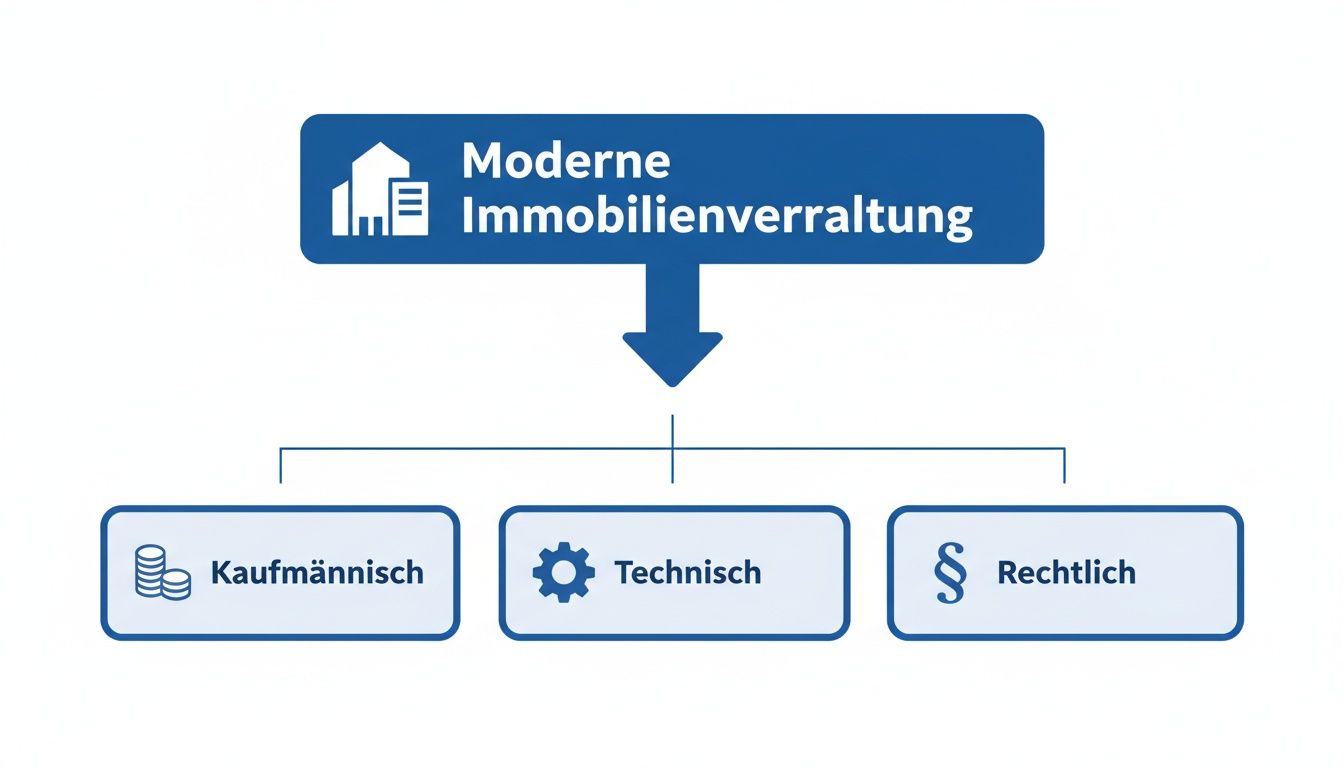
Efficient property management balances four core areas that are closely interlinked. Each area has specific tasks and challenges that must work together perfectly in daily routine to be successful.
This table summarizes the core areas of property management and shows the key tasks and most common challenges in each segment at a glance.
Pillar | Main tasks | Typical challenges |
|---|---|---|
Commercial management | Tenancy and HOA accounting, service charge billing, budget planning, dunning, reporting to owners | Error-prone manual processes, rising costs, non-transparent billing |
Technical management | Maintenance and modernization, maintenance planning, commissioning contractors, acceptance of work | Unplanned repairs, coordination of service providers, documentation of defects |
Letting management | Tenant search, credit checks, conclusion and termination of tenancy agreements, apartment handovers | High administrative effort, communication with prospects, compliance with deadlines |
Legal management | Compliance with laws (tenancy law, HOA law), contract management, handling legal disputes | Constantly changing laws, deadline management, legally secure correspondence |
These four pillars are not separate silos but constantly interlink. A technical problem such as a faulty heating system immediately triggers commercial (costs) and legal (rent reduction) questions. That is precisely why an integrated approach is so important.
The necessity for efficient processes becomes abundantly clear given the market size. In Germany, 9.1 million out of around 25.5 million rental apartments are already managed by professional providers. As these managers plan price adjustments of 12 percent on average to absorb cost increases, efficiency becomes the decisive competitive advantage. To optimize your strategy, learn more about current trends in the housing industry.
The transformation of property management is no longer an option, but a necessity. Those who do not invest in digital, proactive processes today will lose touch with the market and customer expectations tomorrow.
In this transformation, digital tools play a crucial role. They are no longer just nice aids to increase efficiency, but the foundation for strategic, data-driven management.
A platform like DoNexus is designed precisely to facilitate this transition. It bundles communication, automates recurring tasks and creates the necessary transparency so that managers can focus on what really matters: the strategic development of their portfolios and personal support for their clients.
Ten tried-and-tested steps to increase efficiency
Efficiency in property management is no coincidence. It is the result of clearly defined processes and the right tools. It is about getting rid of manual, error-prone tasks so that your team has its hands free for the really important things: value-creating activities.
This section translates theory into practice. The following ten steps are a proven checklist from our daily routine to optimize management processes, raise service quality and concretely reduce costs. Each of these points aims to reduce the daily workload and sharpen the strategic focus of your property management.
Checklist for powerful property management
Here are ten concrete measures with which you can noticeably improve your administrative processes and make them future-proof.
1. Centralize communication channels Emails, calls, messages via portals – the flood of enquiries is often overwhelming. Bundle everything in one central place. In this way, you keep track, ensure that nothing gets lost and avoid duplicate work. The result: significantly faster response times.
2. Classify and assign tasks intelligently Not every task is urgent. Use a system that automatically sorts incoming enquiries by topic, such as "water damage" or "service charge question". In this way, every case ends up immediately with the correct contact person in the team, without manual detours.
3. Automate deadline management Manually kept deadline lists are one of the biggest sources of error in daily management. An automated system monitors contractual and legal deadlines for you and proactively reminds your team. This minimizes risks and ensures legally compliant processes.
A forgotten deadline for a termination or an objection can quickly become expensive. Automated systems are like a digital safety net that protects your team from costly mistakes.
4. Establish a digital customer portal Create transparency for owners and tenants. A portal where they can track the status of their concerns, retrieve documents and communicate directly reduces the volume of calls and emails massively. At the same time, satisfaction increases because everyone is informed at all times.
5. Build and maintain a knowledge base Document recurring processes and solutions in an internal knowledge base. This not only facilitates the onboarding of new employees but also secures the quality and consistency of your work, because the entire team can access proven workflows.
Digitize and automate processes
The next steps go one step further and show how technology can systematically replace manual activities.
6. Accelerate document analysis with AI The manual evaluation of tenancy agreements, declarations of division or handover protocols costs an enormous amount of time. AI-powered tools read these documents in seconds, extract the relevant data and prepare them in a structured way.
7. Define digital workflows for recurring tasks Standardize processes such as tenant searches, apartment handovers or commissioning contractors. Clearly defined digital workflows guide employees step-by-step through the process. This ensures that nothing is forgotten and everything is neatly documented.
8. Use mobile solutions for on-site work Give your team mobile applications to record conditions directly at the property. Photos of defects or meter readings are thus immediately linked with the correct property and process – without any subsequent manual assignment at the desk.
9. Automate regular reporting Create standardized reports for owners that are available at the touch of a button. Professional, automated reporting on finances, maintenance and letting status builds trust and positions you as a strategic partner, not just as a manager.
10. Create integrations between systems Your management software should work seamlessly with accounting, the email program and other tools. A good integration avoids data silos and ensures that everyone in the team works on the same, up-to-date database.
These steps are the roadmap to a modern, relieved administration. Platforms like DoNexus were developed to support exactly these processes. They bundle communication, automate task management and use AI for document analysis – thereby creating the foundation for truly efficient and scalable property management.
The most important areas of responsibility explained in detail
Modern property management is like a well-rehearsed orchestra. It conducts four central areas that must mesh seamlessly. But what does that mean in daily routine? We look closely at commercial, technical, legal and organizational management.
Using a simple water damage incident, it quickly becomes clear how closely interlinked these areas of responsibility really are. If one area fails or works on its own, the entire result suffers. An integrated approach is therefore not a luxury, but the key to success.
The core areas of property management
To master the complexity of daily life, one must understand the four pillars of management and their interactions.
Commercial management It is the financial backbone of every property. This is about clean bookkeeping, the timely generation of service charge bills and budget planning for the coming year. However, dunning in the event of payment delays and transparent reporting to owners also belong here.
Technical management This area concretely secures the value of the property on site. It includes planning and monitoring maintenance, commissioning contractors for repairs and organizing regular maintenance, such as of the heating system. Planning and implementing modernizations to increase value also fall under this.
Legal management This is about complying with all statutory regulations. This affects tenancy law, the Homeowners' Association Act (WEG) and increasingly also energy-related specifications such as the Building Energy Act (GEG). Managing contracts and communicating in a legally secure manner – this is crucial to avoid expensive mistakes.
Organizational management This area is the interface to all parties involved. It bundles all communication with tenants, owners and service providers. Organizing and conducting owners' meetings as well as the clean documentation of all processes are central tasks that ensure transparency and satisfied faces.
A simple water damage in a rented apartment shows how quickly these four areas are interlinked. Without central control, chaos quickly arises and costs explode.
A water damage incident and its consequences
Imagine a tenant reports water on the ceiling of their bathroom. What now? At this moment, a chain of events is triggered that immediately touches all four pillars of property management.
This is how the areas mesh together:
Technical process First, the cause must be found and stopped. A contractor (first leak detector, then plumber) is commissioned to repair the damage.
Organizational process Parallel to this, the affected tenant needs to know when the contractors are coming. Perhaps neighbors must also be informed about water shutoffs or noise.
Commercial process The contractors' invoices must be checked and paid. At the same time, the damage is reported to the building insurance and the entire settlement is accompanied until costs are covered.
Legal process The tenant might claim a rent reduction due to the inconvenience. This must be checked and processed in a legally secure manner.
This example makes one thing clear: an isolated view of tasks does not work. All information – from the tenant's first call through the contractor's invoice to communication with the insurance company – must converge centrally.
An integrated platform is not a "nice-to-have" here, but a necessity to maintain an overview, meet deadlines and coordinate all parties involved.
Platforms like DoNexus are made exactly to manage such complex, cross-divisional processes. They bundle all communication, assign tasks automatically to the correct teams and ensure that all documents and information are available in one place.
Internal management or outsourcing – what pays off for you
As an owner, you will eventually inevitably face a central course setting: do you manage your properties yourself or do you place this task in the hands of an external service provider? This is no trivial question. Both paths have their very own advantages and disadvantages, which weigh completely differently depending on the size of your portfolio, your personal expertise and the time you can invest.
The decision influences not only costs but also the quality of support and even your legal protection.
Those who keep management in-house enjoy maximum control and know every detail of their properties inside out. Yet this advantage has its price: high effort for personnel, constant training and liability risks that should not be underestimated. On the other hand, outsourcing to a professional property management primarily promises relief and deep specialist knowledge. However, many shrink from direct costs and the feeling of giving up control.
Making the right decision for your portfolio
To find out which path is the right one for you, you must weigh up the facts soberly. The following checklist will help you systematically examine both approaches and make a decision based on data and not just gut feeling.
Check these 10 aspects before you decide:
Costs and fees: Compare the fixed costs for your own staff (salary, social security contributions, office) with the variable fees of an external manager. Remember: a service provider often negotiates better conditions with contractors or insurance companies, which can reduce your direct costs again.
Control and influence: How important is it to you personally to tighten every screw yourself? With in-house management, you keep the reins firmly in your hand, whereas with outsourcing you consciously delegate operational decisions.
Specialist knowledge and expertise: Do you really have the necessary knowledge in tenancy law, HOA law and technical regulations internally on hand? A professional manager lives on keeping this knowledge up-to-date and constantly undergoing training.
Time required: The daily nitty-gritty eats up time. Tenant communication, service provider coordination, accounting – do not underestimate this effort. Outsourcing primarily buys you one thing: valuable time.
Scalability: Is your portfolio growing? An external management model often grows more easily with you. In in-house management, you first have to find and train new staff, which costs time and resources.
Liability risks: An external manager is usually covered by professional indemnity and financial loss liability insurance. This protects you from the financial consequences of costly mistakes.
Network and resources: Professional managers bring a network of reliable contractors, lawyers and other service providers grown over years – an invaluable advantage in case of damage.
Technology and digitalization: Does the external partner use modern property management software to keep processes lean and transparent? In our guide to choosing the right software you will find out what matters.
Objectivity: An external manager can act as a neutral buffer between you and the tenants. This often defuses conflicts before they escalate.
Reporting and transparency: Clarify crystal clear how detailed and how often you will be informed about finances, maintenance and letting. This is where the wheat is separated from the chaff.
Here is a comparison summarizing the key points at a glance:
Comparison of in-house management vs. outsourcing This table contrasts the main advantages and disadvantages of in-house management compared to hiring an external property manager.
Aspect | In-house management | Outsourcing to a service provider |
|---|---|---|
Control | Full control over all decisions and processes. | Operational control is given up; focus on strategic specifications. |
Costs | High fixed costs (staff, office), but no external fees. | Variable costs depending on the contract; economies of scale possible. |
Expertise | Internal knowledge must be actively built and maintained. | Direct access to specialized expertise and experience. |
Flexibility | High, as decisions can be made quickly internally. | Dependent on the service provider and contractual arrangements. |
Liability | The full liability risk lies with the owner. | Liability is partially transferred to the service provider (and their insurance). |
Time required | Very high; binds management and employee capacities. | Minimal; creates free space for the core business. |
Network | Must be built up and maintained independently. | Established network of contractors, lawyers etc. is available. |
At the end of the day, there is no right or wrong here. The best solution always depends on your individual situation, your goals and the structure of your portfolio.
The decision for or against outsourcing is not a question of "better" or "worse". It is about finding the solution that best fits your strategy, your resources and your property portfolio.
Whichever model you choose, one thing is clear: it no longer works without digital tools today. Platforms like DoNexus are made exactly for this – they help both internal teams and external service providers to bundle communication and finally control tasks in an automated way. This leaves more time for what really counts.
How PropTech and AI are changing your management
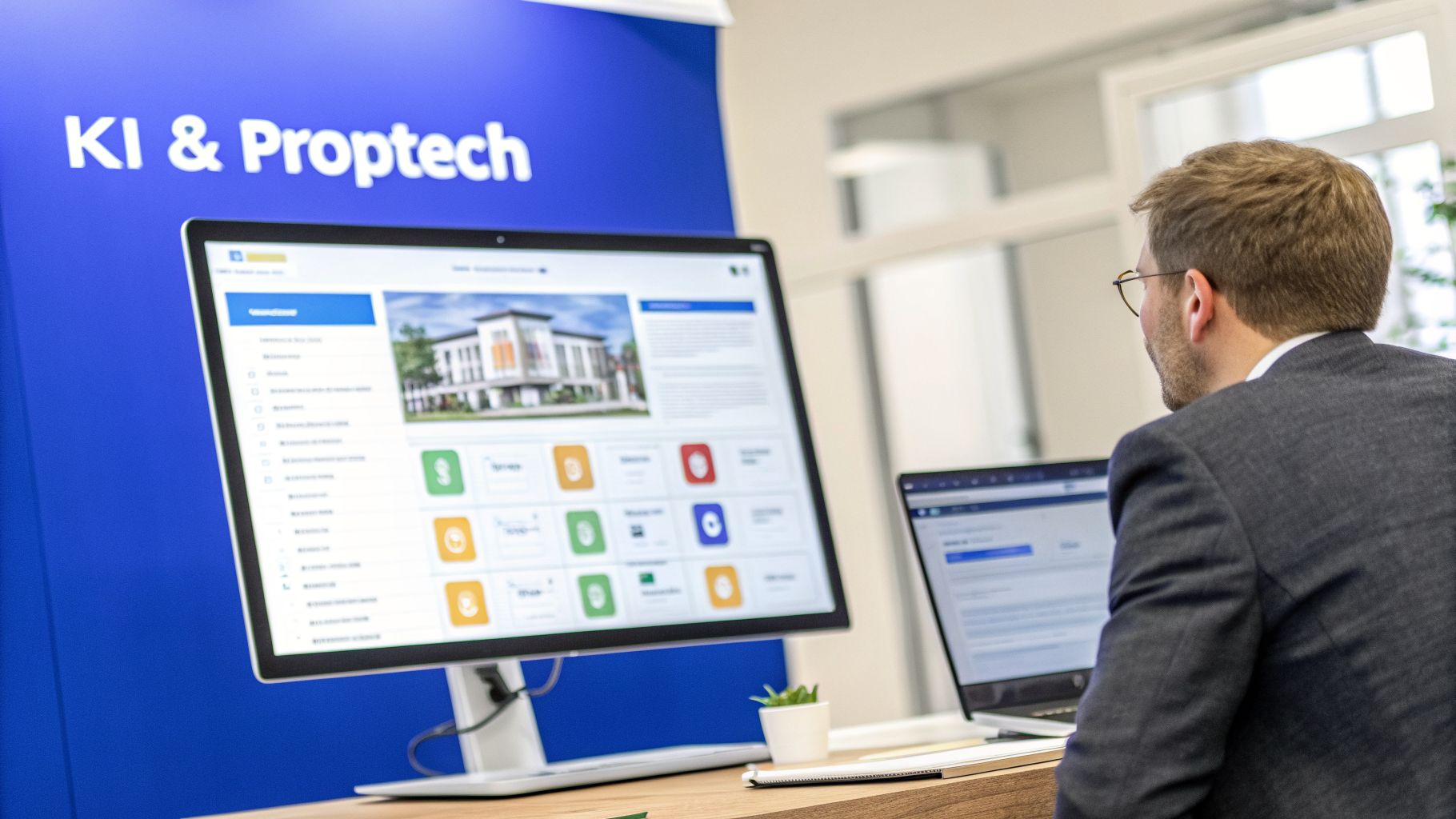
The future of property management is digital. Technologies like PropTech and artificial intelligence (AI) are no longer distant visions. Today, they are powerful tools that turn daily management completely upside down.
Their goal is simple: to automate annoying, repetitive tasks. With this, you give your team the freedom to focus on what really counts – proactive support for clients and the strategic development of the portfolio. Instead of just reacting to enquiries, you can finally act again.
The change begins with getting the daily flood of information under control and abolishing manual processes. Imagine no email had to be sorted by hand anymore, no deadline overlooked and no document searched through with effort. This is exactly what modern AI systems already achieve today. They create free space for better service and healthy growth.
How AI automates concrete management tasks
The use of AI in property management is not an abstract idea but solves very everyday problems. The technology works like a tireless digital assistant that assists the team and unlocks efficiency potentials that would be unreachable by hand.
Here are some examples that directly change your way of working:
Intelligent inbox management: An AI system reads incoming emails, recognizes the content (e.g., a defect report or an invoice query) and automatically assigns the message to the correct property, process and employee. Manual sorting and forwarding are completely eliminated.
Automated prioritization: Not every task is equally urgent. AI evaluates the urgency of enquiries based on keywords like "water damage" or "heating failure" and ensures that critical incidents end up immediately at the top of the to-do list.
AI-powered document analysis: Manually searching through tenancy agreements, declarations of division or protocols for specific clauses is extremely time-consuming. A document AI reads this information in seconds – such as contract periods, notice periods or maintenance obligations – and provides it in a structured way.
AI is not a replacement for the manager, but their strongest tool. It takes over 80% of repetitive routine work so that the team can concentrate on the 20% of tasks that require strategic thinking and human touch.
From cost pressure to growth engine
This technical tailwind is more than just a nice relief – it is becoming an economic necessity. A current analysis shows that the industry's projected revenue growth of 7.8% by the end of 2025 significantly depends on efficiency increases through digitalization.
At the same time, 57% of managers are already terminating unprofitable mandates and almost 14% are no longer accepting any new assignments at all. The number of manager-less communities is growing alarmingly. Implementing AI-powered systems is the most direct way to counteract this trend and manage more mandates profitably.
This is exactly where platforms like DoNexus come in. DoNexus uses AI automation to tame the flood of communication and optimize management processes from scratch. The platform bundles all channels, assigns enquiries intelligently and helps to keep an eye on deadlines proactively. Learn more about how to increase your efficiency with the appropriate AI automation. This is how technology becomes the engine for scalability and secures the future viability of your property management.
How DoNexus makes your property management future-proof
Modern property management must be proactive, efficient and, at the end of the day, above all technology-supported. The decisive question is no longer whether you digitalize, but how you deploy technology in a targeted manner. The goal is clear: away from reactive execution, towards strategic action. It is about eliminating manual processes and giving your team the free space to focus on the essentials – increasing the value of your properties and the satisfaction of your clients.
But how does this change succeed in practice? The key lies in linking everyday challenges directly with intelligent solutions. Instead of juggling countless individual tools for emails, documents and tasks, a central platform like DoNexus bundles all workflows in one place.
How to transform problems into structured workflows
Take a look at the biggest time-wasters in your daily management. This is exactly where a platform like DoNexus comes in, turning reactive tasks into proactive, automated processes.
Taming the flood of communication Instead of sorting countless emails by hand, DoNexus analyzes every incoming message. It is automatically assigned to the correct property and process and forwarded to the responsible employee. The result is a clear, structured workspace where nothing gets lost anymore.
Automating deadline management Manually kept Excel lists for deadlines are a ticking time bomb and a classic source of error. DoNexus reads relevant data such as notice periods or maintenance dates directly from contracts and protocols. This automatically generates tasks with reminders. In this way, compliance with important dates is finally ensured without anyone having to constantly think about it.
Accelerating document analysis Searching for a specific clause in a pages-long declaration of division or an old protocol costs valuable time and nerves. The AI-powered document analysis of DoNexus searches your entire inventory in seconds and delivers the searched information at the touch of a button.
DoNexus is not just another piece of software, but a change of system. It transforms the biggest burdens – the flood of enquiries and documents – into your greatest strengths: structured data and automated processes.
By optimizing these core processes, you do not only solve acute problems but also create the foundation for sustainable growth. Your team is freed from repetitive tasks and can finally focus again on strategic support for your clients and active value appreciation of your portfolio.
Experience for yourself how you can modernize your management processes and equip your team for the future. In a personal demo, we will show you how DoNexus makes your property management more efficient, transparent and scalable.
The most frequently asked questions about modern property management
The leap into modern, digital property management naturally raises questions. What does the whole thing cost? How long does the transition take? And what does it really bring my team in the end? Many managers are unsure when it comes to switching to digital processes.
Here we provide clear and practical answers to exactly these questions so that you can start the transformation of your management perfectly prepared.
What does digitalization really cost?
The costs vary greatly and depend on the scope and the chosen provider. However, a cloud-based platform like DoNexus has a decisive advantage: you save yourself the high initial investments in expensive servers or hardware.
Instead, you pay a monthly or annual license fee, which is often based on the number of managed units or users. However, do not view these costs as pure expense, but as an investment. By automating routine tasks, staff costs quickly drop and efficiency increases noticeably. Usually, this pays off after just a few months.
How long does the introduction of a new software take?
Modern systems are made for a fast introduction. A typical onboarding process often takes only a few days to weeks – not months. Crucial is a good preparation on your part, i.e., collecting and neatly preparing your existing data.
A good software partner then supports you in data migration, ensuring a smooth transition without headaches.
Do I have to train my entire team elaborately?
Yes, training is necessary – but with intuitively designed platforms, the effort is really manageable. The training should focus on the most important new workflows and above all show the team one thing: how the software eases their daily work, not complicates it.
Important points for every training are:
The central inbox: How do we process enquiries now?
Automated task management: How are tasks assigned and tracked?
Digital document storage: How do I find information in seconds?
A successful introduction depends less on technology than on acceptance in the team. Show the concrete benefit for every single individual to reduce resistance and promote motivation.
What is the biggest advantage of automation?
Quite clearly: the time gained. When recurring tasks such as sorting emails, reminding of deadlines or gathering info for reports simply drop away, your team finally has breathing space for what counts.
This includes personal support for owners, proactive planning of maintenance or the strategic development of the portfolio – i.e., the tasks that really create value.
Is property management with AI secure?
Yes, absolutely – provided you rely on a reputable provider. Pay attention to GDPR compliance and server locations in the EU. AI systems process data according to strict, predefined rules. They can even increase security, for example by detecting legal risks in contracts before they become a real problem.
The answers make it clear: the modernization of property management is above all a question of the right tools and a clear strategy. Platforms like DoNexus are designed precisely to make this transition as simple and efficient as possible. They deliver not only the technology but also the necessary support to lead your team successfully into the future. Experience for yourself how you can optimize your administrative processes and visit https://www.donexus.ai.

Daniel Parak
Founder & CEO
Latest Posts
Discover more posts on our blog