AI-Academy
Property Management Organisation: The guide for structured processes
Boost property management organisation with field-tested strategies:...
A functioning property management organisation is less a matter of rigid rules and more a matter of the entrepreneurial attitude that runs like a red thread through all processes. It is the foundation for moving from reactive problem-solving to proactive management, sustainably increasing service quality and relieving the burden on your own team.
Your way out of the chaos: 10 steps for a better organisation
Many management teams battle day in, day out with the same chaos factors: an almost uncontrollable flood of emails, the constantly ringing telephone and confusing Excel lists in which deadlines and responsibilities get lost. Everyone knows the result: overloaded employees, missed deadlines and dissatisfied clients. This guide shows you how to recognise these typical chaos factors and systematically get them under control with concrete solution approaches.
Consider these 10 points as your roadmap to a structured property management:
Analyse the time-wasters: Where exactly is most of the time lost? Is it the manual processing of emails, constant telephone availability or searching for documents? An honest analysis is the first step.
Centralise communication: Create a single input channel for all enquiries (email, phone, portal). No more paper chaos and information getting lost in individual inboxes.
Implement a ticket system: Every enquiry – no matter where it comes from – becomes a digital process (ticket). A classic example: A tenant reports water damage by email. A ticket is immediately created and assigned to the correct property and employee. All further communication (queries from the owner, coordination with the tradesperson) is bundled in this single ticket.
Automate the assignment: Use intelligent systems that understand incoming emails and automatically assign them to the correct property, the right person and the appropriate process. Manual sorting is eliminated.
Define digital standard processes: Establish clear, automated workflows for recurring tasks. Examples include obtaining three quotes for a repair, the process of a defect report or dunning procedures.
Create transparency in the team: Every employee must be able to view the status of a process at any time without having to ask. This avoids duplicate work and time-consuming internal queries.
Use a central document repository: All relevant documents (contracts, invoices, protocols) must be linked directly to the respective process or property. The endless searching in different folders comes to an end.
Integrate your team into the change: Explain the added value of the new processes. Point out which repetitive and frustrating tasks are eliminated. Start with a pilot project to make quick wins visible.
Rely on AI for repetitive tasks: Modern, AI-based systems can not only assign emails but also extract relevant data from documents or draft initial response templates. This creates enormous free space for more demanding activities.
Measure and optimise: Regularly check whether the new processes are working. Where are there still hurdles? Adapt the workflows to continuously improve the organisation of your property management.
The following graphic illustrates the path from unstructured processes to a centrally controlled organisation in which you remain in control.
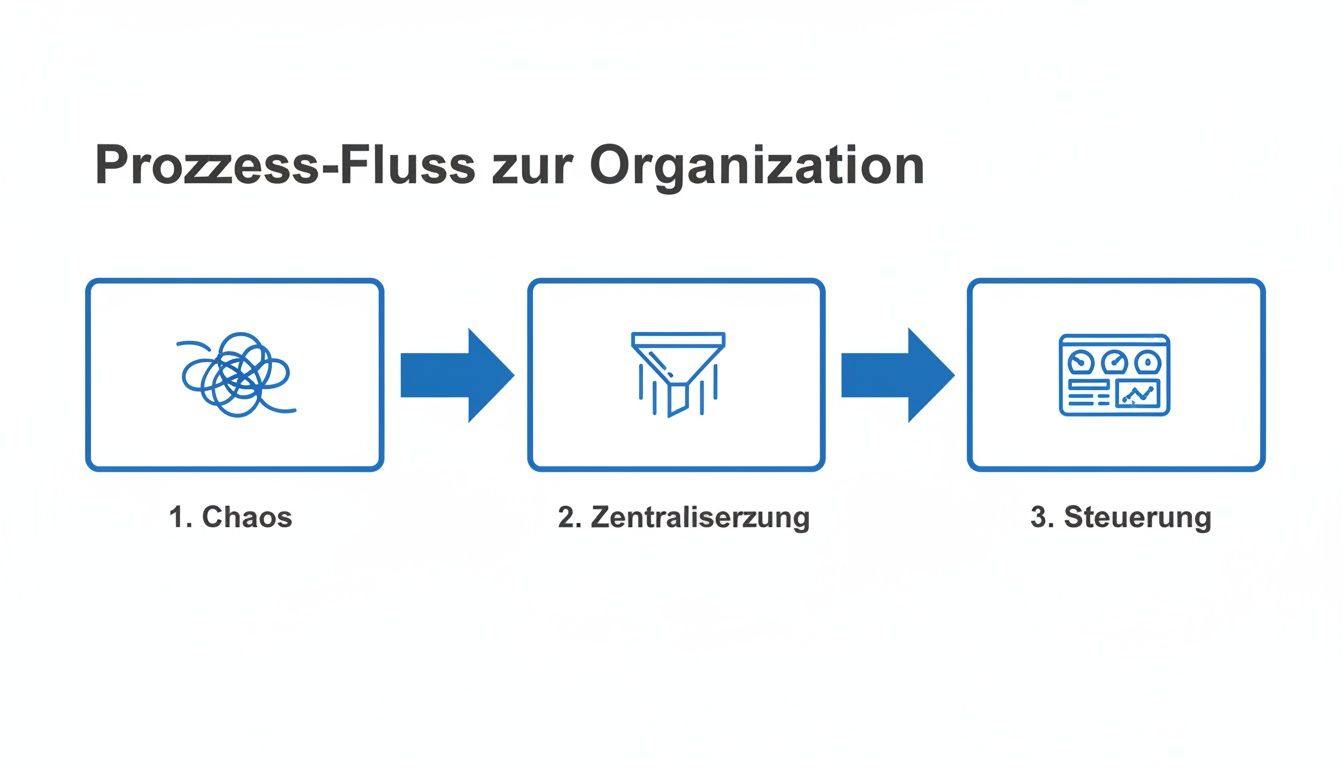
It is clearly visible: The centralisation of the entire communication is the pivotal point to finally become master of the situation again and actively manage processes instead of just reacting to them.
How to structure your property management step by step
A well-organised property management is no coincidence. It is created when the fundamental alignment of the company is correct and this runs like a red thread through all daily processes. We show you how to systematically get a grip on the typical chaos factors that make everyday life so exhausting.
The first and most important step is to honestly analyse where time is really being lost. Usually it is the same suspects: the manual flood of emails and the phone ringing non-stop.
Everyone knows a classic practical example: A tenant reports water damage by email. Shortly afterwards, the owner calls to ask about the status, and the tradesperson asks for the exact address via WhatsApp. Without a clear system, you immediately have three unconnected communication threads for one and the same case. This costs nerves, time and inevitably leads to errors.
Recognise and target the chaos factors
To end this daily muddle, two things are needed: clear rules and a central system that brings all the threads together. Imagine a hub in which all enquiries – whether by email, phone call or portal – are bundled into a single, transparent process.
This is what it looks like in practice:
Communication in one place: All enquiries run through a central channel directly into your system. No more paper chaos and lost emails.
Automated assignment: Every enquiry is immediately assigned to the correct property, the responsible employee and the appropriate process. No more manual sorting.
Digital processes for routine tasks: Recurring tasks such as reminders, commissioning minor repairs or obtaining quotes follow a firmly defined, automated workflow.
A central lever is also the crystal-clear assignment of responsibilities. A successful legally secure transfer of entrepreneurial duties helps you to delegate tasks efficiently and at the same time secure yourself legally.
Modern, AI-supported systems can take over a large part of the work here. They do not only handle the repetitive assignment of enquiries, but can even draft initial responses. How you manage this leap from a mere tool to a fully integrated system is described in detail in our article about AI in property management.
The following table shows at a glance how the daily work routine changes through such a transition.
Comparison of the working methods: Traditional vs. Digitally Organised
A comparison of typical work processes, illustrating the transition from chaotic-reactive to structured-proactive.
Process | Traditional method (Chaos factor) | Digitally organised method (Solution) |
|---|---|---|
Capturing enquiries | Employee reads email, searches for property/tenant manually, creates task by hand. | System captures email automatically, assigns it to property & contact and creates a ticket. |
Status updates | Phone calls and emails to ask colleagues or tradespersons for the status. | All parties involved see the current status transparently in the central process. |
Monitoring deadlines | Manual lists, calendar entries or sticky notes on the monitor. | The system monitors deadlines automatically and sends reminders to responsible persons. |
Communication | Three channels (email, phone, WhatsApp) for one process. Information is scattered. | All communication regarding a process is bundled in one place and traceable. |
Finding documents | Searching in different folders, email attachments and local drives. | All relevant documents are directly linked to the process and instantly findable. |
This comparison makes it clear that it is not about complicated technology, but about a smarter, simpler way of working. The change creates free space for what really matters: looking after properties and personal contact with clients.
Common organisational mistakes and how to avoid them
The best intentions often fail because of the same recurring patterns. A classic mistake: trying to just plaster digital tools over outdated, analogue processes. A ticket system alone does not solve a single problem if responsibilities and escalation stages remain unclear and the organisation of the property management remains essentially the same.
Just imagine this: Employee A searches for the maintenance contract for the lift in his overloaded email inbox. At the same time, Employee B saved it on a local drive months ago. Valuable time is simply lost.
Another well-known mistake is the "everything-in-Excel" trap. Such lists are not only extremely error-prone, they also prevent any scalability and transparent collaboration in the team. Who has the latest version? Who changed what? Pure chaos.
Resistance is human: A lack of team involvement inevitably leads to frustration. Resistance to new systems is completely normal if the personal added value is not clearly communicated. Employees quickly get the feeling of being controlled instead of being relieved.
A clean organisation therefore needs more than just software. It needs well-thought-out processes and a team that really supports the change.
Digitalisation as a motor for growth and efficiency
The market for property management is highly competitive, while at the same time there is a lack of good skilled workers at every corner. As a result, many managements are reaching their limits, even though there would actually be enough potential for growth. At this exact point, the right organisation of property management through digitalisation becomes a real competitive advantage.
Modern platforms do not only save valuable time, they also raise service quality to a new level. Just imagine: An AI-supported document analysis extracts the relevant deadlines from a management contract in a few seconds. A task that takes a good 15–20 minutes by hand. Or think of a digital customer portal that shows owners the status of their enquiries transparently at any time – this significantly reduces time-consuming phone queries.
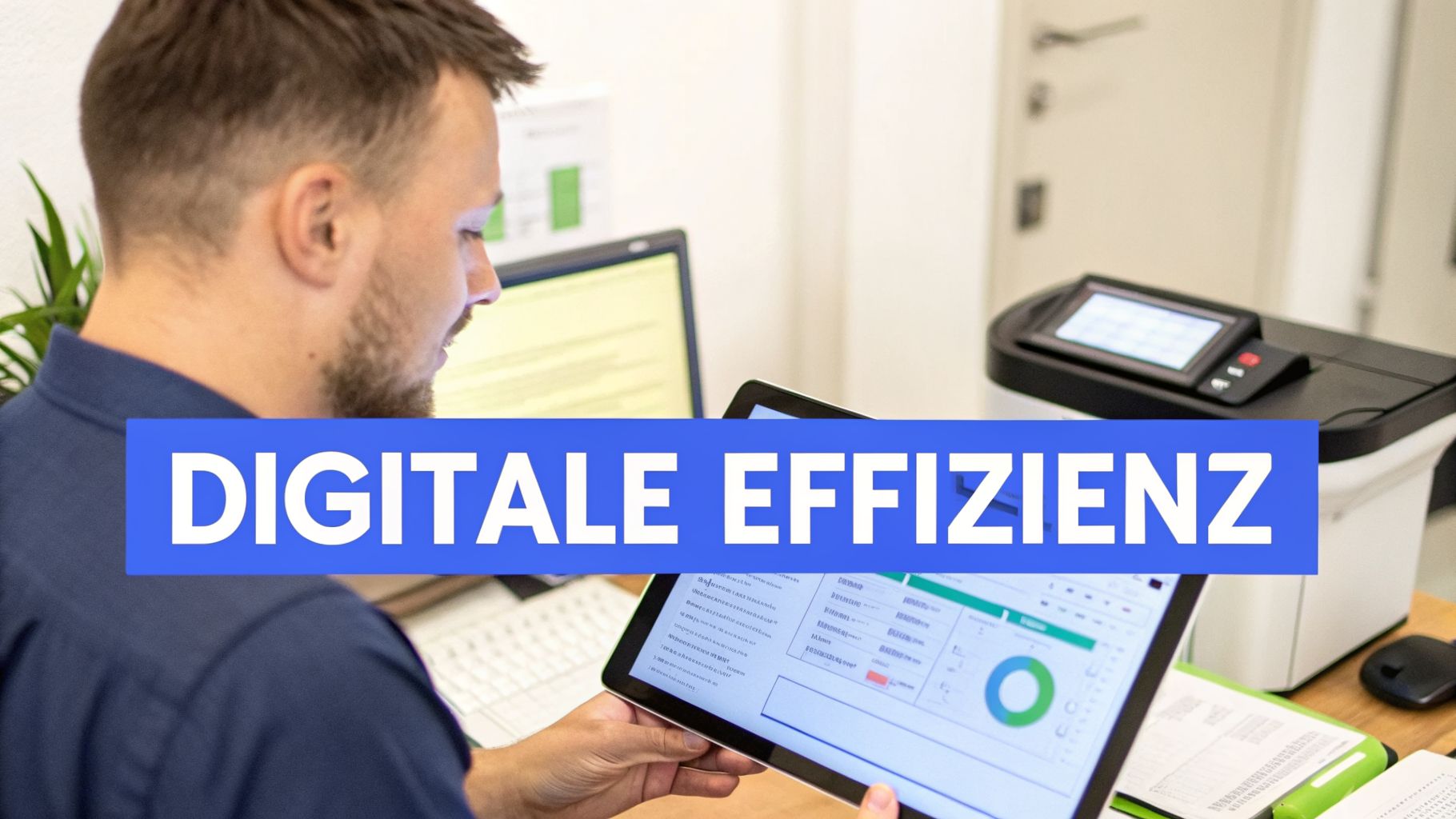
By automating standard processes, growth becomes possible again and profitability increases, even if good people are hard to find.
How central organisation works with DoNexus
Okay, enough theory – now let's get practical. A specialised platform like DoNexus steps in precisely where chaos typically arises in property management, and systematically cleans it up.
Instead of countless emails, phone calls and notes, there is a central workspace that bundles all communication channels. Incoming enquiries are automatically understood by AI, assigned to the correct property and land directly with the responsible employee. No more manual sorting.
The intelligent task management ensures that no deadline slips through. At the same time, the document AI scans contracts and invoices, extracts the relevant data and files it in a structured way. Manual data entry is thus almost completely eliminated.
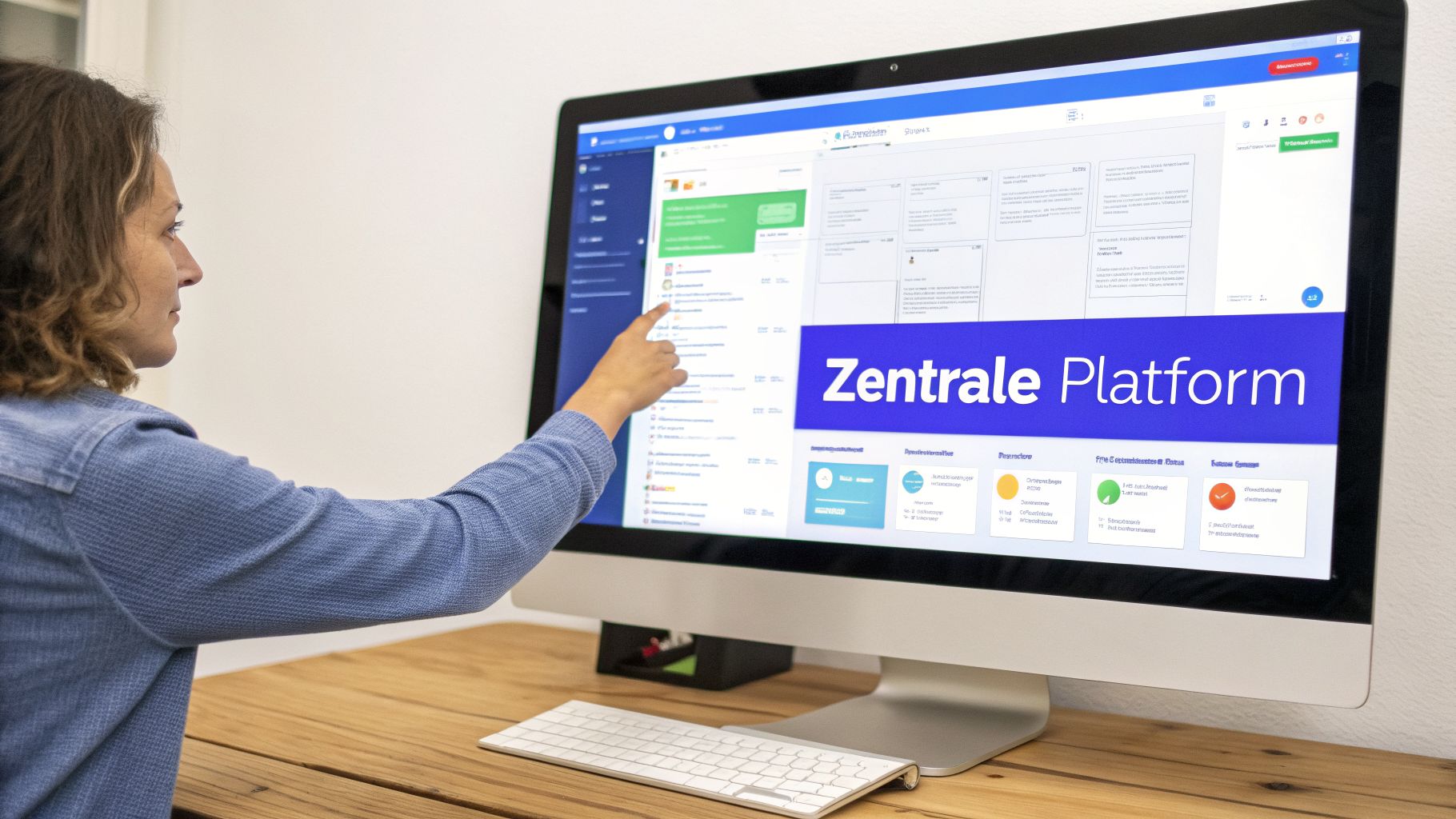
Through the seamless connection to existing ERP systems, teams can finally focus on what really matters: value-adding activities instead of merely processing enquiries. This is exactly where DoNexus comes in: as a central platform that bundles all processes in one place and thus sustainably increases efficiency.
Practical questions about the organisation of property management
To conclude, we answer the questions that managing directors and team leaders ask us again and again when restructuring their property management.
How do I convince my long-standing team of new, digital processes?
Talk about the "why". Show very concretely which gruelling tasks are eliminated and start small with a pilot project. When colleagues see that the flood of emails actually decreases for the testers, a pull effect often arises all by itself.
Which first step has the greatest positive effect?
The centralisation of all incoming communication. Create a single, shared channel for all enquiries regarding your properties. This brings immediate transparency and is the foundation for any further optimisation. Without this step, everything remains piecemeal.
From when does specialised software really pay off?
The question is less about the size of your company and more about the complexity of your processes. A good indicator is when your team spends more time organising tasks than completing them. When searching, sorting and coordinating get out of hand, the time has come.
Are you ready to restructure your property management organisation and leave the daily chaos behind? DoNexus offers the central, AI-supported platform with which you manage your processes, increase efficiency and secure your growth.
Discover now how to relieve your team and raise your service to a new level.

Daniel Parak
Founder & CEO
Latest Posts
Discover more posts on our blog