AI-Academy
Artificial Intelligence Property Management: How to Optimise Your Operations from 2026
Learn how artificial intelligence optimises property management processes,...
Artificial intelligence (AI) in property management is no longer a future topic, but a strategic necessity. It acts as an intelligent digital assistant that automates routine tasks, reduces administrative effort and cushions the acute shortage of skilled workers. By taking over repetitive work such as email sorting and data extraction, AI enables your team to focus on value-adding activities, increase service quality and sustainably improve profitability. Instead of just reacting to problems, managements can act proactively and look after more units more efficiently with the same staff.
10 steps to successful AI integration in your property management
The introduction of artificial intelligence does not have to be a leap into the deep end. A structured roadmap is essential to fully exploit the potential of AI without overwhelming the team or the budget. Consider these ten steps as your practical guide to lead you from the initial idea to successful establishment and secure measurable results.
As-is analysis: Where does the shoe pinch? Start by taking a close look at your current workflows. Where do the biggest bottlenecks occur? Which tasks are particularly repetitive and eat up time? Find out where communication gets bogged down or manual data maintenance slows down your team.
Define clear goals Set yourself specific and measurable goals. Instead of "improving processes", formulate rather: "Reduce response times to standard enquiries via email within six months by 50 %." This is concrete and verifiable.
Start small (Quick Wins) Focus on a single, clearly defined use case with high potential for rapid success in the beginning. Automated processing of incoming emails is often an ideal starting point. Such quick wins increase acceptance and motivation throughout the team. Learn in our article how AI is already working in the real estate industry today.
Get the team on board early on Communication is everything here. Explain to your team from the beginning what you plan to do and what the benefits of introducing AI are. Emphasise that it is about relieving them of routine work – not about replacing jobs.
Define requirements for the solution Create a detailed list of what the solution must be able to do technically and functionally. Should the AI be connected to your ERP system? Which channels (email, phone, portal) does it need to cover?
Ensure GDPR compliance Data protection is a top priority, especially when it comes to the personal data of tenants and owners. Check whether the provider strictly complies with GDPR guidelines and where the data is hosted (ideally in the EU).
Provider selection and test phase Look at various providers that specialise in the real estate industry. Request a live demo and arrange a test phase to try out the solution in your real working environment. You will find more valuable tips on this in our post on evaluating AI use cases.
Calculate Return on Investment (ROI) Calculate the expected benefits. Contrast the investment costs (licence fees, implementation) with the expected savings (fewer working hours, fewer errors) and the potential added value (higher customer satisfaction).
Plan training and onboarding Plan enough time for your team's training. Good onboarding by the provider is crucial so that all employees can use the new software effectively and feel secure.
Measure success and optimise Keep an eye on the previously defined key performance indicators after the launch. Regularly gather feedback from the team and work with the provider to further improve the AI processes.
A platform like DoNexus was specifically developed for the requirements of property management companies and accompanies you in each of these steps. From seamless integration into existing systems to structured onboarding, DoNexus offers a clear path to unlock the potentials of artificial intelligence safely and efficiently for your property management.
Why AI is becoming indispensable for property management
Modern property management companies are under enormous pressure today. The administrative effort is literally exploding, there is an acute shortage of skilled workers and, at the same time, the demands of tenants and owners are rising. Traditional working methods, characterised by floods of emails and manual file keeping, are quickly no longer sustainable.
This is precisely where the topic of artificial intelligence property management comes into play. Instead of just reacting to problems, AI enables proactive, value-adding management. Consider AI as your new digital colleague who never sleeps and takes over exactly those routine tasks that would otherwise slow down your team.
Mastering the biggest challenges
The daily administrative routine is often determined by the same recurring problems that tie up resources unnecessarily. AI systems offer targeted solutions here to overcome these hurdles and tangibly increase efficiency.
Handling the flood of communication: Daily enquiries from tenants and owners – whether via email, phone or portal – quickly lead to chaos. An AI assistant can automatically analyse this communication, categorise it correctly and assign it directly to the appropriate processes.
Compensating for the shortage of skilled workers: Good staff is hard to find and even harder to keep. AI automates time-consuming tasks such as data entry or the first response to enquiries. This relieves your existing employees, allowing them to focus on complex cases where they are really needed.
Meeting customer expectations: Tenants and owners today expect rapid responses and transparent processes. An AI-supported system works around the clock and ensures prompt, consistent answers, which sustainably improves satisfaction.
AI transforms the reactive chaos of firefighting into proactive, structured management. It creates the foundation to manage more properties with the same team while increasing service quality.
Your roadmap to successful AI integration
The introduction of artificial intelligence in your property management does not have to be a leap into the deep end. Rather, it is a strategic process that begins with clear planning. The key to success lies in breaking down the project into manageable, logical phases. In this way, you proceed step by step in a controlled manner, ensuring that the new technology is not only introduced but also sustainably anchored in the team – and ultimately delivers measurable results.
The following graphic clearly illustrates this process: from daily challenges such as piles of paper, the use of an AI assistant leads to smart, efficient solutions.
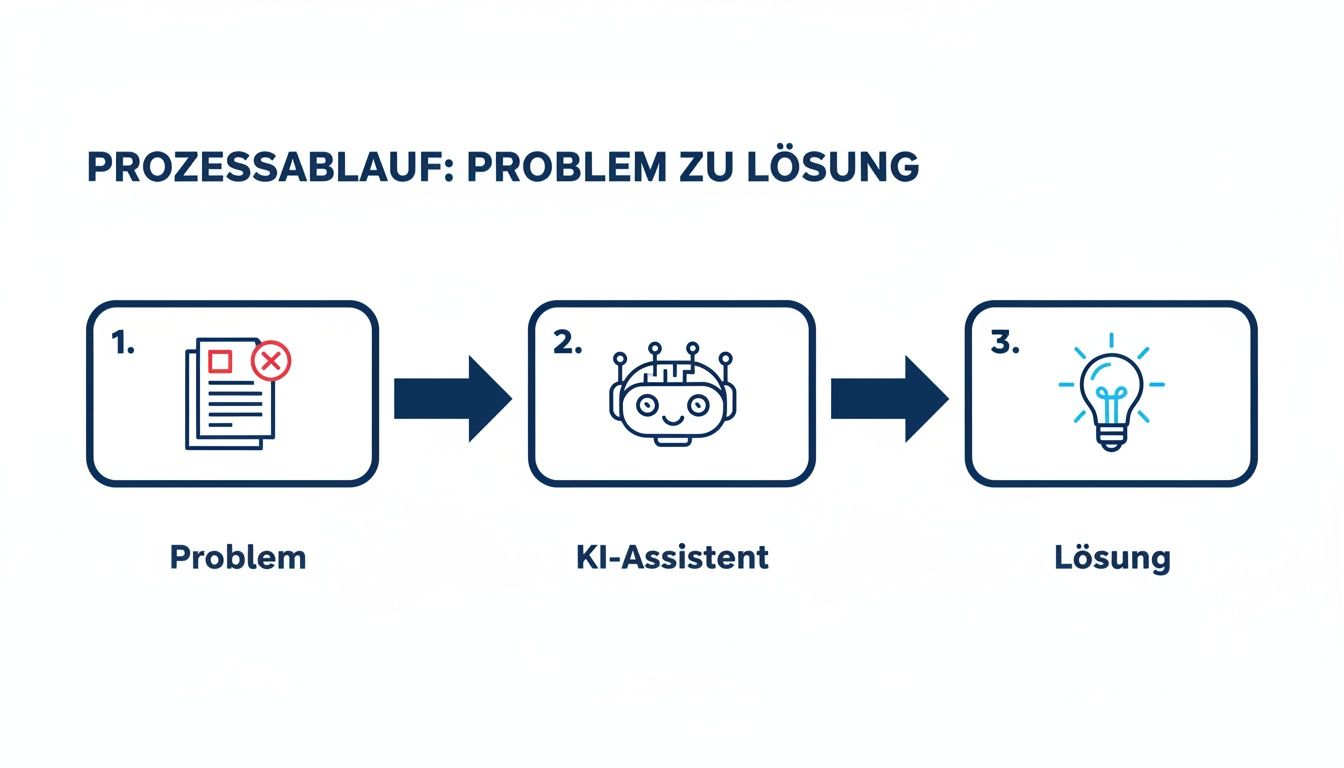
Here you can see very clearly how artificial intelligence in property management works as a bridge – between current problems and an optimised future. The AI assistant transforms manual, paper-based work into automated, intelligent results.
AI in practical use: Your management reimagined
The theory behind artificial intelligence is one thing. But how does it tangibly change the daily work routine in your property management? Today, AI is no longer an abstract concept, but a practical tool. It starts precisely where the biggest bottlenecks occur: with routine tasks that eat up time and tie up valuable resources.
By automating recurring workflows, AI creates free space. Your team can finally focus on the activities that really make a difference again.
Let's look at four areas in which a specialised AI for property management delivers immediately tangible added value and transforms reactive processes into proactive, efficient workflows.
1. Unified and intelligent communication
The biggest time-waster in most administrations is unstructured communication. Emails, calls and messages across various channels create constant noise that must be sorted, prioritised and assigned manually. A modern AI system becomes your intelligent inbox manager here.
The AI analyses every incoming message – whether email, telephone note or portal enquiry. It understands the content, urgency and context. Instead of an employee having to open and painstakingly assign every single email, the AI does this automatically in the background.
What this brings in concrete terms:
Automatic prioritisation: The AI detects an emergency such as water damage immediately and forwards it to the responsible person, while standard enquiries are collected systematically.
No more lost information: Every message is automatically assigned to the correct process, the correct property and the correct tenant or owner. Nothing gets lost anymore.
Significantly faster responses: Because manual sorting is completely eliminated, your team can directly take care of processing the requests. A response to enquiries that is up to 62 % faster is not uncommon here.
2. Automated document processing
Directly after communication, the flood of documents comes as the second major challenge. Invoices, protocols, contracts or insurance policies – they all contain critical information such as deadlines, amounts and responsibilities. Recording this data manually is not only time-consuming but also extremely error-prone.
A document AI, as integrated into modern platforms, reads and understands these documents in seconds. It extracts all relevant data and prepares it for systemic processing.
Imagine: An invoice arrives by email. The AI recognises the sender, reads the invoice amount and deadline, and automatically creates a payment task in the system – without a single number having to be typed manually.
3. Proactive and transparent task management
Once concerns and documents are recorded, the actual work begins. But who keeps track of whether tasks are also completed on time? This is where AI-supported task management comes in, which goes far beyond a simple to-do list.
The AI independently creates tasks based on the recorded information, assigns them to the responsible persons and monitors compliance with deadlines. If a deadline threatens to pass, the system escalates automatically and informs the team leader. This creates a completely new level of commitment and transparency throughout the team.
The commitment to the topic of artificial intelligence property management is enormous in Germany: a proud 93 per cent of companies are already implementing or planning AI pilot projects. However, reality also shows: only five per cent of these companies have achieved most of their goals so far. Cyber security and data protection, lack of skills and insufficient change management are often cited as the biggest hurdles.
4. Transparent customer portals that really relieve pressure
Modern tenants and owners expect a service that is available around the clock. A digital customer portal supported by AI is the logical answer here. It offers 24/7 insight into the status of enquiries, important documents and appointments. Up to 70 % of recurring standard enquiries can be caught through self-service this way.
This not only enormously relieves your team but also increases the satisfaction of your customers. They no longer have to pick up the phone or write an email just to get a simple status update.
To secure the benefits of AI in the long term, it is important to understand the challenges of running AI after implementation.
The measurable success of AI in numbers
Talking about artificial intelligence in property management is more than just playing with ideas about the future. It is about a solid, strategic decision whose benefits can be measured directly in numbers.
When routine tasks are automated and workflows become cleaner, real added value is created. This shows itself very concretely in saved time, lowered costs and a service quality that your customers feel. These are not abstract promises, but tangible results that fundamentally change the daily work routine and economic efficiency of a property management company.
Massive time savings through automation
The biggest and fastest gain is the enormous time saving. Practice shows: modern AI systems can take over up to 80% of the always identical routine tasks in property management. Sorting emails, typing out invoice data or answering standard questions manually – the AI does all of this.
For your team, this means hundreds of hours per month that are no longer lost to mind-numbing, repetitive work. This valuable time flows directly to where it is really needed: into the personal care of owners, into negotiations with service providers or into the strategic development of your portfolio.
Significant cost reduction and scalability
Time is money – this old wisdom becomes a business reality through AI in property management. More efficient processes lead directly to tangible cost reductions. When employees need less time for manual follow-up work and errors become rarer through automation, operational costs drop.
An AI-supported property management company can grow its portfolio without having to hire new staff proportionally. Growth is supported by technology, not by new heads alone. This leads to significantly higher profitability per managed unit.
Precisely this principle enables property management companies to look after more properties with the same team size. You thus gain a decisive competitive advantage and set the course from linear to exponential growth.
The tangible increase in service quality
Good service often feels soft and hard to measure, but with AI this factor suddenly becomes tangible in figures too. Let's look at a nationwide industry analysis as an example: top performers achieve scores of 85 to 100 per cent in the service climate. An artificial intelligence for property management is a decisive lever here. Solely through digital customer portals that manage enquiries intelligently, the number of recurring queries can be reduced by up to 50 %. You can read the complete results of the industry analysis at F+T Immobilien here.
The effect is immediately visible:
Shorter reaction times: Enquiries are accepted round the clock and assigned to the correct process immediately. Processing starts virtually straight away.
More transparency: Owners and tenants can view the status of their requests online at any time. This creates trust and reduces queries.
Proactive service: The AI detects when problems accumulate or deadlines threaten to be missed. You act proactively instead of just reacting to problems.
Comparison: Traditional vs. AI-supported property management
This table contrasts key processes of a traditional property management company with those using an AI solution like DoNexus. The difference quickly becomes clear.
Process | Traditional property management | AI-supported property management |
|---|---|---|
Inbox | Manual screening, sorting and forwarding of each email. High time requirement. | AI automatically reads, understands and assigns emails. Only checked processes land with the team. |
Document search | Time-consuming search in folders and various digital filing systems. | AI finds relevant information in all documents in seconds via search query. |
Customer enquiries | Phone calls and emails that constantly interrupt the workflow. | Customer portal with 24/7 status updates. AI answers standard questions and reduces follow-up queries. |
Task management | Manual creation of tasks, often with media disruptions and missing info. | AI automatically creates complete processes from emails and documents. |
Growth | More properties almost always mean more staff. Linear, expensive growth. | Scaling through technology. More properties can be managed with the existing team. |
You can clearly see how the focus shifts: away from manual hard work, towards steering, control and personal care.
How to find the right AI solution for your property management
The decision for a technology partner is one of the most important course settings for the future of your property management. The market is growing rapidly and the choice can quickly overwhelm. It is about finding a solution that is not only technically mature but also really fits your processes – and delivers real added value instead of just creating another software island.
A well-founded decision protects you from expensive bad investments. It ensures that the artificial intelligence in your property management provides tangible relief from day one.
Checklist: What matters when choosing the right AI partner
Use this checklist as a guide to systematically evaluate potential providers. A good partner should be convincing in all of these areas.
Industry specialisation: Was the solution built explicitly for the real estate and property management industry? Generic AI tools often understand neither the subtleties in communication with tenants and owners nor the structure of an operating cost statement.
Seamless integration: Can the software be easily connected to your existing IT landscape, above all to your ERP system? A solution that cannot communicate with your master data ultimately creates more manual work than it saves.
Transparent onboarding process: How quickly and smoothly does the transition take place? A good provider has a clear, structured plan to import your historical data and get the system ready for use quickly.
Cloud-based architecture: A modern, cloud-based solution gives you flexibility, scalability and security without you having to worry about maintaining your own servers.
Understandable pricing model: Be careful with providers with hidden costs. The pricing model should be clear, fair and comprehensible, for example based on your scope of use or the number of managed units.
Choosing the partner is critical to success. A specialised provider understands your pain points and delivers a solution that feels like it was built for precisely your challenges – and not the other way around.
Data protection and security (GDPR): Ensure that the provider operates in compliance with GDPR and stores the data in secure, ideally EU-based data centres. This is indispensable when handling sensitive tenant and owner data. To ensure successful AI integration, it is crucial to find the matching solution. Similar considerations on the selection process, albeit in a different field, can be found in this post on finding the right AI marketing agency.
This trend is also confirmed by market developments: the German ICT market is expected to grow by 4.4 per cent by 2026, with AI platforms growing the most with an increase of 61 per cent. This boom is a direct response to the shortage of skilled workers and the increasing regulatory requirements that property management companies are also feeling.
The most important questions about AI in property management (FAQ)
Anyone considering introducing Artificial Intelligence in property management understandably has questions. The technology is new and raises topics such as data security, costs and the impact on the team. In this section, we answer the most common and urgent questions asked by managing directors and managers.
Is our data still secure if we use AI? Yes, absolutely – provided you choose a specialised provider. The key is that your partner strictly complies with GDPR specifications and processes all data on servers within the EU. Professional solutions like DoNexus are designed exactly for this.
Will AI eventually replace our employees? No, AI does not replace employees, but relieves them of repetitive tasks such as sorting emails or extracting data. Your team finally has more time for complex cases, personal care and strategic work.
How complicated is the introduction of an AI solution really? Significantly less complicated than most fear. A good provider takes you by the hand, starts small (e.g. with the inbox) and thus ensures quick wins and high acceptance in the team.
What concrete benefits do we get even in the short term? The biggest and immediately tangible advantage is the massive time saving. Up to 70 % of routine enquiries can be processed automatically, which leads to faster response times from day one and tangibly reduces the workload.
A partner like DoNexus was specifically developed for these challenges of the property management industry. The platform is designed to ensure a fast and smooth transition by combining a structured onboarding process with seamless data integration. The specialised AI automation from DoNexus is trained to understand and optimise the specific communication and document processes of property managers – thus teams are relieved immediately. Are you ready to make your property management future-proof? Start your transformation on donexus.ai now.

Daniel Parak
Founder & CEO
Latest Posts
Discover more posts on our blog