AI-Academy
Property Manager Training: Your practical guide for getting started
Start your training to become a property manager. Insights into IHK certificates,...

The training to become a property manager is your direct entry into a crisis-proof and future-oriented industry. This guide leads you through all the important stages in a highly practical way: from the legal foundations and the various educational paths to financing and an efficient start with digital tools.
In 7 steps to becoming a qualified property manager
Self-assessment: Check whether you bring the necessary soft skills such as organizational talent, communication strength and stress resilience.
Understand legal foundations: Familiarise yourself with the trade permit (§ 34c GewO), the mandatory training requirement (20 hours in 3 years) and the certification requirement.
Choose educational path: Decide between a recognized IHK qualification, a flexible distance learning course or an academic degree, depending on your personal goals and your time budget.
Compare providers: Obtain information material from at least three providers and compare course content, costs and graduate feedback.
Secure financing: Clarify early on whether you can use funding such as the education voucher (Bildungsgutschein) from the Federal Employment Agency or the Aufstiegs-BAföG.
Master the learning phase: Create a realistic study plan and stick to it with discipline, especially in flexible formats.
Go digital: Rely on professional software from the very beginning to put what you have learned into practice efficiently and automate administrative tasks.
The professionalisation of the industry and the high staff workload of many administrations create excellent career opportunities. A proactive approach, supported by the right digital tools like DoNexus, gives you a clear competitive advantage right from the start.
Your entry into property management

The profession of property manager has professionalised significantly in recent years. Simple "managing" is no longer enough by far. Today, strategic thinking, legally sound knowledge and digital competence are required.
Particularly because condominiums are so popular as an investment, the demand for good managers is huge. The industry barometer of the VDIV shows it in black and white: around 70% of administrations feel understaffed. This naturally creates excellent career opportunities for well-trained newcomers. You can find more on the current market data of the property management industry here.
Legal framework at a glance
Before you start, you should know the legal foundations. The job title has been protected since the WEG reform and requires a trade permit under § 34c GewO.
A key pillar is the mandatory training requirement: within three years, you must prove 20 hours of training. This not only ensures quality across the entire industry, but also keeps your own knowledge fresh.
Additionally, there is a certification requirement. It officially confirms your competence and immediately creates trust with owners' associations.
Modern tools as a success factor
My tip: rely on efficiency from the very start. Modern software solutions take administrative routine tasks off your hands and thus free up space for what really matters – the strategic support of the properties.
A proactive approach, supported by the right digital tools, gives you a clear competitive advantage. Platforms like DoNexus help to structure processes cleanly from the beginning. This makes the transition from learned theory to practice much easier.
Your path to becoming a qualified property manager
So you have decided to become a property manager? Great, that is the first step. But how do you proceed concretely? This section is your roadmap. We look at what you should bring to the table personally, what educational paths are available and how you can master the first steps in the job after graduation. It's about making a decision that really fits you and your life.
The path to becoming a qualified manager does not begin in the seminar room, but with an honest self-assessment. Ask yourself: do I have an organizational talent? Do I stay calm even when things get hectic and the phones don't stop ringing? Can I sit between two chairs and mediate? The work demands strong nerves and a good hand for communication, in addition to commercial and technical knowledge.
If you nod at most of these points, we can move on to the next step: the right educational format. The options are diverse, and each has its own strengths.
What you should look out for in your training
Before you decide on a provider, you should think through a few key points. These factors ultimately decide whether the training will be a complete success or just expensive.
Your learning style and time budget Do you learn best in direct exchange with others? Then a classroom course, for example at the IHK, is probably just your thing. Do you, on the other hand, need full flexibility because you have to balance work and family? Then a distance learning course is often the much better choice.
Recognition of the qualification Make sure that the qualification is actually worth something. An IHK certificate has an excellent reputation in the industry. For distance learning courses, you should check whether state accreditation (such as by the ZFU) is present. This is a good sign of quality.
Financing and funding opportunities Good training is not free. Expect costs between €1,500 and over €3,000. Clarify as early as possible whether you can get funding. The education voucher from the Federal Employment Agency is a well-known option that often covers the costs completely.
Practical steps for starting
As soon as the rough direction is clear, it becomes concrete. Here are a few practical tips to ensure a smooth start.
Compare providers Have information material sent to you by at least three different providers. Do not only look at the price, but also compare the course content, the support and what former participants have to say.
Apply for funding Approach the Federal Employment Agency or other funding bodies early on. Applications for an education voucher often take time.
Create a study plan Especially if you choose a flexible format like a distance learning course, discipline is key. Make yourself a realistic study plan with fixed times and stick to it.
After graduation, things really get going. In practice, you will see how well you can actually implement what you have learned. Remember: training is the foundation, but how efficient you are in daily life decides your success.
The reality in the job often looks different from the theory in the textbook. In daily work, you juggle hundreds of emails, calls and documents. Without a crystal-clear structure, you can quickly drown.
Modern tools are not a luxury here, but a necessity. A platform like DoNexus helps you build professional processes from the start. Instead of sinking in administrative chaos, you can focus on what your new role really is: solving complex problems and creating value.
Finding the right training path
Deciding on the right educational path is far more than just choosing a course – it is the foundation for your entire professional career as a property manager. There are various paths that will lead you to your goal, and each has its own strengths and weaknesses. To make the right turn for your personal and professional situation, it is worth taking a close look at the most common options.
This visual decision-making aid summarises the most important considerations on the way to becoming a property manager – from the initial suitability test to the question of financing.
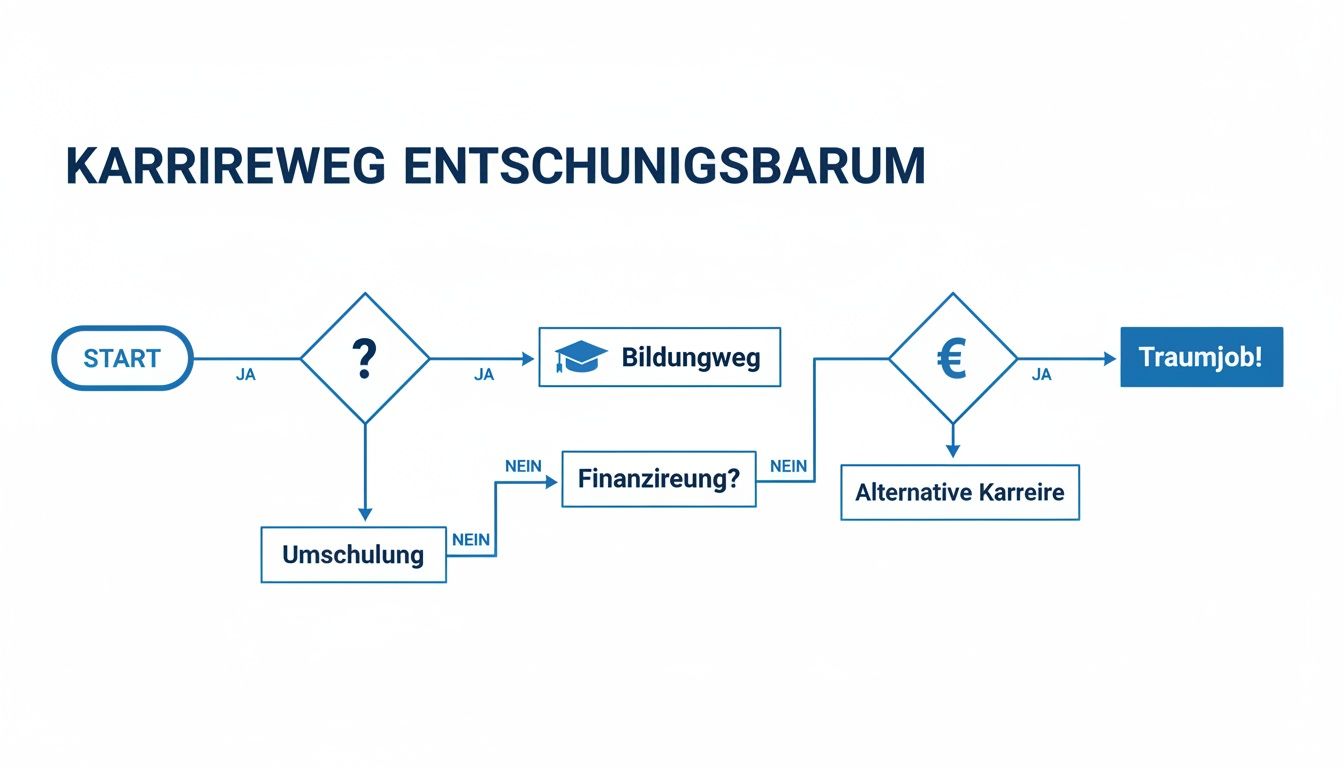
The graphic makes it clear: an honest assessment of your own prerequisites, preferred learning style and financial possibilities is key to finding the optimal path for you.
The IHK qualification as the industry standard
The qualification "Certified Property Manager (IHK)" is something like the gold standard in the industry. It is highly regarded and signals to potential employers and clients at first glance that sound, certified expertise is present here.
The courses cover literally everything you need in daily life: from legal basics in WEG and tenancy law, to commercial topics like bookkeeping and operating cost accounting, right through to the technical basics of building management.
This path fits perfectly for everyone who appreciates structured training with personal exchange. The recognized qualification is a real door opener and creates a solid basis of trust.
Direct contact with lecturers and other participants in face-to-face classes or in blended learning formats is priceless. Professional networks often develop from this that carry you through years.
Distance learning as a flexible alternative
For working professionals, career changers or people with family commitments, distance learning is often the only realistic option. Its flexibility is unbeatable. You study when and where it fits into your daily life, and determine the pace entirely yourself.
But here it is crucial to pay attention to state recognition, for example by the State Central Office for Distance Learning (ZFU). This is your guarantee that the learning content and the pedagogical preparation meet real quality standards. A reputable distance learning course is more than just an online course; it offers personal support, regular assessments of learning success and a qualification that is actually worth something.
Academic paths for strategic depth
For those who want to aim higher from the start or already bring solid prior experience, an academic path can be exactly the right choice. A degree course in the field of real estate management or facility management at a university of applied sciences or university imparts not only operational knowledge, but above all strategic and management-oriented skills.
Graduates of such degree programmes are typically in demand for leadership roles or specialised tasks in large real estate companies. However, it is also clear that this option requires a significantly higher investment of time and money.
Comparison of training paths to become a property manager
This table compares the main training options based on duration, cost, target group and qualification, to enable a quick and informed decision.
Feature | Certified Property Manager (IHK) | Certified Distance Learning | Degree/Master Craftsman |
|---|---|---|---|
Duration | 6–12 months, part-time | 12–24 months, flexible | 3–5 years, full or part-time |
Costs | €1,500 – €3,500 | €1,200 – €3,000 | Often high five-figure sums |
Target group | Career changers, professionals | Working individuals, self-learners | School-leavers, managers |
Qualification | IHK Certificate | Provider Certificate (ZFU) | Bachelor/Master, Master Craftsman |
The table shows that there is a suitable path for every life situation. The decision depends heavily on personal goals and available resources.
Whichever path you choose, one thing is certain: dealing with new technologies is essential. Digitalisation is shaping property management today more than ever before. If you want to understand what role AI plays in this, you can find out more here about how AI is already working in the real estate industry today.
Ultimately, everything depends on your goals, your learning style and your life circumstances. Take the time to carefully review the options to correctly set the course for your professional success. Modern tools are essential to implement what you have freshly learned. A platform like DoNexus helps to transfer theoretical knowledge directly into practice by automating administrative processes and creating a clear structure for daily tasks.
How much the training to become a property manager costs and what funding is available
Training to become a property manager is a smart investment in your professional future. But of course, the financing must be well-planned. The costs fluctuate quite widely – from IHK courses, which usually range between €1,500 and €3,000, up to more expensive distance learning degrees.
The good news is: there is a whole range of funding opportunities that can make this financial hurdle significantly smaller. The key is to know the right pots and to apply correctly. From state subsidies like the education voucher to tangible tax advantages – the options are so diverse that high-quality qualification becomes feasible for almost everyone.
How to manage the financing step by step
To cover the costs of your training to become a property manager, it is best to proceed systematically. Clean planning is key here.
1. Estimate costs realistically: First, get concrete offers from several providers. Do not only look at the pure course fees. Also think about exam fees, teaching materials and possible travel expenses. This is how you avoid nasty surprises.
2. Check funding opportunities: The education voucher from the Federal Employment Agency is probably the best-known option and can even cover the costs completely. In addition, there is the Aufstiegs-BAföG for more demanding training or specific funding programmes of the individual federal states. A quick call to the responsible offices is always worth it.
3. Use tax advantages: As a rule, you can deduct training costs from tax as professional expenses or special expenses. So keep all receipts carefully and speak briefly with your tax advisor to get the maximum out of this.
Quick reminder: since 1 August 2018, property managers have a statutory training requirement. Within three calendar years, 20 hours of further training must be proven. This is specified in § 34c Paragraph 2a of the Trade Regulation Act (GewO). Certified courses, as offered by the IHK, cover this need perfectly – and are often made significantly more affordable by funding. You can find out more about the background of the training requirement for property managers in this insightful article.
The screenshot of the Federal Employment Agency shows the central point of contact for the education voucher – one of the most important funding schemes ever.
This official page is the best starting point to check the exact requirements and arrange a consultation appointment directly.
What you should think about before applying
If you are considering external financing such as a loan, good preparation is crucial. It can be useful to know how to improve your credit rating to get the best possible conditions.
Well-thought-out financing not only secures your training, but also makes it easier for you to start in practice. If you then want to start directly after graduation, professional software like DoNexus helps to implement what you have learned immediately and efficiently and to automate administrative tasks from the very beginning.
Start efficiently with digital tools
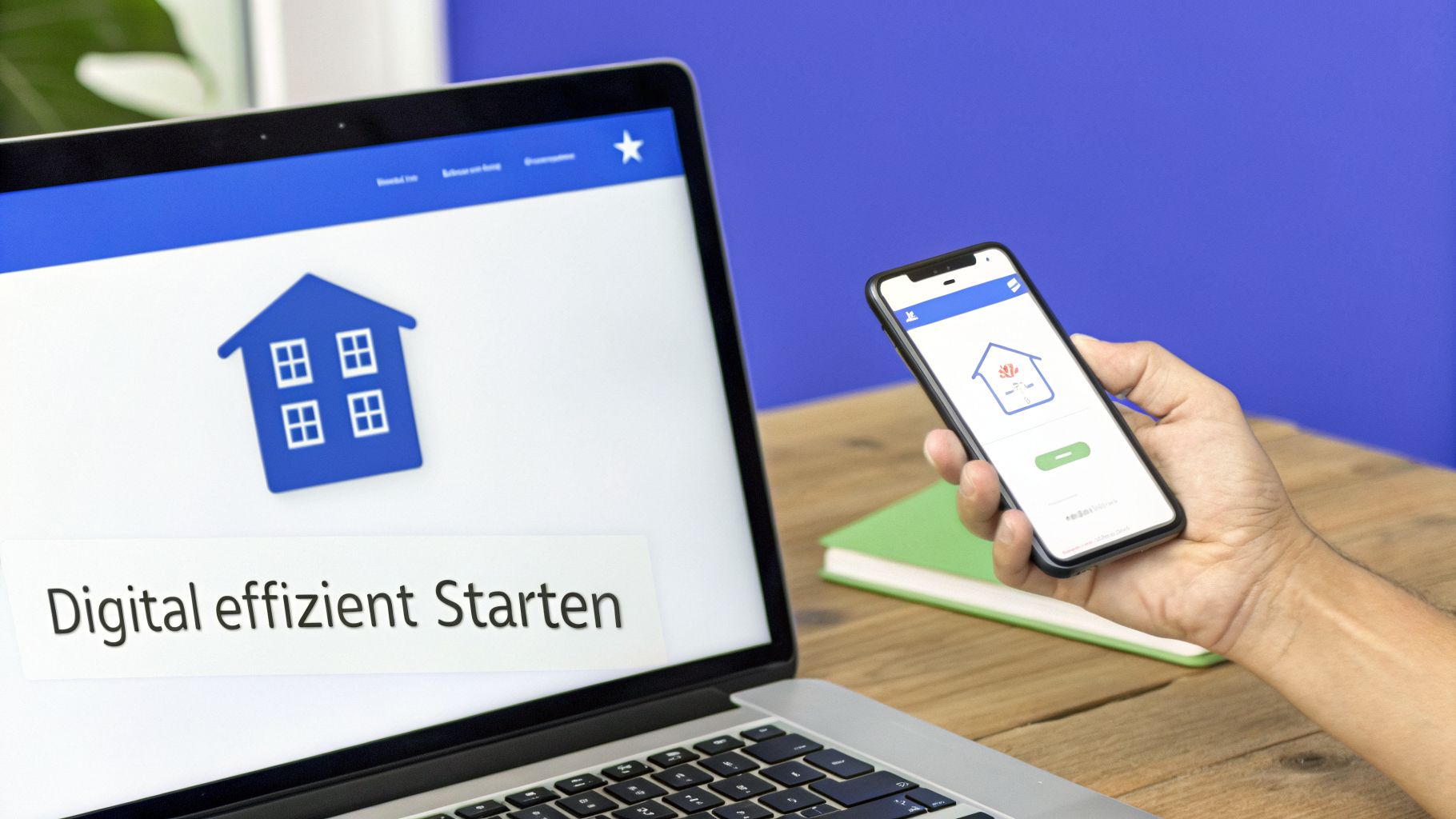
The training to become a property manager is done, the certificate is on the wall – congratulations! But the real test begins only now, in daily business. This is where it shows how well you translate fresh knowledge into clean, efficient processes. And the key to this lies in modern, digital tools that support you from day one.
Imagine your working day starts not with an overflowing inbox and a desk full of sticky notes, but with a clear dashboard that shows your most important tasks prioritized. Instead of laboriously organizing emails, calls and documents by hand, an intelligent platform does it for you.
This is exactly where specialized software solutions come in. They take the dull, repetitive administrative tasks off your hands so that you can focus on what really matters: looking after your properties and clients. This is how you avoid typical beginner mistakes, work professionally from the start and show owners and tenants from day one that you can be relied upon.
From knowledge to practical application
The leap from theory to practice is often the biggest hurdle. In the course, you learned how an operating cost statement is structured or what deadlines apply to a termination. In daily life, however, you have to apply this knowledge under time pressure to dozens of cases simultaneously.
Digital helpers bridge this gap. They give your processes a firm structure and help to transfer what has been learned directly into practice.
Central transaction processing: Every single tenant inquiry is automatically assigned to the correct property, the responsible person and the matching transaction. No more searching.
Automated communication: Standard answers to frequent questions or status updates to owners? The system sends them automatically.
Deadline and task management: No important date slips through anymore. The software creates tasks independently and reminds you of every deadline.
A structured start is half the battle. Instead of sinking in administrative chaos, you work like an experienced professional from the start with the right software. This creates not only efficiency, but above all the trust of your clients.
The role of AI and automation
Modern platforms even go one step further and use artificial intelligence to take work off your hands. Tools like DoNexus do this in a very concrete way by automating recurring processes supported by AI, thus freeing up valuable time. Requests are classified, deadlines monitored and documents captured as if by themselves.
The cloud AI is trained on the specific knowledge of your company, integrates existing systems like ERP or CRM and scans contracts in seconds.
If you do not just want to use tools, but want to rethink processes holistically, you should also look into the topic of Digital Transformation. It secures success in the long term.
If you combine your training to become a property manager directly with the use of the right technology, you lay the perfect foundation for a successful and, above all, scalable career. High-performance software for property management is not a pure cost factor, but a strategic investment in your future. The DoNexus platform is designed exactly for this: to seamlessly bring theoretical knowledge into practice – it bundles communication channels, assigns requests intelligently and ensures transparency for all involved via a digital customer portal.
What else you should know
Even after a comprehensive guide, a few specific questions often remain open. Here, I have gathered the most common uncertainties from practice and answered them briefly for you – so you can clear up final doubts and start well-prepared.
What is clear: today, training is more than just a legal requirement, it is above all a crucial quality feature. It secures your expertise and gives you the necessary tools for the really complex challenges of daily management life.
Your checklist for the last questions
Before you register for a course, it is best to go through these points once more. This helps to make the right decision and not overlook anything.
How long does the training take? The duration depends heavily on the provider. An IHK certificate course, which you do part-time, usually takes 6 to 12 months. A flexible distance learning course can extend to 12 to 24 months depending on your personal pace.
Do I need prior knowledge? Not necessarily. For most entry-level courses, like the IHK course, no special prior knowledge is required. Commercial training or initial points of contact with the real estate industry naturally help enormously, but are not a prerequisite.
Can I deduct the training from tax? Yes, in the vast majority of cases. You can claim the costs for professional training as professional expenses or special expenses in your tax return. So be sure to collect all invoices and receipts.
Legal and financial – short and sweet
Two topics come up again and again and should be clear before you start.
First, there is the mandatory training requirement. Introduced on 1 August 2018, it obliges managers to prove 20 hours of training within three years. Currently, its abolition is being discussed as part of a bureaucracy relief act, but until the Bundestag and Bundesrat agree, it remains in place. A VDIV survey shows where the journey is heading anyway: 84.9% of managers consider training important and 73.7% find the obligation sensible. You can find more on the background of the planned change directly in the Handelsblatt article.
Important difference: Certification as a manager is not the same as the mandatory training requirement. The "certified manager" according to § 26a WEG is a separate proof that apartment owners can demand of you. However, many training courses prepare you specifically for exactly this exam.
And secondly, the financing. The education voucher from the Federal Employment Agency is one of the most attractive options here. To get it, you usually have to be unemployed or threatened by unemployment. The first and most important step is always a personal consultation at your local employment agency to clarify your individual chances.
In the end, investing in sound training is the foundation for your professional success. It gives you not only the knowledge, but also the confidence you need with your future clients.
To bring this new knowledge into practice efficiently from the start, digital tools are hard to avoid today. DoNexus helps you transform reactive administrative tasks into proactive, clear processes. The AI-powered platform bundles your communication, automates transaction processing and ensures transparency. So you can focus on what really matters. Start your career professionally at https://www.donexus.ai.

Daniel Parak
Founder & CEO
Latest Posts
Discover more posts on our blog